About Evening Sky
Because Albert Bierstadt died in 1902, this work is in the public domain. We are painting a copy of a painting — we never pass it off as the original, and neither should anyone selling you one.
Ours is a painting made with brushes. There is no giclée, no canvas transfer and no digital underlayer anywhere in the process.
The painting was made in the years before 1902, and what we reproduce is the record of it, not the object.
What arrives is a canvas with paint on it, made by a person. That is the only thing we sell.
Where the painting lives
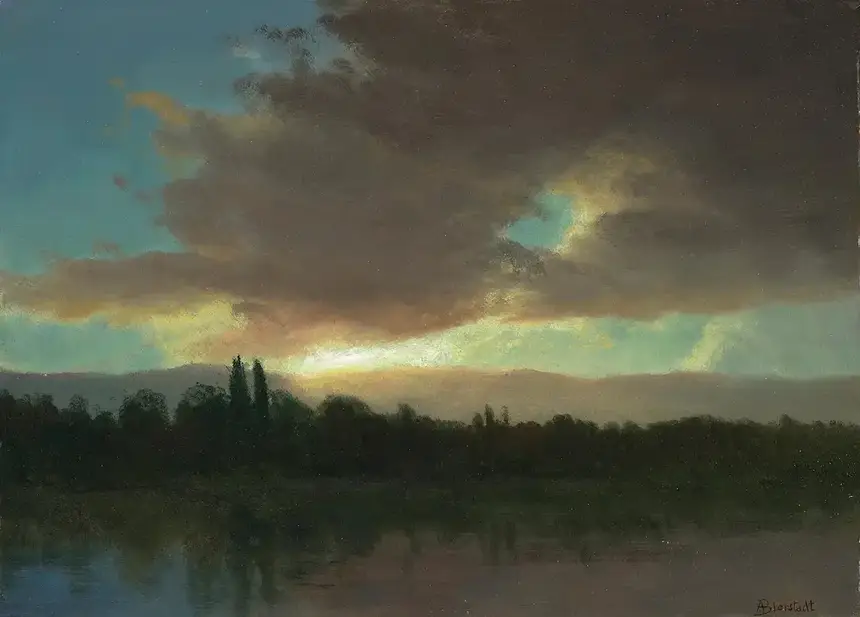
Painted by hand, Evening Sky keeps the hesitation in the brushwork that gives the place its scale.
Space in a night subject is made with value, not perspective: things that are further away are painted cooler and weaker.
We do not brighten the picture for reproduction. The original's key is kept as it is.
Whites here are never white. They are warm or cool depending on the light, and that is what makes them read.
Nothing here is blended flat. Blending is what makes a painting look printed.
The difficulty is restraint: leaving out most of what a photograph would show.
Hang it at eye level — roughly 145 cm from the floor to the centre — and it will hold the wall.
| Artist | Albert Bierstadt |
|---|---|
| Title | Evening Sky |
| Medium | Oil on canvas, hand-painted to order |
| How it is made | Painted by hand in oil on canvas, to your size |
| Original status | Public domain (artist deceased) |
Hand-painted, not printed
What you lose in a print is the air. A press lays ink flat; a painter builds depth in layers, and the depth is what you actually see.
Our painter follows the same logic rather than copying a photograph of it: the far distances go down cool and weak, the near ground stays loaded, and nothing is blended flat.
| Aspect | Hand-painted oil | Printed canvas |
|---|---|---|
| Changing something | Tell us and the passage gets repainted | Usually means starting the file again |
| How it ages | Warms and settles; cleanable by a conservator | Fades, then cracks at the stretcher |
| Time to make | Days of one painter's working time | Minutes |
| Available sizes | Whatever you need, painted to order | What the printer can output |
| Edge quality | Soft where the form turns, sharp where it does not | Uniformly sharp or uniformly blurred |
The hardest passage is the quiet one, where a small mistake has nowhere to hide.
Every canvas is painted to order, so the quote follows your size, frame and destination rather than a fixed list. Tell us what you need on WhatsApp and we reply with an exact figure, usually within the hour. You are buying from the workshop, not a catalogue.
How it gets painted
Here is what actually happens between your message and the crate:
- Stretching and priming the support — cotton duck or linen goes onto the bars and gets its ground.
- A loose underdrawing — proportions checked by eye against the source image.
- The big shapes are blocked in — thin paint, one colour at a time, the whole canvas at once.
- Setting the key — how dark the darks go determines everything that follows.
- Colour is built up — warmer and cooler versions of each passage, laid over the underpainting.
- Finishing passes — the loaded highlights go on at the end and stay there.
- It dries, then gets varnished — and only then is it photographed for you.
Anyone can copy the shapes. The skill is in the transitions, and that is what takes the days.
Keeping it
Do not wipe it with anything wet. Dust lightly, hang it somewhere stable, and forget about it.
On framing
If you are shipping, an unframed canvas rolled in a tube is considerably cheaper to move than a framed one.
A frame is a separate line on the quote, not a bundle. You choose it once the painting exists.
Canvas, paint and varnish
The varnish is removable, so a conservator can clean the painting in fifty years without touching the paint. Brushes, knives and rags. That is the equipment list; there is no machine in the process.
Stretcher bars are kiln-dried and wedged, so the canvas can be re-tensioned years later. Large canvases get a cross-brace; anything over about a metre and a half needs one.
Choosing a size
Because each piece is painted from scratch, you are not limited to stock dimensions. These are the sizes clients ask for most:
| Size (inches) | Size (cm) | Best for |
|---|---|---|
| 20 × 16 in | 50 × 40 cm | Bedroom, hallway, above a console |
| 16 × 12 in | 40 × 30 cm | A shelf, a small wall, a gallery group |
| 64 × 48 in | 163 × 122 cm | Villa scale, lobby, hospitality wall |
| 48 × 36 in | 122 × 91 cm | Large living room, stairwell, loft |
Anything outside this table is fine — we paint to the number you give us. Terms are DAP. Import duties and taxes, where they apply, are paid by the buyer on arrival — we never collect them in advance and never guess at the amount.
It wants a wall where the light rakes across it, because the surface is part of the picture.
Tell us the size and frame — exact quote back, usually within the hour.
💬 Get a Quote for Evening SkyFrom order to your wall
The painting takes 9–15 days, and delivery is priced separately on the quote so there is no surprise later.
Expect 7–10 business days in transit, with tracking from our door to yours. Unframed canvases are rolled face-out on a tube; framed ones are corner-protected and crated.
You approve the painting from photographs before it is packed — that is the checkpoint. Changes are handled by telling us what to change; we change it and send new photographs.
Import charges, where they exist, are the buyer's responsibility (DAP). We never add them to the quote and never guess what they will be.
You pay a deposit to start and the remainder before shipping. Nothing is hidden in between. If a crate arrives damaged, send us photographs within 48 hours and contact us directly — we will sort it out with you.
What people ask us
Will the dark passages look muddy?
That is the main risk in a night painting and the reason it cannot be printed. The painter mixes darks from colour rather than reaching for black, which keeps them transparent instead of dead.
Can I resell the reproduction?
Yes. Because the underlying work is in the public domain, the hand-painted canvas is yours to sell, gift or install commercially.
Is there a rush option?
It depends on the canvas and what else is in the studio. Ask on WhatsApp with your size and we will tell you straight what is possible.
What does it cost?
There is no price list, because the number depends on your size and frame. Message us and we will quote exactly.
Do you take a deposit?
A deposit starts the canvas and the balance falls due before it ships. Both figures appear on the quote.
Will I see it before it ships?
Yes. We send photographs of the finished canvas and wait for your reply before packing.
Can you paint a different work by Albert Bierstadt?
Yes — send us the image, or look through the other Albert Bierstadt works on the site.
Can you paint it from a different photograph of the same work?
Send your own reference image and we will paint from that instead.
Does it come framed?
Frames are priced on their own line. Most clients choose after seeing the photographs.
Is owning a reproduction legal?
Yes. The painting is out of copyright because Albert Bierstadt died more than 70 years ago. We paint copies honestly and never claim they are originals.
Do you sell prints?
No. Hand-painted oil on canvas only. No printing, no giclée, no canvas transfer.
How long does it take?
Allow 9–15 days for the painting itself, then roughly 7–10 business days in transit.