About the original
Albert Gleizes died in 1953. That puts the painting well outside copyright, which is why we can paint it and you can own it anywhere in the world.
Ours is a painting made with brushes. There is no giclée, no canvas transfer and no digital underlayer anywhere in the process.
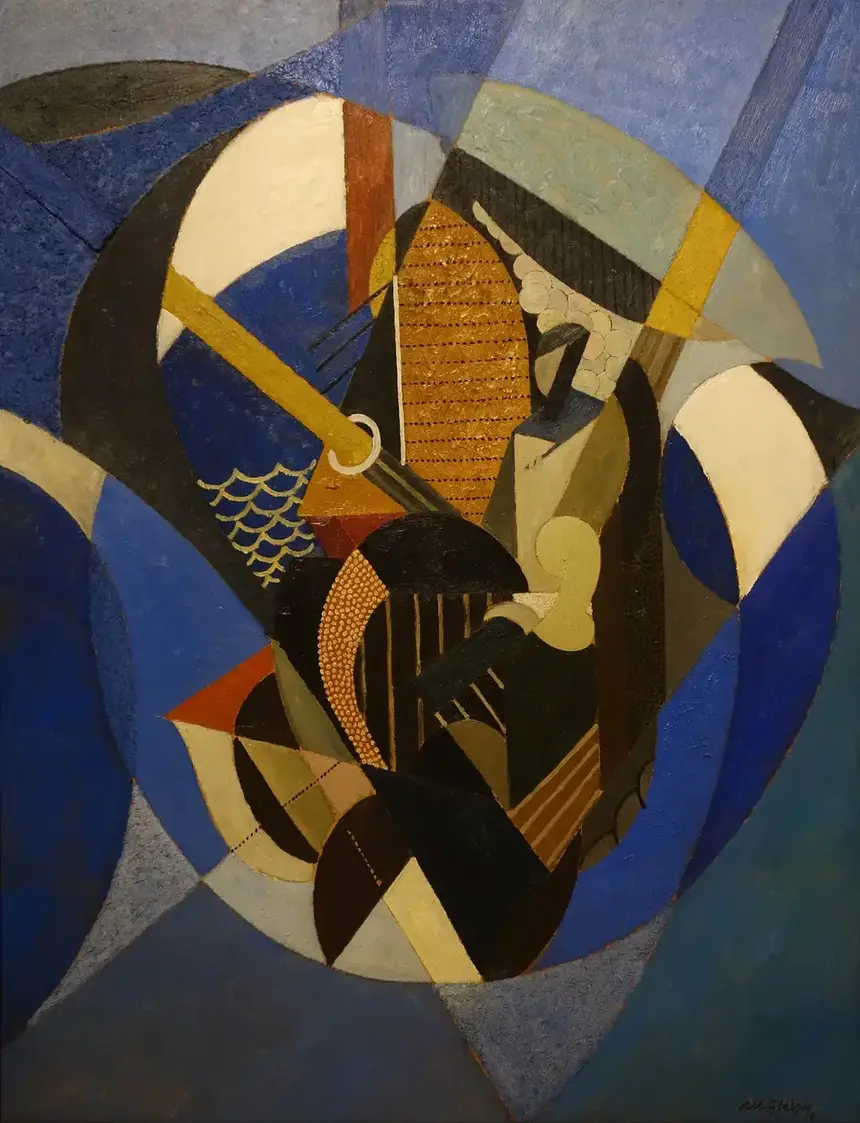
It is an original composition painted before 1953, and our version is painted from the surviving image of it.
You are buying a painting, not a file. That distinction is the whole business we are in.
How to read it
Most reproductions of a seascape flatten it into a view. This one keeps the weather in it.
Our painter blocks the big shapes first and lets the detail come last, so the composition holds at any size.
The light in On a Sailboat has a direction, and the painter keeps it consistent across every object in the picture.
The saturation is deliberately uneven: strongest at the focal point, weaker everywhere else.
The brushwork is left visible, which is the whole argument for painting it by hand.
The difficulty is restraint: leaving out most of what a photograph would show.
A plain wall is better than a busy one; the painting supplies the interest.
| Artist | Albert Gleizes |
|---|---|
| Title | On a Sailboat |
| Created (original) | 1916 |
| Medium | Oil on canvas, hand-painted to order |
| Reproduction | Hand-painted oil on canvas, made to order |
| Copyright | Public domain; the original is out of copyright |
The case for painting it by hand
What you lose in a print is the air. A press lays ink flat; a painter builds depth in layers, and the depth is what you actually see.
Our painter follows the same logic rather than copying a photograph of it: the far distances go down cool and weak, the near ground stays loaded, and nothing is blended flat.
| Aspect | Hand-painted oil | Printed canvas |
|---|---|---|
| Changing something | Tell us and the passage gets repainted | Usually means starting the file again |
| Edges | Chosen by the painter, passage by passage | Whatever the file happens to contain |
| Impasto | Real paint standing off the canvas | Flat ink, sometimes embossed to imitate |
| Lifespan | Slow to change; varnish can be refreshed decades later | Fades and cracks sooner |
| Size | Any size, painted to your wall | Limited by the printer |
The hardest passage is the quiet one, where a small mistake has nowhere to hide.
Every canvas is painted to order, so the quote follows your size, frame and destination rather than a fixed list. Tell us what you need on WhatsApp and we reply with an exact figure, usually within the hour. No resellers, no drop-shipper. The painter's studio handles your commission from first message to final crate.
The sequence on our floor
No two canvases are painted the same way, but the sequence is always this:
- Stretching and priming the support — cotton duck or linen goes onto the bars and gets its ground.
- A loose underdrawing — proportions checked by eye against the source image.
- The big shapes are blocked in — thin paint, one colour at a time, the whole canvas at once.
- The values are established — this is the stage that decides whether the painting works.
- Building the colour — a warm and a cool version of each passage, put down in order.
- Detail and highlights last — put on thickly and then not touched again.
- Drying and varnishing — the final varnish goes on once the paint has set, before we photograph it.
Matching the original's degree of finish is harder than matching its colours.
Frames
If you are shipping, an unframed canvas rolled in a tube is considerably cheaper to move than a framed one.
We can supply a simple floater frame, a traditional gilt, or nothing at all. It is your call.
Canvas, paint and varnish
Pigment is artist-grade oil colour, not acrylic and not house paint. It behaves differently and it lasts. The paint is built in layers, fat over lean, which is what stops it cracking later.
Varnish goes on only once the paint is properly dry, months after the last stroke, not before. Large canvases get a cross-brace; anything over about a metre and a half needs one.
Keeping it
Dust it with a dry, soft brush. Keep it out of direct sun and away from radiators, and it will outlive you.
Getting the size right
Any size is possible. These are simply the ones that come up most often in quotes:
| Size (inches) | Size (cm) | Best for |
|---|---|---|
| 30 × 24 in | 76 × 61 cm | Dining room, bedroom feature wall |
| 24 × 20 in | 60 × 50 cm | Study, home office, above a desk |
| 20 × 16 in | 50 × 40 cm | Bedroom, hallway, above a console |
| 16 × 12 in | 40 × 30 cm | A shelf, a small wall, a gallery group |
| 64 × 48 in | 163 × 122 cm | Villa scale, lobby, hospitality wall |
| 48 × 36 in | 122 × 91 cm | Large living room, stairwell, loft |
Anything outside this table is fine — we paint to the number you give us. Duties and import taxes are the buyer's account (DAP). Your customs authority sets them; we do not.
Hang it at eye level — roughly 145 cm from the floor to the centre — and it will hold the wall.
Give us your size and framing preference and you will have a quote shortly.
💬 Get a Quote for On a SailboatFrom order to your wall
Painting takes 9–15 days. Freight is quoted as its own line on the quote, agreed before you pay anything, and never added afterwards.
Transit is usually 7–10 business days, tracked all the way. Rolled in a tube it travels cheaper and safer than framed; most overseas clients take it that way.
Before anything is packed, you get photographs of the actual canvas and a chance to ask for changes. Changes are handled by telling us what to change; we change it and send new photographs.
Terms are DAP. Import duties and taxes, where they apply, are paid by the buyer on arrival — we never collect them in advance and never guess at the amount.
A deposit starts the canvas and books the painter's time; the balance is due before the crate leaves. Report any transit damage within 48 hours with photographs and we will deal with the carrier. We will not promise a payout, but we will not leave you to argue alone either.
Questions worth asking
Does it come with a certificate of authenticity?
No, and we would be wary of anyone who issues one for a public-domain reproduction. What you receive is a hand-painted canvas and photographs of it before it ships.
Can I see progress photos while it is being painted?
We send photographs of the finished painting for approval before it ships. Mid-process images are not part of the standard workflow.
What happens after I message you?
You tell us the painting, size and whether you want a frame. We quote, a painter starts on your canvas, and you get photographs before it ships.
Who pays the import duty?
The buyer does. Terms are DAP: duties and taxes, where they apply, are paid on arrival. We never add a tax line of our own.
How long does it take?
From order to finished canvas is 9–15 days; delivery adds about 7–10 business days by air.
Is it really painted by hand?
Yes — oil on canvas, brush and knife. There is no printing, no giclée and no canvas transfer at any stage.
Will I see it before it ships?
Yes. We send photographs of the finished canvas and wait for your reply before packing.
What is the canvas made of?
Cotton or linen, oil colour, and varnish. Stretcher bars are wedged so the canvas can be re-tensioned later.
Can you paint a different work by Albert Gleizes?
Yes — send us the image, or look through the other Albert Gleizes works on the site.
Can you change the colours to suit my room?
We can shift the palette, but we will tell you honestly when a change would spoil the painting.
What does it cost?
Every canvas is quoted on size, frame and destination rather than a fixed list. Tell us what you need and we reply with an exact figure.
Does it come framed?
Frames are priced on their own line. Most clients choose after seeing the photographs.