Where this painting comes from
Alberto Pasini died in 1899. That puts the painting well outside copyright, which is why we can paint it and you can own it anywhere in the world.
Every version we make is oil on canvas, painted by one painter from start to finish. No printing is involved at any stage.
It is an original composition painted before 1899, and our version is painted from the surviving image of it.
If you want something printed, we are the wrong workshop. We do not own a printer that touches canvas.
How to read it
A painted a landscape is an argument about air. Copy the shapes and you still have not copied the argument.
We keep the original proportions rather than cropping to a standard frame, so an unusually wide composition stays honest.
We do not brighten the picture for reproduction. The original's key is kept as it is.
The saturation is deliberately uneven: strongest at the focal point, weaker everywhere else.
Nothing here is blended flat. Blending is what makes a painting look printed.
Anyone can copy the shapes. The skill is in the transitions, and that is what takes the days.
Given the subject, this sits naturally in a living room or a study rather than a hallway.
| Artist | Alberto Pasini |
|---|---|
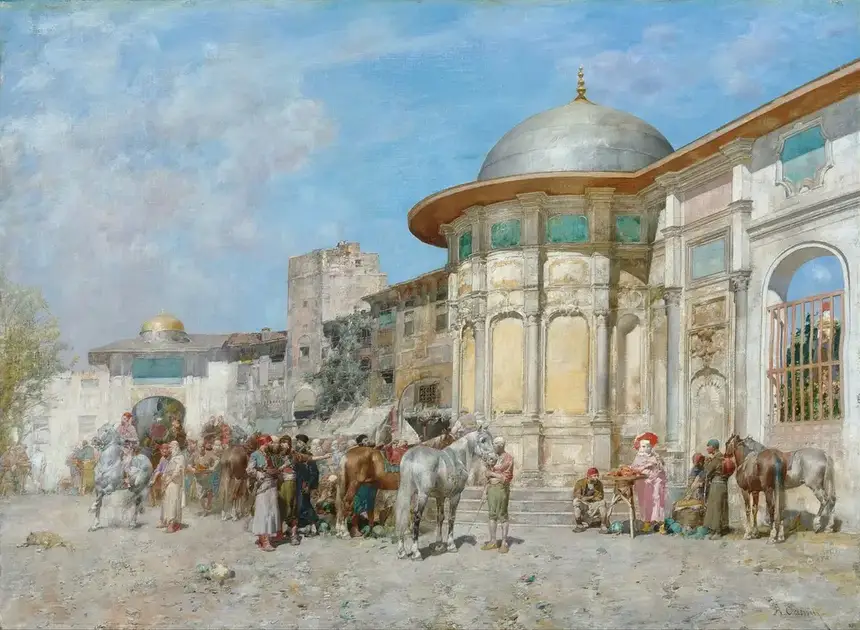
| Title | Caravan at the gates of Constantinople |
| Created (original) | 1881 |
| Medium | Oil on canvas, hand-painted to order |
| What you receive | A hand-painted oil painting on canvas |
| Public domain | Yes — the artist died over 70 years ago |
The case for painting it by hand
What you lose in a print is the air. A press lays ink flat; a painter builds depth in layers, and the depth is what you actually see.
Our painter follows the same logic rather than copying a photograph of it: the far distances go down cool and weak, the near ground stays loaded, and nothing is blended flat.
| Aspect | Hand-painted oil | Printed canvas |
|---|---|---|
| Available sizes | Whatever you need, painted to order | What the printer can output |
| Edges | Chosen by the painter, passage by passage | Whatever the file happens to contain |
| Corrections | We adjust it and repaint the passage | The file is reprinted or it is not |
| What it takes | One painter, several days, start to finish | A machine, a few minutes |
| Depth | Built in layers, catches light from the side | Flat; highlights are printed as pale ink |
The difficulty is restraint: leaving out most of what a photograph would show.
Every canvas is painted to order, so the quote follows your size, frame and destination rather than a fixed list. Tell us what you need on WhatsApp and we reply with an exact figure, usually within the hour. You deal directly with the studio that paints it — no reseller layer.
How your painting is made
This is how the painting is built, in the order our painters build it:
- Stretching and priming the support — cotton duck or linen goes onto the bars and gets its ground.
- Laying in the drawing — done by eye from the reference, not traced or projected.
- Blocking the masses — thin paint, working the whole surface rather than one corner at a time.
- Setting the key — how dark the darks go determines everything that follows.
- The colour passes — each area gets its own mixture rather than one colour used throughout.
- Detail and highlights last — put on thickly and then not touched again.
- Drying and varnishing — the final varnish goes on once the paint has set, before we photograph it.
The hardest passage is the quiet one, where a small mistake has nowhere to hide.
What goes into it
Pigment is artist-grade oil colour, not acrylic and not house paint. It behaves differently and it lasts. Brushes, knives and rags. That is the equipment list; there is no machine in the process.
Nothing is sprayed, sealed or laminated. The surface you see is paint and varnish, and that is all. Linen is worth the extra cost above about a metre across, because it holds tension better in humid rooms.
Whether to frame it
If you are shipping, an unframed canvas rolled in a tube is considerably cheaper to move than a framed one.
If you are shipping, an unframed canvas rolled in a tube is considerably cheaper to move than a framed one.
Care and cleaning
Once the varnish has cured the surface can be cleaned by a conservator, but in a normal house it will not need it for decades.
Getting the size right
Because each piece is painted from scratch, you are not limited to stock dimensions. These are the sizes clients ask for most:
| Size (inches) | Size (cm) | Best for |
|---|---|---|
| 24 × 20 in | 60 × 50 cm | Study, home office, above a desk |
| 20 × 16 in | 50 × 40 cm | Bedroom, hallway, above a console |
| 16 × 12 in | 40 × 30 cm | A shelf, a small wall, a gallery group |
| 64 × 48 in | 163 × 122 cm | Villa scale, lobby, hospitality wall |
| 48 × 36 in | 122 × 91 cm | Large living room, stairwell, loft |
Anything outside this table is fine — we paint to the number you give us. Duties and import taxes are the buyer's account (DAP). Your customs authority sets them; we do not.
This reads well above a sofa or a sideboard, where it will be seen from two to three metres.
Send the wall, the size and whether you want a frame, and we will quote.
💬 Get a Quote for Caravan at the gates of ConstantinopleFrom order to your wall
Allow 9–15 days for the painting itself. Shipping is a separate line on your quote — you see it before payment, not after.
Air freight runs about 7–10 business days, tracked, to your door. Unframed canvases are rolled face-out on a tube; framed ones are corner-protected and crated.
You see photographs of the finished painting before it ships, and you tell us what to adjust. Adjustments are part of the process. Say what you want different and it gets done.
We sell DAP: the price covers the painting and the freight, and any import duties or taxes are the buyer's to settle with customs. We do not collect them and we do not estimate them.
Work begins on a deposit and ships on the balance. Both figures are on the quote. Report any transit damage within 48 hours with photographs and we will deal with the carrier. We will not promise a payout, but we will not leave you to argue alone either.
What people ask us
What if it does not look right to me?
We send photographs of the actual painting for your approval before anything ships. That is the moment to tell us what to adjust.
What does it cost?
Every canvas is quoted on size, frame and destination rather than a fixed list. Tell us what you need and we reply with an exact figure.
What is the canvas made of?
Cotton duck as standard, linen on request, artist-grade oil paint, and a final varnish once the paint is fully dry.
Can you change the colours to suit my room?
We can shift the palette, but we will tell you honestly when a change would spoil the painting.
Does it come framed?
Frames are priced on their own line. Most clients choose after seeing the photographs.
Is owning a reproduction legal?
Yes. Alberto Pasini died more than 70 years ago, so the work is in the public domain and owning a hand-painted version is legal anywhere. We never pass ours off as the original.
How long does it take?
Painting takes 9–15 days. Air freight is usually 7–10 business days on top of that, tracked.
Will I see it before it ships?
Yes — photographs of the actual painting go to you first, and nothing is packed until you have seen them.
How do I hang it?
Centre it at about 145 cm from the floor, or two-thirds the width of the furniture below it. We will tell you the exact number for your wall.
What if it arrives damaged?
Report damage within 48 hours with photographs. We deal with the carrier rather than leaving you to argue alone.