The original, and why we can paint it
Albrecht Dürer died in 1528, so the work has been in the public domain for decades. Reproducing it by hand is legal, and so is owning one.
Every version we make is oil on canvas, painted by one painter from start to finish. No printing is involved at any stage.
The painting was made in the years before 1528, and what we reproduce is the record of it, not the object.
You are buying a painting, not a file. That distinction is the whole business we are in.
What the painting is doing
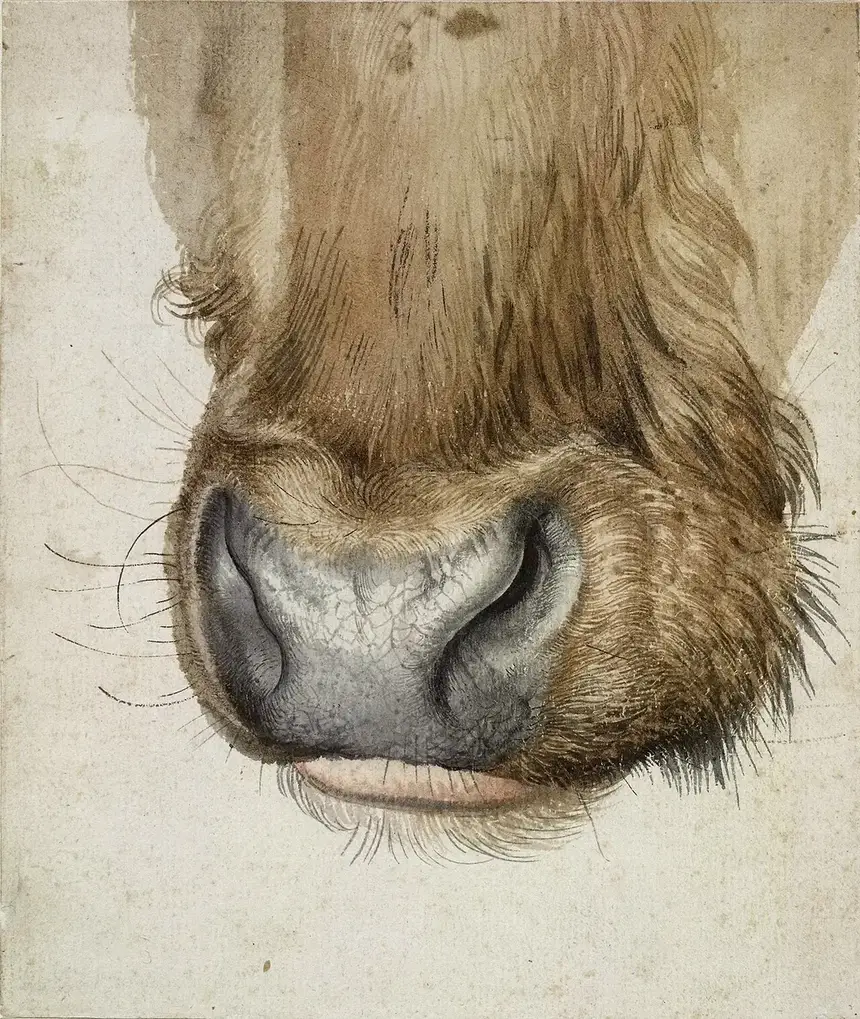
The reason Museau bovin, by Albrecht Dürer still works as a painting is that it was built as paint, not as a picture of a place.
The composition is built on a few large masses. Get those right and the rest follows.
Light is handled as a value problem: how dark the darkest dark is determines the whole picture.
The saturation is deliberately uneven: strongest at the focal point, weaker everywhere else.
Our painter loads the brush differently for the near and far passages, and you can read the difference.
The risk with a landscape is overworking, and the way to avoid it is knowing when to stop.
It wants a wall where the light rakes across it, because the surface is part of the picture.
| Artist | Albrecht Dürer |
|---|---|
| Title | Museau bovin, by Albrecht Dürer |
| Medium | Oil on canvas, hand-painted to order |
| Our version | Oil on canvas, painted by hand to order |
| Public domain | Yes — the artist died over 70 years ago |
Why this one cannot be printed
The difference is not subtle when the two hang side by side. Ink sits on the surface; oil stands off it.
Our painter follows the same logic rather than copying a photograph of it: the far distances go down cool and weak, the near ground stays loaded, and nothing is blended flat.
| Aspect | Hand-painted oil | Printed canvas |
|---|---|---|
| Texture | Ridges and drag you can see from across a room | None, or a printed imitation of it |
| What it takes | One painter, several days, start to finish | A machine, a few minutes |
| Available sizes | Whatever you need, painted to order | What the printer can output |
| Sense of depth | Real, created by layers of paint | Simulated by darker ink |
| Lifespan | Slow to change; varnish can be refreshed decades later | Fades and cracks sooner |
The hardest passage is the quiet one, where a small mistake has nowhere to hide.
Every canvas is painted to order, so the quote follows your size, frame and destination rather than a fixed list. Tell us what you need on WhatsApp and we reply with an exact figure, usually within the hour. There is no agency in between; the studio that paints your canvas is the one answering your messages.
How it gets painted
Every canvas is painted to order, so nothing is pulled off a shelf. This is the sequence:
- Stretching and priming the support — cotton duck or linen goes onto the bars and gets its ground.
- A loose underdrawing — proportions checked by eye against the source image.
- The first colour pass — thin and simple, establishing the main shapes only.
- The values are established — this is the stage that decides whether the painting works.
- Colour is built up — warmer and cooler versions of each passage, laid over the underpainting.
- The detail and highlights go on — last, loaded, and left alone once they are down.
- Left to dry before varnish — nothing is photographed or packed until the surface is ready.
What takes time here is the number of separate decisions, not the size of the canvas.
Whether to frame it
Most clients wait for the photographs before choosing a frame, which is the sensible order.
We can supply a simple floater frame, a traditional gilt, or nothing at all. It is your call.
What it is made of
Varnish goes on only once the paint is properly dry, months after the last stroke, not before. We use cotton duck for most sizes and linen where the canvas is large or the client asks for it.
Linen is worth the extra cost above about a metre across, because it holds tension better in humid rooms. Nothing is sprayed, sealed or laminated. The surface you see is paint and varnish, and that is all.
Care and cleaning
Once the varnish has cured the surface can be cleaned by a conservator, but in a normal house it will not need it for decades.
Choosing a size
Because each piece is painted from scratch, you are not limited to stock dimensions. These are the sizes clients ask for most:
| Size (inches) | Size (cm) | Best for |
|---|---|---|
| 16 × 12 in | 40 × 30 cm | A shelf, a small wall, a gallery group |
| 64 × 48 in | 163 × 122 cm | Villa scale, lobby, hospitality wall |
| 48 × 36 in | 122 × 91 cm | Large living room, stairwell, loft |
| 40 × 30 in | 102 × 76 cm | Living room focal wall, above a sofa |
| 32 × 24 in | 81 × 61 cm | Living room, above a sideboard |
We will size the canvas to the room, not to a stock list. Send us the measurement. Shipments go out DAP. If your customs office charges duty or tax on arrival, that is between you and them — we do not collect it and we do not put a number on it.
For a stairwell or a double-height space, go larger than you think — the composition was built for distance.
Tell us where it will hang and how big it needs to be — we will price it properly.
💬 Get a Quote for Museau bovin, by Albrecht DürerHow it reaches you
The painting takes 9–15 days, and delivery is priced separately on the quote so there is no surprise later.
Expect 7–10 business days in transit, with tracking from our door to yours. Rolled in a tube it travels cheaper and safer than framed; most overseas clients take it that way.
You approve the painting from photographs before it is packed — that is the checkpoint. If something is not right, tell us what to adjust and we adjust it.
Our terms are DAP, meaning the freight is paid by us and any import charges are yours to settle. We will not estimate them, because the figure is your customs authority's to set.
A deposit starts the canvas and books the painter's time; the balance is due before the crate leaves. Damage in transit should be reported to us within 48 hours, with photographs. We pursue it with the carrier rather than promising a refund.
The practical questions
What if my wall is an unusual shape?
That is normal for us. Send the measurements and we will work out a canvas proportion that suits the space.
How long does a hand-painted version take?
9–15 days of studio time, depending mostly on size and how much impasto the surface carries, then several more days for the oil to set before we photograph, pack and send.
Do you work from my own photograph?
Yes, though that is a separate service. This page is for a hand-painted version of {title}; for a photo-to-painting commission, send the image on WhatsApp.
Who pays the import duty?
You do. We sell DAP, so any duty or tax your customs authority charges is settled by you at import. We do not collect it and we do not estimate it.
How do I hang it?
Centre it at about 145 cm from the floor, or two-thirds the width of the furniture below it. We will tell you the exact number for your wall.
Will I see it before it ships?
Yes — photographs of the actual painting go to you first, and nothing is packed until you have seen them.
Can I change the size?
Any size you like. We paint to the number you give us rather than to a standard range.
Do you take a deposit?
Work begins on a deposit and ships once the balance is paid. Nothing is charged that is not on the quote.
Do you ship to my country?
We ship to over 20 countries. Give us your city and the freight appears as its own line on the quote.
Can you paint a different work by Albrecht Dürer?
Yes. Send the image and we will quote it, or browse the other paintings we have listed.
Do you sell prints?
No prints at all — no giclée, no canvas transfer, nothing machine-made.
What is the canvas made of?
Cotton duck as standard, linen on request, artist-grade oil paint, and a final varnish once the paint is fully dry.