Where this painting comes from
Alexej von Jawlensky died in 1941, so the work has been in the public domain for decades. Reproducing it by hand is legal, and so is owning one.
Every version we make is oil on canvas, painted by one painter from start to finish. No printing is involved at any stage.
It is an original composition painted before 1941, and our version is painted from the surviving image of it.
You are buying a painting, not a file. That distinction is the whole business we are in.
Where the painting lives
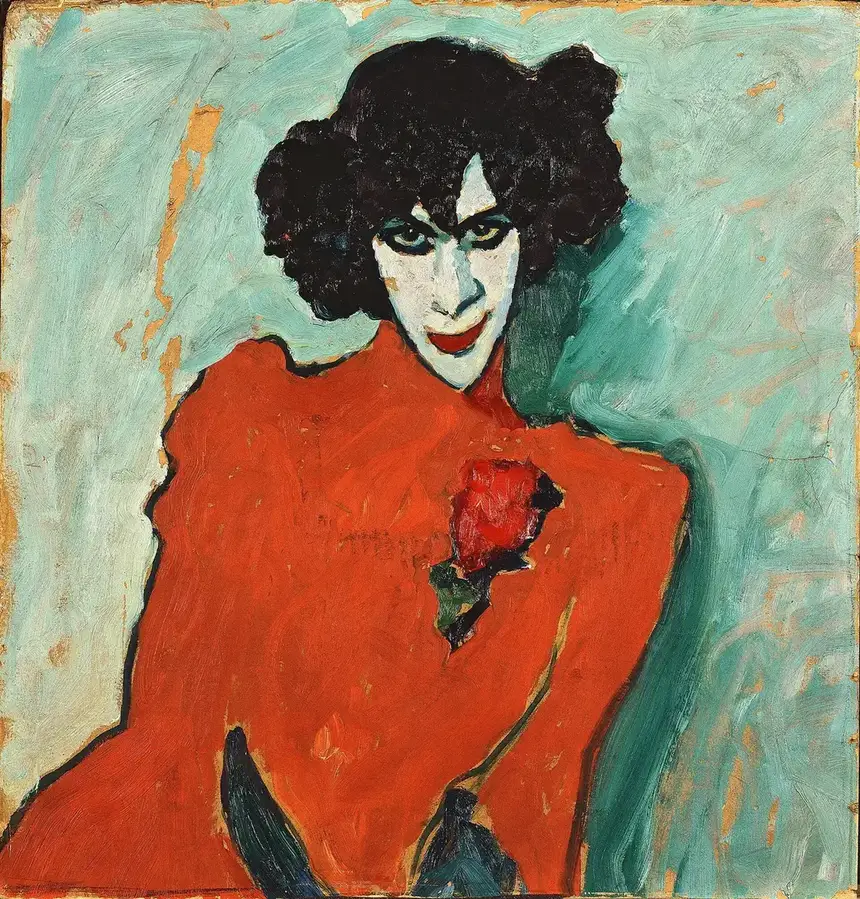
Bildnis des Tänzers is a portrait you can stand two feet from. That is the test, and it is the test oil passes.
The head sits slightly off centre, as it does in the source, and we keep that.
Where the source is lit from below or behind, we keep it, however unflattering.
Every colour in Bildnis des Tänzers has a warm version and a cool version, and the painter chooses between them passage by passage.
Our painter loads the brush differently for the near and far passages, and you can read the difference.
The difficult part is not the detail. It is keeping the whole canvas at the same stage of finish.
This reads well above a sofa or a sideboard, where it will be seen from two to three metres.
| Artist | Alexej von Jawlensky |
|---|---|
| Title | Bildnis des Tänzers |
| Created (original) | 1909 |
| Medium | Oil on canvas, hand-painted to order |
| Our version | Oil on canvas, painted by hand to order |
| Original status | Public domain (artist deceased) |
What a print loses
A print reproduces the shapes and drops the substance. It is the substance you are buying.
Our painter follows the same logic rather than copying a photograph of it: the far distances go down cool and weak, the near ground stays loaded, and nothing is blended flat.
| Aspect | Hand-painted oil | Printed canvas |
|---|---|---|
| Handling of colour | Mixed on the palette and finished on the canvas | Fixed by the colour profile |
| How it ages | Warms and settles; cleanable by a conservator | Fades, then cracks at the stretcher |
| Time to make | Days of one painter's working time | Minutes |
| Value over time | Can be re-stretched, cleaned and re-framed | Little value beyond the print |
| Sense of depth | Real, created by layers of paint | Simulated by darker ink |
Anyone can copy the shapes. The skill is in the transitions, and that is what takes the days.
Every canvas is painted to order, so the quote follows your size, frame and destination rather than a fixed list. Tell us what you need on WhatsApp and we reply with an exact figure, usually within the hour. There is no agency in between; the studio that paints your canvas is the one answering your messages.
The sequence on our floor
This is how the painting is built, in the order our painters build it:
- The canvas is stretched and primed — cotton or linen, sized and ready before any paint goes near it.
- The drawing goes down — charcoal or thin paint, done by eye rather than traced from a printout.
- The big shapes are blocked in — thin paint, one colour at a time, the whole canvas at once.
- Getting the values right — the stage that decides whether the finished painting holds together.
- The colour passes — each area gets its own mixture rather than one colour used throughout.
- The detail and highlights go on — last, loaded, and left alone once they are down.
- Drying and varnishing — the final varnish goes on once the paint has set, before we photograph it.
The risk with a portrait is overworking, and the way to avoid it is knowing when to stop.
Frames
If you are shipping, an unframed canvas rolled in a tube is considerably cheaper to move than a framed one.
If you are shipping, an unframed canvas rolled in a tube is considerably cheaper to move than a framed one.
Canvas, paint and varnish
The paint is built in layers, fat over lean, which is what stops it cracking later. We use a neutral-sized ground so the whites stay warm rather than going blue over time.
Oil paint dries by oxidation, not evaporation, which is why a finished canvas needs weeks before it travels. Each painter works on one canvas at a time — the painting you ordered is not shared with another order.
Living with it
Oil paint needs very little: no water, no cleaners, no sprays. A dry brush and a stable room.
Choosing a size
You are not choosing from a list; you are telling us a measurement. These are the common ones:
| Size (inches) | Size (cm) | Best for |
|---|---|---|
| 16 × 12 in | 40 × 30 cm | A shelf, a small wall, a gallery group |
| 64 × 48 in | 163 × 122 cm | Villa scale, lobby, hospitality wall |
| 48 × 36 in | 122 × 91 cm | Large living room, stairwell, loft |
| 40 × 30 in | 102 × 76 cm | Living room focal wall, above a sofa |
Anything outside this table is fine — we paint to the number you give us. We sell DAP: the price covers the painting and the freight, and any import duties or taxes are the buyer's to settle with customs. We do not collect them and we do not estimate them.
Hang it at eye level — roughly 145 cm from the floor to the centre — and it will hold the wall.
Tell us where it will hang and how big it needs to be — we will price it properly.
💬 Get a Quote for Bildnis des Tänzers Alexander Sacharoff Portrait of Alexander SakharoffTimeline and shipping
The painting takes 9–15 days, and delivery is priced separately on the quote so there is no surprise later.
Expect 7–10 business days in transit, with tracking from our door to yours. We send photographs of the finished painting before it is packed, and again once it is boxed.
You approve the painting from photographs before it is packed — that is the checkpoint. If something is not right, tell us what to adjust and we adjust it.
Our terms are DAP, meaning the freight is paid by us and any import charges are yours to settle. We will not estimate them, because the figure is your customs authority's to set.
A deposit starts the canvas and books the painter's time; the balance is due before the crate leaves. Report any transit damage within 48 hours with photographs and we will deal with the carrier. We will not promise a payout, but we will not leave you to argue alone either.
What people ask us
How do I know what size will look right?
Measure the wall and send a photograph. We will say honestly if the canvas you have in mind is too small for the space, which is the most common mistake.
Is there a rush option?
It depends on the canvas and what else is in the studio. Ask on WhatsApp with your size and we will tell you straight what is possible.
How close will it be to the original?
The composition, colour and drawing follow the original closely; the brushwork carries the painter's own hand. The painter works freehand on a blank canvas, following the same logic as the original rather than copying a photograph.
How do I hang it?
Centre it at about 145 cm from the floor, or two-thirds the width of the furniture below it. We will tell you the exact number for your wall.
Do you sell prints?
No prints at all — no giclée, no canvas transfer, nothing machine-made.
Do you take a deposit?
Work begins on a deposit and ships once the balance is paid. Nothing is charged that is not on the quote.
Who pays the import duty?
The buyer does. Terms are DAP: duties and taxes, where they apply, are paid on arrival. We never add a tax line of our own.
Can you paint it from a different photograph of the same work?
Send your own reference image and we will paint from that instead.
What does it cost?
There is no price list, because the number depends on your size and frame. Message us and we will quote exactly.
Is it really painted by hand?
Yes — oil on canvas, brush and knife. There is no printing, no giclée and no canvas transfer at any stage.
Can I change the size?
Any size you like. We paint to the number you give us rather than to a standard range.
What is the canvas made of?
Cotton duck as standard, linen on request, artist-grade oil paint, and a final varnish once the paint is fully dry.