The original, and why we can paint it
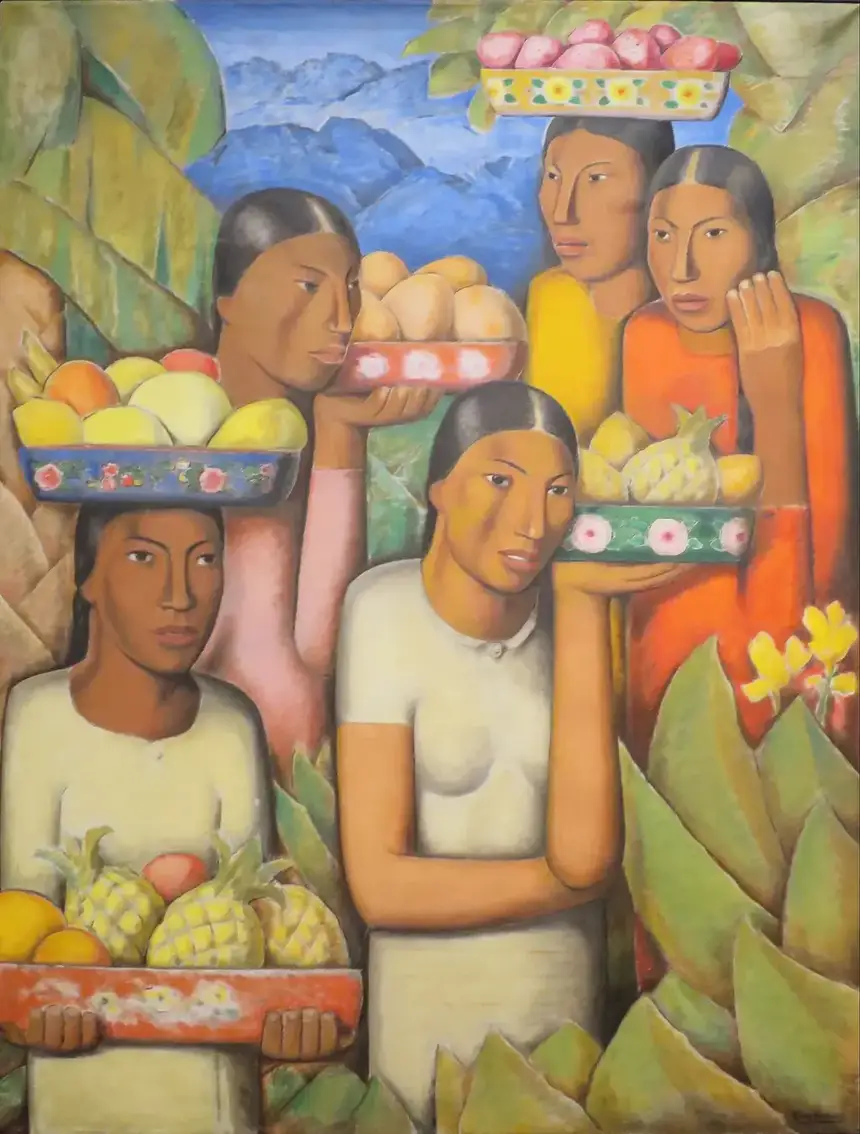
Because Alfredo Ramos Martínez died in 1946, this work is in the public domain. We are painting a copy of a painting — we never pass it off as the original, and neither should anyone selling you one.
We paint it in oil on canvas, one at a time, in Dafen Village. Nothing is printed, scanned or transferred.
It is an original composition painted before 1946, and our version is painted from the surviving image of it.
You are buying a painting, not a file. That distinction is the whole business we are in.
What the painting is doing
A print gives you the objects. Vendedoras de Frutas painted by hand gives you the material they are made of.
We paint the shadow first and the object into it, so things sit on a surface instead of floating.
Where the source has a strong single highlight, we leave that passage for the end.
Our painter keeps the colour relationships rather than the exact hues, because relationships are what survive.
The last marks are the ones that are left alone. Overworking is the enemy.
The risk with a still life is overworking, and the way to avoid it is knowing when to stop.
It works best on a wall you pass rather than one you sit and stare at — the paint rewards a moving eye.
| Artist | Alfredo Ramos Martínez |
|---|---|
| Title | Vendedoras de Frutas |
| Medium | Oil on canvas, hand-painted to order |
| What you receive | A hand-painted oil painting on canvas |
| Public domain | Yes — the artist died over 70 years ago |
Why this one cannot be printed
What you lose in a print is the air. A press lays ink flat; a painter builds depth in layers, and the depth is what you actually see.
Where the original is loaded, ours is loaded. Where it is thin, ours is thin. Matching the weight of the paint matters more than matching the colour.
| Aspect | Hand-painted oil | Printed canvas |
|---|---|---|
| Changing something | Tell us and the passage gets repainted | Usually means starting the file again |
| How it ages | Warms and settles; cleanable by a conservator | Fades, then cracks at the stretcher |
| Sense of depth | Real, created by layers of paint | Simulated by darker ink |
| Edge quality | Soft where the form turns, sharp where it does not | Uniformly sharp or uniformly blurred |
| Surface | Hand-painted oil on canvas | Ink on canvas, flat |
The passage that will take longest is the one that looks simplest.
Every canvas is painted to order, so the quote follows your size, frame and destination rather than a fixed list. Tell us what you need on WhatsApp and we reply with an exact figure, usually within the hour. You are buying from the workshop, not a catalogue.
The sequence on our floor
Every canvas is painted to order, so nothing is pulled off a shelf. This is the sequence:
- We start with the canvas itself — stretched, sized and left to settle before any colour is mixed.
- The drawing goes down — charcoal or thin paint, done by eye rather than traced from a printout.
- The big shapes are blocked in — thin paint, one colour at a time, the whole canvas at once.
- Setting the key — how dark the darks go determines everything that follows.
- Building the colour — a warm and a cool version of each passage, put down in order.
- Finishing passes — the loaded highlights go on at the end and stay there.
- Left to dry before varnish — nothing is photographed or packed until the surface is ready.
The difficulty is restraint: leaving out most of what a photograph would show.
What goes into it
The ground is a proper acrylic sizing, so the oil does not rot the fabric over time. We use cotton duck for most sizes and linen where the canvas is large or the client asks for it.
Stretcher bars are kiln-dried and wedged, so the canvas can be re-tensioned years later. Pigment is artist-grade oil colour, not acrylic and not house paint. It behaves differently and it lasts.
Looking after it
Once the varnish has cured the surface can be cleaned by a conservator, but in a normal house it will not need it for decades.
On framing
Frames are priced once you have chosen them, not estimated in advance.
We can supply a simple floater frame, a traditional gilt, or nothing at all. It is your call.
What size works
Because each piece is painted from scratch, you are not limited to stock dimensions. These are the sizes clients ask for most:
| Size (inches) | Size (cm) | Best for |
|---|---|---|
| 48 × 36 in | 122 × 91 cm | Large living room, stairwell, loft |
| 40 × 30 in | 102 × 76 cm | Living room focal wall, above a sofa |
| 32 × 24 in | 81 × 61 cm | Living room, above a sideboard |
| 30 × 24 in | 76 × 61 cm | Dining room, bedroom feature wall |
| 24 × 20 in | 60 × 50 cm | Study, home office, above a desk |
Tell us the wall width and we will tell you what looks right rather than what is standard. Our terms are DAP, meaning the freight is paid by us and any import charges are yours to settle. We will not estimate them, because the figure is your customs authority's to set.
Hang it at eye level — roughly 145 cm from the floor to the centre — and it will hold the wall.
Tell us the size and frame — exact quote back, usually within the hour.
💬 Get a Quote for Vendedoras de FrutasHow it reaches you
Painting takes 9–15 days. Freight is quoted as its own line on the quote, agreed before you pay anything, and never added afterwards.
Expect 7–10 business days in transit, with tracking from our door to yours. We send photographs of the finished painting before it is packed, and again once it is boxed.
Before anything is packed, you get photographs of the actual canvas and a chance to ask for changes. Changes are handled by telling us what to change; we change it and send new photographs.
We sell DAP: the price covers the painting and the freight, and any import duties or taxes are the buyer's to settle with customs. We do not collect them and we do not estimate them.
You pay a deposit to start and the remainder before shipping. Nothing is hidden in between. Report any transit damage within 48 hours with photographs and we will deal with the carrier. We will not promise a payout, but we will not leave you to argue alone either.
Questions worth asking
How do I clean and care for it?
Dust lightly with a dry, soft brush and keep it out of direct sun. Nothing else is needed for decades; oil paint is slow to change and easy to live with.
What size should I order?
You choose the size. Each canvas is cut to your measurements rather than pulled from stock, so tell us the wall dimensions and we will tell you what proportion works.
Will I see it before it ships?
Yes — photographs of the actual painting go to you first, and nothing is packed until you have seen them.
What is the canvas made of?
Cotton duck as standard, linen on request, artist-grade oil paint, and a final varnish once the paint is fully dry.
What does it cost?
There is no price list, because the number depends on your size and frame. Message us and we will quote exactly.
Do you take a deposit?
Work begins on a deposit and ships once the balance is paid. Nothing is charged that is not on the quote.
Is owning a reproduction legal?
Yes. The painting is out of copyright because Alfredo Ramos Martínez died more than 70 years ago. We paint copies honestly and never claim they are originals.
Is it really painted by hand?
Yes. One painter, oil paint, brushes. We do not own a printer that touches canvas.
Who pays the import duty?
The buyer does. Terms are DAP: duties and taxes, where they apply, are paid on arrival. We never add a tax line of our own.
Do you ship to my country?
We export to more than 20 countries. Tell us where you are and we will quote the freight as a separate line.
Can you paint it from a different photograph of the same work?
Send your own reference image and we will paint from that instead.