The original, and why we can paint it
André Derain died in 1954. That puts the painting well outside copyright, which is why we can paint it and you can own it anywhere in the world.
Every version we make is oil on canvas, painted by one painter from start to finish. No printing is involved at any stage.
The painting was made in the years before 1954, and what we reproduce is the record of it, not the object.
What arrives is a canvas with paint on it, made by a person. That is the only thing we sell.
What the painting is doing
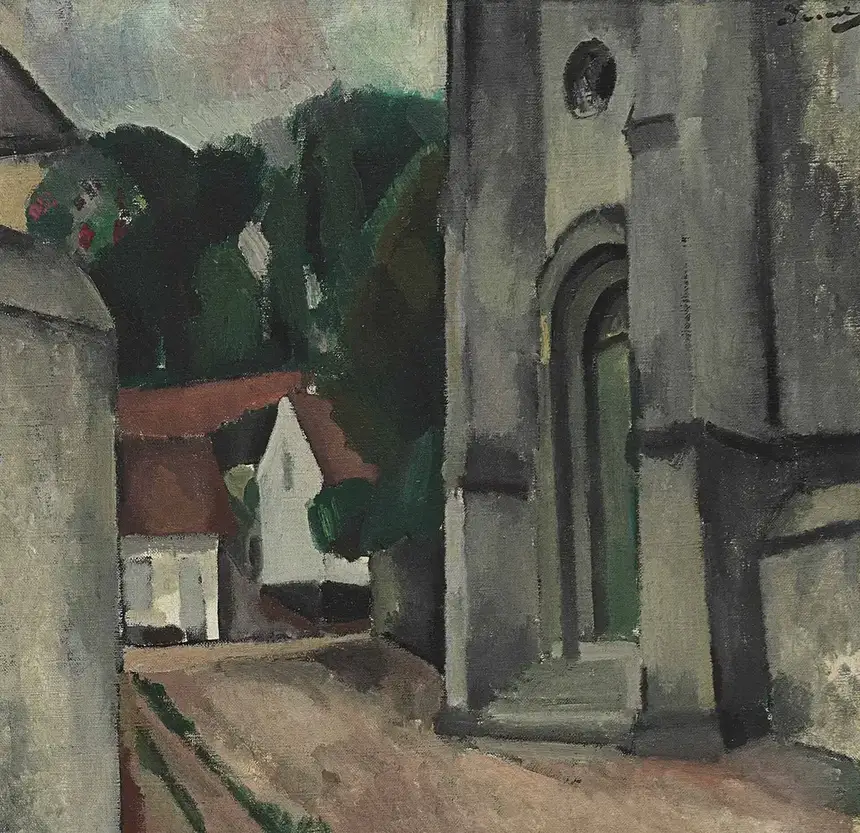
L'église de Crécy-en-Brie rewards a second look because the light is doing something specific, and it only does it in oil.
We keep the original proportions rather than cropping to a standard frame, so an unusually wide composition stays honest.
Dusk and overcast passages are the hardest and the most rewarding — they are all half-tones.
Saturated colour is kept for a small area; the rest is deliberately knocked back.
Our painter uses a larger brush than you would expect, which is why the passages stay simple.
The passage that will take longest is the one that looks simplest.
It suits a room with warm, low light. Strong downlighting flattens the surface.
| Artist | André Derain |
|---|---|
| Title | L'église de Crécy-en-Brie |
| Created (original) | 1911 |
| Medium | Oil on canvas, hand-painted to order |
| Reproduction | Hand-painted oil on canvas, made to order |
| Copyright | Public domain; the original is out of copyright |
The case for painting it by hand
A print reproduces the shapes and drops the substance. It is the substance you are buying.
Paint goes on in the original's order — thin first, thick last — so the surface behaves the way the painter intended.
| Aspect | Hand-painted oil | Printed canvas |
|---|---|---|
| What it takes | One painter, several days, start to finish | A machine, a few minutes |
| Size | Any size, painted to your wall | Limited by the printer |
| Colour | Mixed for each passage, warm and cool versions | One flat value per area |
| Depth | Built in layers, catches light from the side | Flat; highlights are printed as pale ink |
| Changing something | Tell us and the passage gets repainted | Usually means starting the file again |
This one repaints badly, so our painter gets the values right early and leaves them.
Every canvas is painted to order, so the quote follows your size, frame and destination rather than a fixed list. Tell us what you need on WhatsApp and we reply with an exact figure, usually within the hour. There is no agency in between; the studio that paints your canvas is the one answering your messages.
How your painting is made
No two canvases are painted the same way, but the sequence is always this:
- We start with the canvas itself — stretched, sized and left to settle before any colour is mixed.
- The drawing goes down — charcoal or thin paint, done by eye rather than traced from a printout.
- The big shapes are blocked in — thin paint, one colour at a time, the whole canvas at once.
- Getting the values right — the stage that decides whether the finished painting holds together.
- The colour passes — each area gets its own mixture rather than one colour used throughout.
- Finishing passes — the loaded highlights go on at the end and stay there.
- It dries, then gets varnished — and only then is it photographed for you.
The difficulty is restraint: leaving out most of what a photograph would show.
Care and cleaning
Oil paint needs very little: no water, no cleaners, no sprays. A dry brush and a stable room.
Canvas, paint and varnish
We use cotton duck for most sizes and linen where the canvas is large or the client asks for it. We do not use a printer at any stage. There is no giclée, no canvas transfer, no digital underlayer.
Linen is worth the extra cost above about a metre across, because it holds tension better in humid rooms. Large canvases get a cross-brace; anything over about a metre and a half needs one.
On framing
Frames are priced once you have chosen them, not estimated in advance.
A frame is a separate line on the quote, not a bundle. You choose it once the painting exists.
Choosing a size
Because each piece is painted from scratch, you are not limited to stock dimensions. These are the sizes clients ask for most:
| Size (inches) | Size (cm) | Best for |
|---|---|---|
| 64 × 48 in | 163 × 122 cm | Villa scale, lobby, hospitality wall |
| 48 × 36 in | 122 × 91 cm | Large living room, stairwell, loft |
| 40 × 30 in | 102 × 76 cm | Living room focal wall, above a sofa |
| 32 × 24 in | 81 × 61 cm | Living room, above a sideboard |
| 30 × 24 in | 76 × 61 cm | Dining room, bedroom feature wall |
| 24 × 20 in | 60 × 50 cm | Study, home office, above a desk |
We will size the canvas to the room, not to a stock list. Send us the measurement. Duties and import taxes are the buyer's account (DAP). Your customs authority sets them; we do not.
For a stairwell or a double-height space, go larger than you think — the composition was built for distance.
Tell us where it will hang and how big it needs to be — we will price it properly.
💬 Get a Quote for L'église de Crécy-en-BrieTimeline and shipping
Allow 9–15 days for the painting itself. Shipping is a separate line on your quote — you see it before payment, not after.
In transit it is typically 7–10 business days by air, tracked door to door. We send photographs of the finished painting before it is packed, and again once it is boxed.
You see photographs of the finished painting before it ships, and you tell us what to adjust. Changes are handled by telling us what to change; we change it and send new photographs.
Shipments go out DAP. If your customs office charges duty or tax on arrival, that is between you and them — we do not collect it and we do not put a number on it.
Work begins on a deposit and ships on the balance. Both figures are on the quote. Damage in transit should be reported to us within 48 hours, with photographs. We pursue it with the carrier rather than promising a refund.
Before you order
What happens after I message you?
You tell us the painting, size and whether you want a frame. We quote, a painter starts on your canvas, and you get photographs before it ships.
Can I see progress photos while it is being painted?
We send photographs of the finished painting for approval before it ships. Mid-process images are not part of the standard workflow.
Does it come with a certificate of authenticity?
No, and we would be wary of anyone who issues one for a public-domain reproduction. What you receive is a hand-painted canvas and photographs of it before it ships.
Can you change the colours to suit my room?
Sometimes. We will adjust the palette if it can be done without ruining the picture, and say so if it cannot.
What is the canvas made of?
Cotton or linen, oil colour, and varnish. Stretcher bars are wedged so the canvas can be re-tensioned later.
Do you take a deposit?
Work begins on a deposit and ships once the balance is paid. Nothing is charged that is not on the quote.
Does it come framed?
Frames are priced on their own line. Most clients choose after seeing the photographs.
Do you ship to my country?
We ship to over 20 countries. Give us your city and the freight appears as its own line on the quote.
Is owning a reproduction legal?
Yes. The painting is out of copyright because André Derain died more than 70 years ago. We paint copies honestly and never claim they are originals.
Is it really painted by hand?
Yes. One painter, oil paint, brushes. We do not own a printer that touches canvas.
Can you paint it from a different photograph of the same work?
Send your own reference image and we will paint from that instead.
What does it cost?
There is no price list, because the number depends on your size and frame. Message us and we will quote exactly.