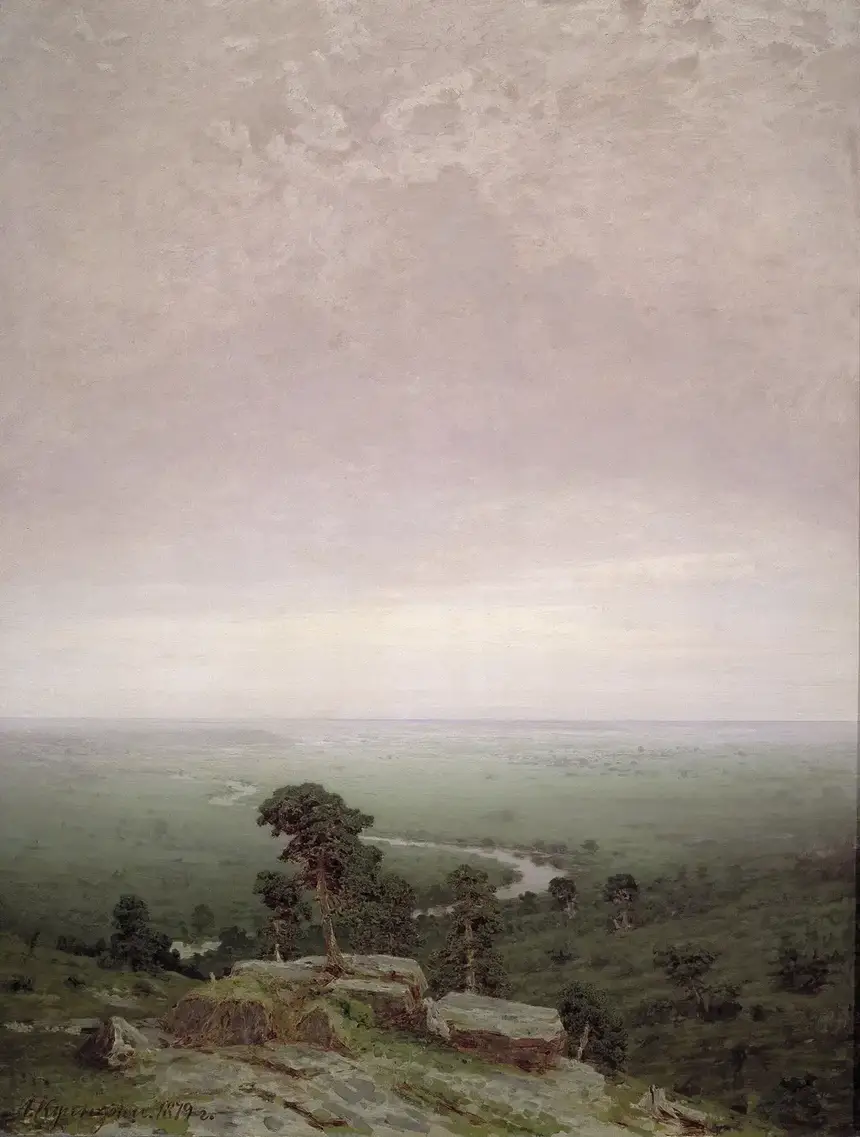
About The North
Arkhip Kuindzhi died in 1910, so the work has been in the public domain for decades. Reproducing it by hand is legal, and so is owning one.
Ours is a painting made with brushes. There is no giclée, no canvas transfer and no digital underlayer anywhere in the process.
It is an original composition painted before 1910, and our version is painted from the surviving image of it.
If you want something printed, we are the wrong workshop. We do not own a printer that touches canvas.
What the painting is doing
Ours is painted from the source image, stroke by stroke, so The North keeps the order it was originally built in.
The composition is built on a few large masses. Get those right and the rest follows.
Light is handled as a value problem: how dark the darkest dark is determines the whole picture.
Every colour in The North has a warm version and a cool version, and the painter chooses between them passage by passage.
Where the source has a loaded passage, ours is loaded too — you will feel it from the side.
Matching the original's degree of finish is harder than matching its colours.
It wants a wall where the light rakes across it, because the surface is part of the picture.
| Artist | Arkhip Kuindzhi |
|---|---|
| Title | The North |
| Created (original) | 1879 |
| Medium | Oil on canvas, hand-painted to order |
| Reproduction | Hand-painted oil on canvas, made to order |
| Public domain | Yes — the artist died over 70 years ago |
Why hand-painting matters here
A print reproduces the shapes and drops the substance. It is the substance you are buying.
Where the original is loaded, ours is loaded. Where it is thin, ours is thin. Matching the weight of the paint matters more than matching the colour.
| Aspect | Hand-painted oil | Printed canvas |
|---|---|---|
| Time to make | Days of one painter's working time | Minutes |
| Surface | Hand-painted oil on canvas | Ink on canvas, flat |
| Edge quality | Soft where the form turns, sharp where it does not | Uniformly sharp or uniformly blurred |
| Lifespan | Slow to change; varnish can be refreshed decades later | Fades and cracks sooner |
| Later on | Can be restored, re-framed, handed on | Replaceable, and usually replaced |
The hardest passage is the quiet one, where a small mistake has nowhere to hide.
Every canvas is painted to order, so the quote follows your size, frame and destination rather than a fixed list. Tell us what you need on WhatsApp and we reply with an exact figure, usually within the hour. You deal directly with the studio that paints it — no reseller layer.
From blank canvas to finished painting
This is how the painting is built, in the order our painters build it:
- Stretching and priming the support — cotton duck or linen goes onto the bars and gets its ground.
- Laying in the drawing — done by eye from the reference, not traced or projected.
- Blocking the masses — thin paint, working the whole surface rather than one corner at a time.
- Setting the key — how dark the darks go determines everything that follows.
- Building the colour — a warm and a cool version of each passage, put down in order.
- Finishing passes — the loaded highlights go on at the end and stay there.
- Drying and varnishing — the final varnish goes on once the paint has set, before we photograph it.
What takes time here is the number of separate decisions, not the size of the canvas.
Whether to frame it
Frames are priced once you have chosen them, not estimated in advance.
Framing is quoted separately, so you can decide after you have seen the finished canvas in photographs.
Keeping it
Dust it with a dry, soft brush. Keep it out of direct sun and away from radiators, and it will outlive you.
What goes into it
Stretcher bars are kiln-dried and wedged, so the canvas can be re-tensioned years later. Brushes, knives and rags. That is the equipment list; there is no machine in the process.
We use cotton duck for most sizes and linen where the canvas is large or the client asks for it. The ground is a proper acrylic sizing, so the oil does not rot the fabric over time.
Getting the size right
Because each piece is painted from scratch, you are not limited to stock dimensions. These are the sizes clients ask for most:
| Size (inches) | Size (cm) | Best for |
|---|---|---|
| 64 × 48 in | 163 × 122 cm | Villa scale, lobby, hospitality wall |
| 48 × 36 in | 122 × 91 cm | Large living room, stairwell, loft |
| 40 × 30 in | 102 × 76 cm | Living room focal wall, above a sofa |
| 32 × 24 in | 81 × 61 cm | Living room, above a sideboard |
| 30 × 24 in | 76 × 61 cm | Dining room, bedroom feature wall |
Anything outside this table is fine — we paint to the number you give us. We quote DAP, so any duty or tax your country charges is settled by you at import. We do not add a tax line of our own.
It suits a room with warm, low light. Strong downlighting flattens the surface.
Send the wall, the size and whether you want a frame, and we will quote.
💬 Get a Quote for The NorthTimeline and shipping
From order to finished canvas is 9–15 days. Freight appears as a separate line on the quote and is fixed before you pay.
Transit is usually 7–10 business days, tracked all the way. Unframed canvases are rolled face-out on a tube; framed ones are corner-protected and crated.
Before anything is packed, you get photographs of the actual canvas and a chance to ask for changes. Adjustments are part of the process. Say what you want different and it gets done.
Shipments go out DAP. If your customs office charges duty or tax on arrival, that is between you and them — we do not collect it and we do not put a number on it.
You pay a deposit to start and the remainder before shipping. Nothing is hidden in between. If a crate arrives damaged, send us photographs within 48 hours and contact us directly — we will sort it out with you.
The practical questions
Why not just print it?
A print flattens the surface into a poster: the distance collapses and the highlights turn to grey. Paint keeps the depth and the texture the original was built from.
Does it come with a certificate of authenticity?
No, and we would be wary of anyone who issues one for a public-domain reproduction. What you receive is a hand-painted canvas and photographs of it before it ships.
How long does it take?
Allow 9–15 days for the painting itself, then roughly 7–10 business days in transit.
Do you take a deposit?
A deposit starts the canvas and the balance falls due before it ships. Both figures appear on the quote.
Do you ship to my country?
We export to more than 20 countries. Tell us where you are and we will quote the freight as a separate line.
Do you sell prints?
No prints at all — no giclée, no canvas transfer, nothing machine-made.
What if it arrives damaged?
Report damage within 48 hours with photographs. We deal with the carrier rather than leaving you to argue alone.
What is the canvas made of?
Cotton or linen, oil colour, and varnish. Stretcher bars are wedged so the canvas can be re-tensioned later.
Who pays the import duty?
The buyer does. Terms are DAP: duties and taxes, where they apply, are paid on arrival. We never add a tax line of our own.
Is owning a reproduction legal?
Yes. Arkhip Kuindzhi died more than 70 years ago, so the work is in the public domain and owning a hand-painted version is legal anywhere. We never pass ours off as the original.
Can you paint a different work by Arkhip Kuindzhi?
Yes. Send the image and we will quote it, or browse the other paintings we have listed.