What you are buying into
Berthe Morisot died in 1895, so the work has been in the public domain for decades. Reproducing it by hand is legal, and so is owning one.
Ours is a painting made with brushes. There is no giclée, no canvas transfer and no digital underlayer anywhere in the process.
The painting was made in the years before 1895, and what we reproduce is the record of it, not the object.
If you want something printed, we are the wrong workshop. We do not own a printer that touches canvas.
Where the painting lives
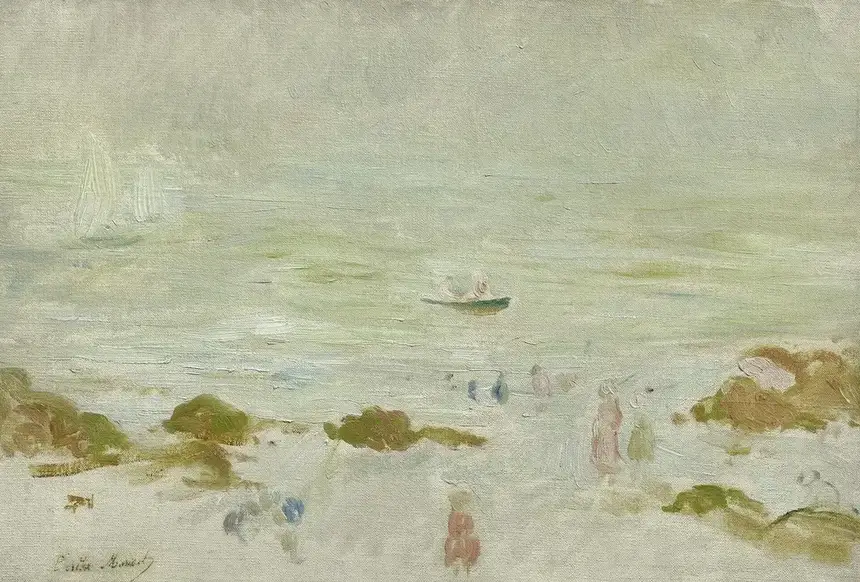
Most reproductions of a landscape flatten it into a view. This one keeps the weather in it.
The composition is built on a few large masses. Get those right and the rest follows.
Dusk and overcast passages are the hardest and the most rewarding — they are all half-tones.
Colour here is mixed for the passage, not for the object, which is why nothing looks like it was filled in.
Edges are made by the brush, not by an outline, and they are the hardest thing to copy.
The risk with a landscape is overworking, and the way to avoid it is knowing when to stop.
Hang it at eye level — roughly 145 cm from the floor to the centre — and it will hold the wall.
| Artist | Berthe Morisot |
|---|---|
| Title | Plage de la Comtesse dans la brume |
| Created (original) | 1894 |
| Medium | Oil on canvas, hand-painted to order |
| How it is made | Painted by hand in oil on canvas, to your size |
| Copyright | Public domain; the original is out of copyright |
Why this one cannot be printed
What you lose in a print is the air. A press lays ink flat; a painter builds depth in layers, and the depth is what you actually see.
Edges are left soft where the form turns away and sharp where it does not. That single habit is what separates a painting from a copy.
| Aspect | Hand-painted oil | Printed canvas |
|---|---|---|
| Sense of depth | Real, created by layers of paint | Simulated by darker ink |
| Handling of colour | Mixed on the palette and finished on the canvas | Fixed by the colour profile |
| Changing something | Tell us and the passage gets repainted | Usually means starting the file again |
| Available sizes | Whatever you need, painted to order | What the printer can output |
| How it ages | Warms and settles; cleanable by a conservator | Fades, then cracks at the stretcher |
What takes time here is the number of separate decisions, not the size of the canvas.
Every canvas is painted to order, so the quote follows your size, frame and destination rather than a fixed list. Tell us what you need on WhatsApp and we reply with an exact figure, usually within the hour. There is no agency in between; the studio that paints your canvas is the one answering your messages.
How it gets painted
The order of work matters as much as the work itself. Ours runs like this:
- The canvas is stretched and primed — cotton or linen, sized and ready before any paint goes near it.
- Laying in the drawing — done by eye from the reference, not traced or projected.
- The first colour pass — thin and simple, establishing the main shapes only.
- Getting the values right — the stage that decides whether the finished painting holds together.
- Building the colour — a warm and a cool version of each passage, put down in order.
- Finishing passes — the loaded highlights go on at the end and stay there.
- Left to dry before varnish — nothing is photographed or packed until the surface is ready.
This one repaints badly, so our painter gets the values right early and leaves them.
What goes into it
Pigment is artist-grade oil colour, not acrylic and not house paint. It behaves differently and it lasts. The varnish is removable, so a conservator can clean the painting in fifty years without touching the paint.
The ground is a proper acrylic sizing, so the oil does not rot the fabric over time. We buy pigment in tubes from the same suppliers the village has used for years, not in bulk drums.
Framing
Most clients wait for the photographs before choosing a frame, which is the sensible order.
Framing is quoted separately, so you can decide after you have seen the finished canvas in photographs.
Living with it
Oil paint needs very little: no water, no cleaners, no sprays. A dry brush and a stable room.
Choosing a size
You are not choosing from a list; you are telling us a measurement. These are the common ones:
| Size (inches) | Size (cm) | Best for |
|---|---|---|
| 40 × 30 in | 102 × 76 cm | Living room focal wall, above a sofa |
| 32 × 24 in | 81 × 61 cm | Living room, above a sideboard |
| 30 × 24 in | 76 × 61 cm | Dining room, bedroom feature wall |
| 24 × 20 in | 60 × 50 cm | Study, home office, above a desk |
| 20 × 16 in | 50 × 40 cm | Bedroom, hallway, above a console |
| 16 × 12 in | 40 × 30 cm | A shelf, a small wall, a gallery group |
If your wall is an odd shape, send the measurement and we will work to it. Proportions from the original are kept unless you ask us to change them. We quote DAP, so any duty or tax your country charges is settled by you at import. We do not add a tax line of our own.
This reads well above a sofa or a sideboard, where it will be seen from two to three metres.
Tell us where it will hang and how big it needs to be — we will price it properly.
💬 Get a Quote for plage de la comtesse dans la brume2024 CKS 22658How it reaches you
From order to finished canvas is 9–15 days. Freight appears as a separate line on the quote and is fixed before you pay.
Transit is usually 7–10 business days, tracked all the way. We send photographs of the finished painting before it is packed, and again once it is boxed.
Before anything is packed, you get photographs of the actual canvas and a chance to ask for changes. Changes are handled by telling us what to change; we change it and send new photographs.
Shipments go out DAP. If your customs office charges duty or tax on arrival, that is between you and them — we do not collect it and we do not put a number on it.
A deposit starts the canvas and books the painter's time; the balance is due before the crate leaves. Damage in transit should be reported to us within 48 hours, with photographs. We pursue it with the carrier rather than promising a refund.
What people ask us
Can I resell the reproduction?
Yes. Because the underlying work is in the public domain, the hand-painted canvas is yours to sell, gift or install commercially.
Will it look exactly like the image?
Not exactly, and that is the point — it is a painting, not a scan. Composition, colour and drawing follow the original closely; the surface is where a painter's own decisions show.
Can I change something in the composition?
Often yes — background, cropping, or adapting the proportions to your wall. Tell us what you have in mind and we will say honestly whether it will work.
Can I change the size?
Any size you like. We paint to the number you give us rather than to a standard range.
Can you paint a different work by Berthe Morisot?
Yes. Send the image and we will quote it, or browse the other paintings we have listed.
Does it come framed?
Frames are priced on their own line. Most clients choose after seeing the photographs.
Can you paint it from a different photograph of the same work?
Yes. If you have a better reference, send it on WhatsApp and we will work from yours.
How do I hang it?
Roughly 145 cm from floor to centre works for most rooms. Tell us your wall and we will give you the measurement.
Do you sell prints?
No. Hand-painted oil on canvas only. No printing, no giclée, no canvas transfer.
Will I see it before it ships?
Yes. We send photographs of the finished canvas and wait for your reply before packing.
Is it really painted by hand?
Yes. One painter, oil paint, brushes. We do not own a printer that touches canvas.
Can you change the colours to suit my room?
We can shift the palette, but we will tell you honestly when a change would spoil the painting.