What you are buying into
Caravaggio died in 1610, so the work has been in the public domain for decades. Reproducing it by hand is legal, and so is owning one.
Ours is a painting made with brushes. There is no giclée, no canvas transfer and no digital underlayer anywhere in the process.
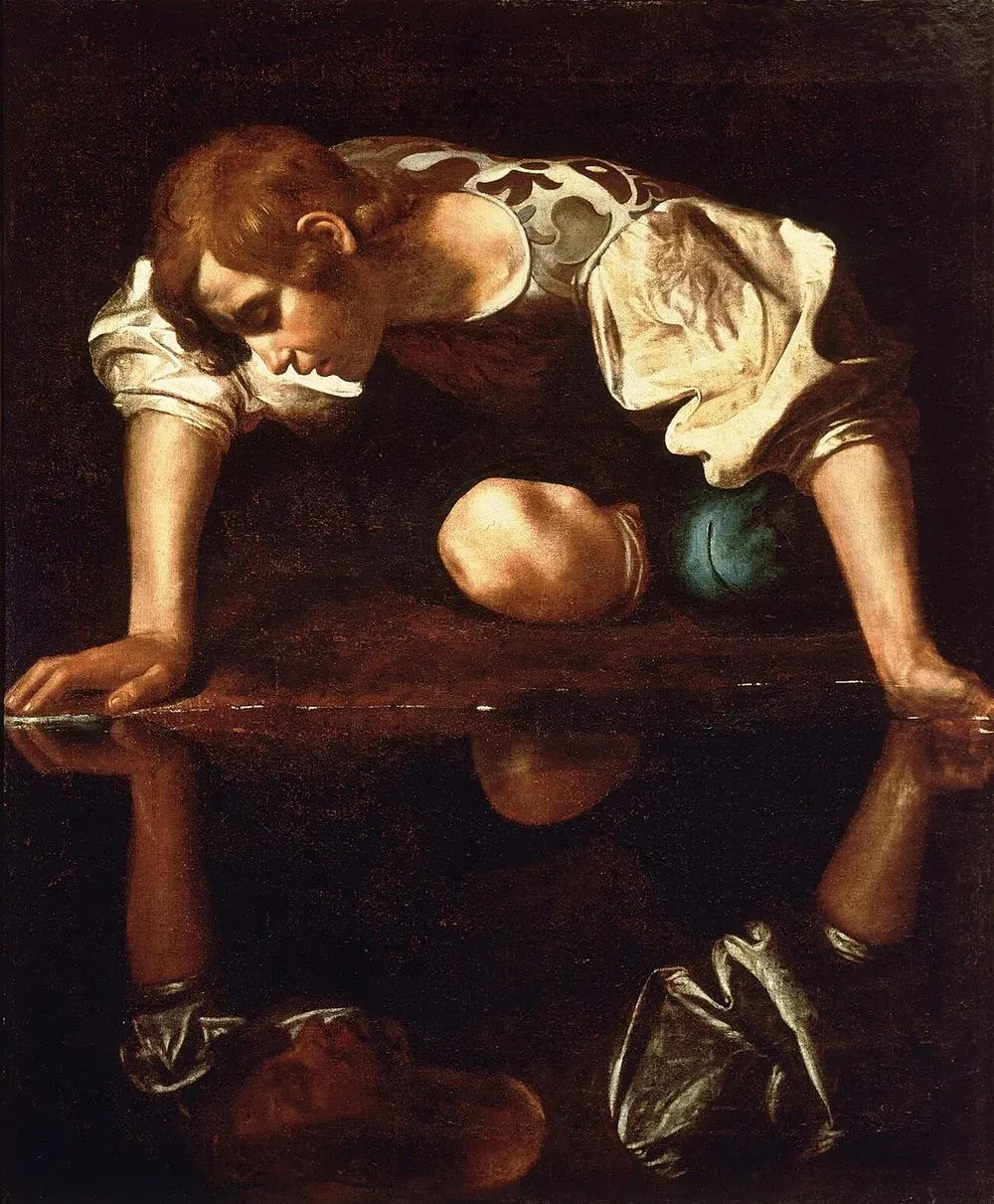
It is an original composition painted before 1610, and our version is painted from the surviving image of it.
If you want something printed, we are the wrong workshop. We do not own a printer that touches canvas.
Looking at it properly
Abstract work is the clearest case for hand-painting: the surface is the subject.
The composition is built to be seen from across a room, and we size it accordingly.
Ridges and valleys in the surface do the work that shading would do elsewhere.
Temperature does the work of contrast in the quiet areas, where value differences are small.
The thick paint is kept for the light and the thin paint for the dark, which is the traditional way round.
Anyone can copy the shapes. The skill is in the transitions, and that is what takes the days.
For a stairwell or a double-height space, go larger than you think — the composition was built for distance.
| Artist | Caravaggio |
|---|---|
| Title | Narcissus Hand-Painted Oil Reproduction |
| What you receive | A hand-painted oil painting on canvas |
| Public domain | Yes — the artist died over 70 years ago |
What a print loses
The difference is not subtle when the two hang side by side. Ink sits on the surface; oil stands off it.
Where the original is loaded, ours is loaded. Where it is thin, ours is thin. Matching the weight of the paint matters more than matching the colour.
| Aspect | Hand-painted oil | Printed canvas |
|---|---|---|
| Value over time | Can be re-stretched, cleaned and re-framed | Little value beyond the print |
| Depth | Built in layers, catches light from the side | Flat; highlights are printed as pale ink |
| Corrections | We adjust it and repaint the passage | The file is reprinted or it is not |
| Edges | Chosen by the painter, passage by passage | Whatever the file happens to contain |
| Handling of colour | Mixed on the palette and finished on the canvas | Fixed by the colour profile |
The passage that will take longest is the one that looks simplest.
Every canvas is painted to order, so the quote follows your size, frame and destination rather than a fixed list. Tell us what you need on WhatsApp and we reply with an exact figure, usually within the hour. You are talking to the people who will actually paint it, not a middleman.
How it gets painted
The order of work matters as much as the work itself. Ours runs like this:
- We start with the canvas itself — stretched, sized and left to settle before any colour is mixed.
- The drawing goes down — charcoal or thin paint, done by eye rather than traced from a printout.
- The first colour pass — thin and simple, establishing the main shapes only.
- Setting the key — how dark the darks go determines everything that follows.
- The colour passes — each area gets its own mixture rather than one colour used throughout.
- The detail and highlights go on — last, loaded, and left alone once they are down.
- Left to dry before varnish — nothing is photographed or packed until the surface is ready.
The hardest passage is the quiet one, where a small mistake has nowhere to hide.
Care and cleaning
Once the varnish has cured the surface can be cleaned by a conservator, but in a normal house it will not need it for decades.
Whether to frame it
Framing is quoted separately, so you can decide after you have seen the finished canvas in photographs.
Frames are priced once you have chosen them, not estimated in advance.
Canvas, paint and varnish
Nothing is sprayed, sealed or laminated. The surface you see is paint and varnish, and that is all. We use a neutral-sized ground so the whites stay warm rather than going blue over time.
The varnish is removable, so a conservator can clean the painting in fifty years without touching the paint. Brushes, knives and rags. That is the equipment list; there is no machine in the process.
Sizing it
The canvas is cut to your wall, not the other way round. For reference, these are the dimensions most often requested:
| Size (inches) | Size (cm) | Best for |
|---|---|---|
| 36 × 54 in | 91 × 137 cm | Lobby, chapel-like corner, tall foyer |
| 12 × 16 in | 30 × 40 cm | A narrow wall between two openings |
| 16 × 24 in | 41 × 61 cm | Hallway end, beside a door |
| 20 × 30 in | 51 × 76 cm | A tight wall that needs height, not width |
| 24 × 36 in | 61 × 91 cm | Stairwell, tall entrance, gallery group |
| 30 × 45 in | 76 × 114 cm | Double-height space, narrow feature wall |
We will size the canvas to the room, not to a stock list. Send us the measurement. Duties and import taxes are the buyer's account (DAP). Your customs authority sets them; we do not.
It wants a wall where the light rakes across it, because the surface is part of the picture.
Tell us your size and frame — we reply with an exact quote, usually within the hour.
💬 Get a Narcissus Quote on WhatsAppHow it reaches you
Allow 9–15 days for the painting itself. Shipping is a separate line on your quote — you see it before payment, not after.
Air freight runs about 7–10 business days, tracked, to your door. We send photographs of the finished painting before it is packed, and again once it is boxed.
You see photographs of the finished painting before it ships, and you tell us what to adjust. Adjustments are part of the process. Say what you want different and it gets done.
We sell DAP: the price covers the painting and the freight, and any import duties or taxes are the buyer's to settle with customs. We do not collect them and we do not estimate them.
Work begins on a deposit and ships on the balance. Both figures are on the quote. If a crate arrives damaged, send us photographs within 48 hours and contact us directly — we will sort it out with you.
What people ask us
What happens after I message you?
You tell us the painting, size and whether you want a frame. We quote, a painter starts on your canvas, and you get photographs before it ships.
Does it come with a certificate of authenticity?
No, and we would be wary of anyone who issues one for a public-domain reproduction. What you receive is a hand-painted canvas and photographs of it before it ships.
Why not just print it?
A print flattens the surface into a poster: the distance collapses and the highlights turn to grey. Paint keeps the depth and the texture the original was built from.
How long does it take?
Allow 9–15 days for the painting itself, then roughly 7–10 business days in transit.
Who pays the import duty?
You do. We sell DAP, so any duty or tax your customs authority charges is settled by you at import. We do not collect it and we do not estimate it.
Can I change the size?
Yes. The canvas is painted to your measurement, not taken from a stock list.
What does it cost?
There is no price list, because the number depends on your size and frame. Message us and we will quote exactly.
Will I see it before it ships?
Yes. We send photographs of the finished canvas and wait for your reply before packing.
Can you paint a different work by Caravaggio?
Yes. Send the image and we will quote it, or browse the other paintings we have listed.
Do you ship to my country?
We export to more than 20 countries. Tell us where you are and we will quote the freight as a separate line.
Can you paint it from a different photograph of the same work?
Send your own reference image and we will paint from that instead.
What if it arrives damaged?
Report damage within 48 hours with photographs. We deal with the carrier rather than leaving you to argue alone.
Brushwork details
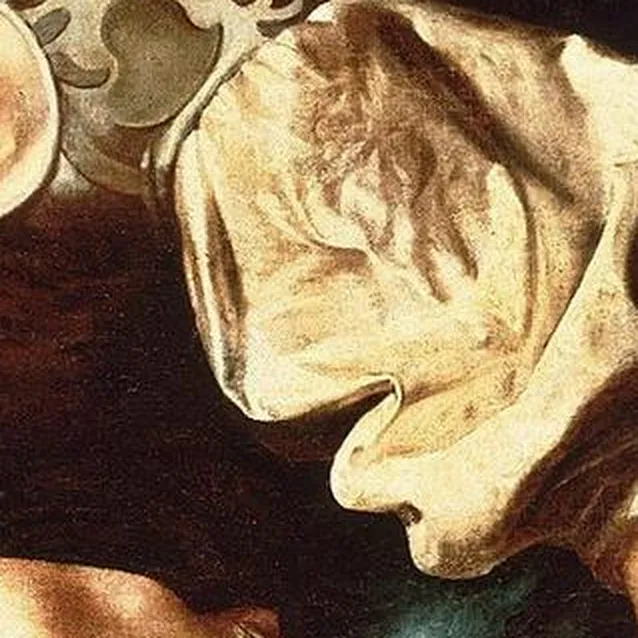
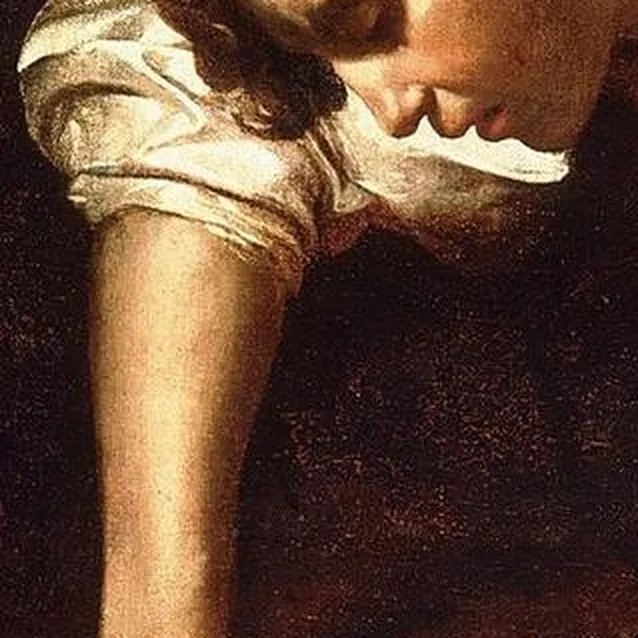
Close-up crops of this 100% hand-painted oil reproduction — real oil texture, never a print.