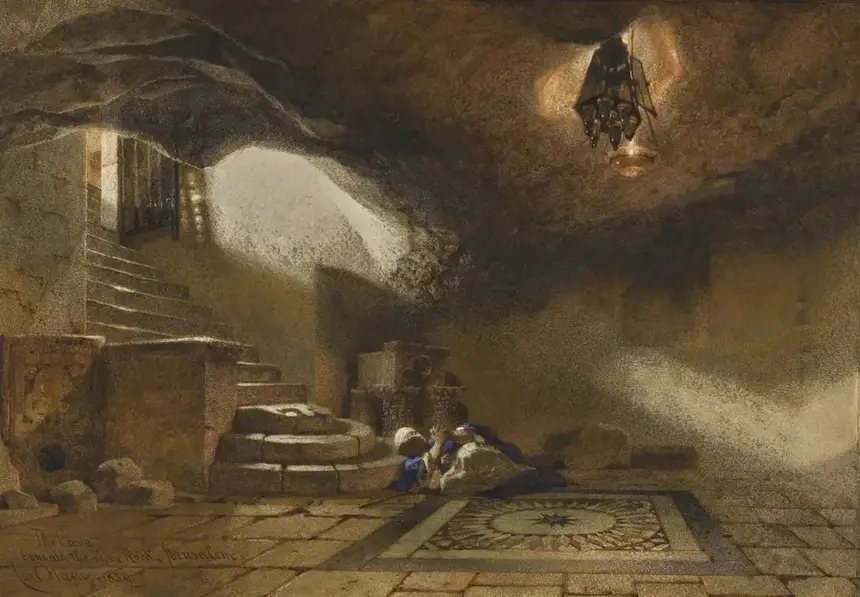
About The Cave beneath the Holy Rock, Jerusalem
Carl Haag died in 1915, so the work has been in the public domain for decades. Reproducing it by hand is legal, and so is owning one.
We paint it in oil on canvas, one at a time, in Dafen Village. Nothing is printed, scanned or transferred.
The painting was made in the years before 1915, and what we reproduce is the record of it, not the object.
What arrives is a canvas with paint on it, made by a person. That is the only thing we sell.
What the painting is doing
The reason The Cave beneath the Holy Rock, Jerusalem still works as a painting is that it was built as paint, not as a picture of a place.
Depth here is a matter of edges: sharp in front, lost at the back. It is the hardest thing to print and the easiest to paint.
Our painter leaves the highlights until last and puts them on thickly, so they stand off the surface.
Our painter mixes on the palette but finishes on the canvas, which is where the small variations come from.
Paint is laid on, not pushed around. That is what keeps it fresh.
The difficulty is restraint: leaving out most of what a photograph would show.
Given the subject, this sits naturally in a living room or a study rather than a hallway.
| Artist | Carl Haag |
|---|---|
| Title | The Cave beneath the Holy Rock, Jerusalem |
| Created (original) | 1859 |
| Medium | Oil on canvas, hand-painted to order |
| Our version | Oil on canvas, painted by hand to order |
| Original status | Public domain (artist deceased) |
What a print loses
Prints are good at information and bad at paint. This subject is mostly paint.
Paint goes on in the original's order — thin first, thick last — so the surface behaves the way the painter intended.
| Aspect | Hand-painted oil | Printed canvas |
|---|---|---|
| Surface | Hand-painted oil on canvas | Ink on canvas, flat |
| Handling of colour | Mixed on the palette and finished on the canvas | Fixed by the colour profile |
| Size | Any size, painted to your wall | Limited by the printer |
| Lifespan | Slow to change; varnish can be refreshed decades later | Fades and cracks sooner |
| Corrections | We adjust it and repaint the passage | The file is reprinted or it is not |
The passage that will take longest is the one that looks simplest.
Every canvas is painted to order, so the quote follows your size, frame and destination rather than a fixed list. Tell us what you need on WhatsApp and we reply with an exact figure, usually within the hour. There is no agency in between; the studio that paints your canvas is the one answering your messages.
The sequence on our floor
No two canvases are painted the same way, but the sequence is always this:
- The canvas is stretched and primed — cotton or linen, sized and ready before any paint goes near it.
- Laying in the drawing — done by eye from the reference, not traced or projected.
- The first colour pass — thin and simple, establishing the main shapes only.
- Getting the values right — the stage that decides whether the finished painting holds together.
- Building the colour — a warm and a cool version of each passage, put down in order.
- Finishing passes — the loaded highlights go on at the end and stay there.
- Drying and varnishing — the final varnish goes on once the paint has set, before we photograph it.
The risk with a seascape is overworking, and the way to avoid it is knowing when to stop.
Keeping it
Once the varnish has cured the surface can be cleaned by a conservator, but in a normal house it will not need it for decades.
What goes into it
We use a neutral-sized ground so the whites stay warm rather than going blue over time. The paint is built in layers, fat over lean, which is what stops it cracking later.
Varnish goes on only once the paint is properly dry, months after the last stroke, not before. Stretcher bars are kiln-dried and wedged, so the canvas can be re-tensioned years later.
Framing
Most clients wait for the photographs before choosing a frame, which is the sensible order.
Frames are priced once you have chosen them, not estimated in advance.
Sizing it
Because each piece is painted from scratch, you are not limited to stock dimensions. These are the sizes clients ask for most:
| Size (inches) | Size (cm) | Best for |
|---|---|---|
| 32 × 24 in | 81 × 61 cm | Living room, above a sideboard |
| 30 × 24 in | 76 × 61 cm | Dining room, bedroom feature wall |
| 24 × 20 in | 60 × 50 cm | Study, home office, above a desk |
| 20 × 16 in | 50 × 40 cm | Bedroom, hallway, above a console |
We will size the canvas to the room, not to a stock list. Send us the measurement. Import charges, where they exist, are the buyer's responsibility (DAP). We never add them to the quote and never guess what they will be.
This reads well above a sofa or a sideboard, where it will be seen from two to three metres.
Tell us where it will hang and how big it needs to be — we will price it properly.
💬 Get a Quote for The Cave beneath the Holy Rock, JerusalemOrder, painting, shipping
From order to finished canvas is 9–15 days. Freight appears as a separate line on the quote and is fixed before you pay.
Air freight runs about 7–10 business days, tracked, to your door. Rolled in a tube it travels cheaper and safer than framed; most overseas clients take it that way.
Before anything is packed, you get photographs of the actual canvas and a chance to ask for changes. Changes are handled by telling us what to change; we change it and send new photographs.
We sell DAP: the price covers the painting and the freight, and any import duties or taxes are the buyer's to settle with customs. We do not collect them and we do not estimate them.
You pay a deposit to start and the remainder before shipping. Nothing is hidden in between. Report any transit damage within 48 hours with photographs and we will deal with the carrier. We will not promise a payout, but we will not leave you to argue alone either.
Before you order
How do I know what size will look right?
Measure the wall and send a photograph. We will say honestly if the canvas you have in mind is too small for the space, which is the most common mistake.
Do you work from my own photograph?
Yes, though that is a separate service. This page is for a hand-painted version of {title}; for a photo-to-painting commission, send the image on WhatsApp.
What about duties and import taxes?
Those are the buyer's responsibility (DAP). The amounts are set by your customs authority, not by us.
What is the canvas made of?
Cotton duck as standard, linen on request, artist-grade oil paint, and a final varnish once the paint is fully dry.
How long does it take?
Allow 9–15 days for the painting itself, then roughly 7–10 business days in transit.
Can you change the colours to suit my room?
We can shift the palette, but we will tell you honestly when a change would spoil the painting.
What if it arrives damaged?
Report damage within 48 hours with photographs. We deal with the carrier rather than leaving you to argue alone.
Do you ship to my country?
We ship to over 20 countries. Give us your city and the freight appears as its own line on the quote.
Can you paint it from a different photograph of the same work?
Send your own reference image and we will paint from that instead.
Is it really painted by hand?
Yes. One painter, oil paint, brushes. We do not own a printer that touches canvas.
Can I change the size?
Any size you like. We paint to the number you give us rather than to a standard range.
Who pays the import duty?
You do. We sell DAP, so any duty or tax your customs authority charges is settled by you at import. We do not collect it and we do not estimate it.