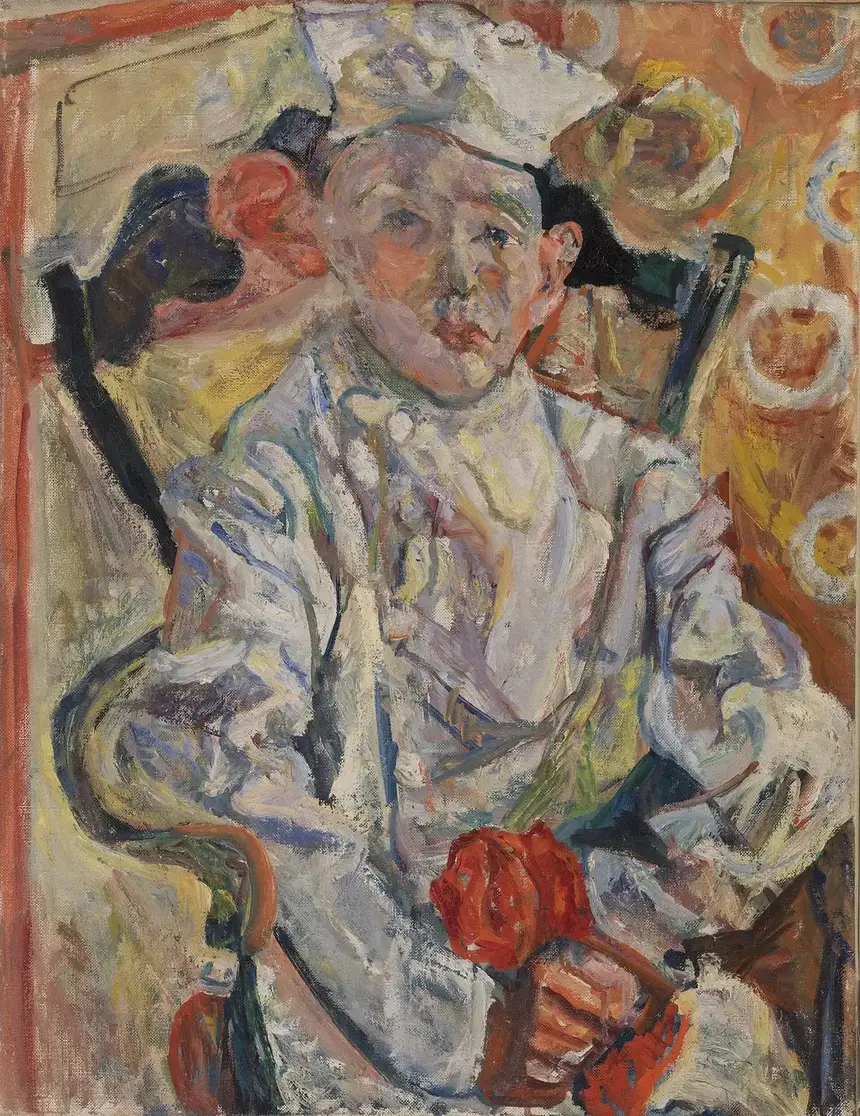
About Le Pâtissier
Because Chaim Soutine died in 1943, this work is in the public domain. We are painting a copy of a painting — we never pass it off as the original, and neither should anyone selling you one.
Ours is a painting made with brushes. There is no giclée, no canvas transfer and no digital underlayer anywhere in the process.
The painting was made in the years before 1943, and what we reproduce is the record of it, not the object.
You are buying a painting, not a file. That distinction is the whole business we are in.
How to read it
Most reproductions of a landscape flatten it into a view. This one keeps the weather in it.
Where the original has an awkward crop, we keep it. Correcting it would be painting a different picture.
Our painter keeps the shadows transparent, because a shadow in a landscape is lit by the sky, not by nothing.
Our painter keeps the colour relationships rather than the exact hues, because relationships are what survive.
Nothing here is blended flat. Blending is what makes a painting look printed.
The difficulty is restraint: leaving out most of what a photograph would show.
Given the subject, this sits naturally in a living room or a study rather than a hallway.
| Artist | Chaim Soutine |
|---|---|
| Title | Le Pâtissier |
| Medium | Oil on canvas, hand-painted to order |
| How it is made | Painted by hand in oil on canvas, to your size |
| Copyright | Public domain; the original is out of copyright |
The case for painting it by hand
What you lose in a print is the air. A press lays ink flat; a painter builds depth in layers, and the depth is what you actually see.
Where the original is loaded, ours is loaded. Where it is thin, ours is thin. Matching the weight of the paint matters more than matching the colour.
| Aspect | Hand-painted oil | Printed canvas |
|---|---|---|
| Time to make | Days of one painter's working time | Minutes |
| Changing something | Tell us and the passage gets repainted | Usually means starting the file again |
| Sense of depth | Real, created by layers of paint | Simulated by darker ink |
| Lifespan | Slow to change; varnish can be refreshed decades later | Fades and cracks sooner |
| Colour | Mixed for each passage, warm and cool versions | One flat value per area |
The passage that will take longest is the one that looks simplest.
Every canvas is painted to order, so the quote follows your size, frame and destination rather than a fixed list. Tell us what you need on WhatsApp and we reply with an exact figure, usually within the hour. No resellers, no drop-shipper. The painter's studio handles your commission from first message to final crate.
From blank canvas to finished painting
Here is what actually happens between your message and the crate:
- Stretching and priming the support — cotton duck or linen goes onto the bars and gets its ground.
- Laying in the drawing — done by eye from the reference, not traced or projected.
- Blocking the masses — thin paint, working the whole surface rather than one corner at a time.
- The values are established — this is the stage that decides whether the painting works.
- Building the colour — a warm and a cool version of each passage, put down in order.
- Finishing passes — the loaded highlights go on at the end and stay there.
- Left to dry before varnish — nothing is photographed or packed until the surface is ready.
Matching the original's degree of finish is harder than matching its colours.
On framing
We can supply a simple floater frame, a traditional gilt, or nothing at all. It is your call.
A frame is a separate line on the quote, not a bundle. You choose it once the painting exists.
Care and cleaning
Oil paint needs very little: no water, no cleaners, no sprays. A dry brush and a stable room.
What it is made of
Oil paint dries by oxidation, not evaporation, which is why a finished canvas needs weeks before it travels. Varnish goes on only once the paint is properly dry, months after the last stroke, not before.
Pigment is artist-grade oil colour, not acrylic and not house paint. It behaves differently and it lasts. Nothing is sprayed, sealed or laminated. The surface you see is paint and varnish, and that is all.
Choosing a size
Because each piece is painted from scratch, you are not limited to stock dimensions. These are the sizes clients ask for most:
| Size (inches) | Size (cm) | Best for |
|---|---|---|
| 40 × 30 in | 102 × 76 cm | Living room focal wall, above a sofa |
| 32 × 24 in | 81 × 61 cm | Living room, above a sideboard |
| 30 × 24 in | 76 × 61 cm | Dining room, bedroom feature wall |
| 24 × 20 in | 60 × 50 cm | Study, home office, above a desk |
| 20 × 16 in | 50 × 40 cm | Bedroom, hallway, above a console |
| 16 × 12 in | 40 × 30 cm | A shelf, a small wall, a gallery group |
If your wall is an odd shape, send the measurement and we will work to it. Proportions from the original are kept unless you ask us to change them. Import charges, where they exist, are the buyer's responsibility (DAP). We never add them to the quote and never guess what they will be.
For a stairwell or a double-height space, go larger than you think — the composition was built for distance.
Give us your size and framing preference and you will have a quote shortly.
💬 Get a Quote for Le PâtissierOrder, painting, shipping
The painting takes 9–15 days, and delivery is priced separately on the quote so there is no surprise later.
Transit is usually 7–10 business days, tracked all the way. Rolled in a tube it travels cheaper and safer than framed; most overseas clients take it that way.
Before anything is packed, you get photographs of the actual canvas and a chance to ask for changes. If something is not right, tell us what to adjust and we adjust it.
DAP terms: we pay the freight, you settle any duty or tax your country applies. We do not collect taxes on anyone's behalf.
Work begins on a deposit and ships on the balance. Both figures are on the quote. Report any transit damage within 48 hours with photographs and we will deal with the carrier. We will not promise a payout, but we will not leave you to argue alone either.
The practical questions
Will it look exactly like the image?
Not exactly, and that is the point — it is a painting, not a scan. Composition, colour and drawing follow the original closely; the surface is where a painter's own decisions show.
Can I resell the reproduction?
Yes. Because the underlying work is in the public domain, the hand-painted canvas is yours to sell, gift or install commercially.
When will it actually arrive?
Studio time is 9–15 days, then a few more days for the oil to set before we can photograph and pack it. We tell you where your canvas is at each stage.
What is the canvas made of?
Cotton or linen, oil colour, and varnish. Stretcher bars are wedged so the canvas can be re-tensioned later.
What if it arrives damaged?
Report damage within 48 hours with photographs. We deal with the carrier rather than leaving you to argue alone.
Is it really painted by hand?
Yes — oil on canvas, brush and knife. There is no printing, no giclée and no canvas transfer at any stage.
Can you change the colours to suit my room?
Sometimes. We will adjust the palette if it can be done without ruining the picture, and say so if it cannot.
Can you paint it from a different photograph of the same work?
Send your own reference image and we will paint from that instead.
How long does it take?
Painting takes 9–15 days. Air freight is usually 7–10 business days on top of that, tracked.
Can I change the size?
Any size you like. We paint to the number you give us rather than to a standard range.
What does it cost?
There is no price list, because the number depends on your size and frame. Message us and we will quote exactly.
Can you paint a different work by Chaim Soutine?
Yes — send us the image, or look through the other Chaim Soutine works on the site.