What you are buying into
Because Charles Conder died in 1909, this work is in the public domain. We are painting a copy of a painting — we never pass it off as the original, and neither should anyone selling you one.
We paint it in oil on canvas, one at a time, in Dafen Village. Nothing is printed, scanned or transferred.
It is an original composition painted before 1909, and our version is painted from the surviving image of it.
If you want something printed, we are the wrong workshop. We do not own a printer that touches canvas.
What the painting is doing
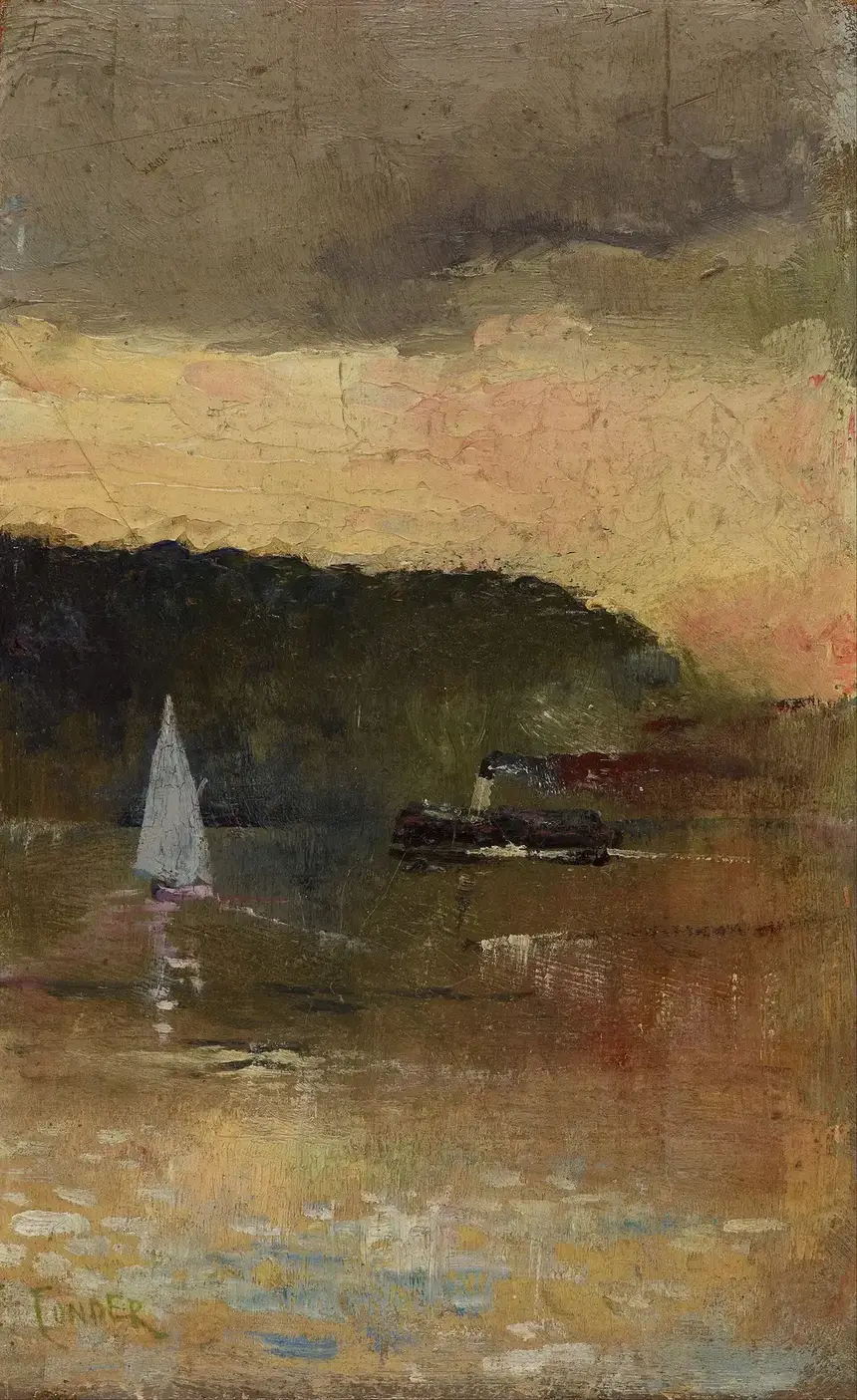
Sunset, Sydney Harbour rewards a second look because the light is doing something specific, and it only does it in oil.
Space in a seascape is made with value, not perspective: things that are further away are painted cooler and weaker.
Our painter keeps the shadows transparent, because a shadow in a seascape is lit by the sky, not by nothing.
Our painter keeps the colour relationships rather than the exact hues, because relationships are what survive.
Our painter uses a larger brush than you would expect, which is why the passages stay simple.
The passage that will take longest is the one that looks simplest.
For a stairwell or a double-height space, go larger than you think — the composition was built for distance.
| Artist | Charles Conder |
|---|---|
| Title | Sunset, Sydney Harbour |
| Medium | Oil on canvas, hand-painted to order |
| Our version | Oil on canvas, painted by hand to order |
| Original status | Public domain (artist deceased) |
Why this one cannot be printed
Prints are good at information and bad at paint. This subject is mostly paint.
Where the original is loaded, ours is loaded. Where it is thin, ours is thin. Matching the weight of the paint matters more than matching the colour.
| Aspect | Hand-painted oil | Printed canvas |
|---|---|---|
| Handling of colour | Mixed on the palette and finished on the canvas | Fixed by the colour profile |
| Corrections | We adjust it and repaint the passage | The file is reprinted or it is not |
| Impasto | Real paint standing off the canvas | Flat ink, sometimes embossed to imitate |
| What it takes | One painter, several days, start to finish | A machine, a few minutes |
| Edge quality | Soft where the form turns, sharp where it does not | Uniformly sharp or uniformly blurred |
The hardest passage is the quiet one, where a small mistake has nowhere to hide.
Every canvas is painted to order, so the quote follows your size, frame and destination rather than a fixed list. Tell us what you need on WhatsApp and we reply with an exact figure, usually within the hour. You are talking to the people who will actually paint it, not a middleman.
The sequence on our floor
The order of work matters as much as the work itself. Ours runs like this:
- We start with the canvas itself — stretched, sized and left to settle before any colour is mixed.
- The drawing goes down — charcoal or thin paint, done by eye rather than traced from a printout.
- Blocking the masses — thin paint, working the whole surface rather than one corner at a time.
- The values are established — this is the stage that decides whether the painting works.
- The colour passes — each area gets its own mixture rather than one colour used throughout.
- Detail and highlights last — put on thickly and then not touched again.
- Drying and varnishing — the final varnish goes on once the paint has set, before we photograph it.
What takes time here is the number of separate decisions, not the size of the canvas.
Whether to frame it
Framing is quoted separately, so you can decide after you have seen the finished canvas in photographs.
Frames are priced once you have chosen them, not estimated in advance.
Looking after it
Do not wipe it with anything wet. Dust lightly, hang it somewhere stable, and forget about it.
What it is made of
Each painter works on one canvas at a time — the painting you ordered is not shared with another order. The ground is a proper acrylic sizing, so the oil does not rot the fabric over time.
Pigment is artist-grade oil colour, not acrylic and not house paint. It behaves differently and it lasts. We use a neutral-sized ground so the whites stay warm rather than going blue over time.
What size works
Because each piece is painted from scratch, you are not limited to stock dimensions. These are the sizes clients ask for most:
| Size (inches) | Size (cm) | Best for |
|---|---|---|
| 32 × 24 in | 81 × 61 cm | Living room, above a sideboard |
| 30 × 24 in | 76 × 61 cm | Dining room, bedroom feature wall |
| 24 × 20 in | 60 × 50 cm | Study, home office, above a desk |
| 20 × 16 in | 50 × 40 cm | Bedroom, hallway, above a console |
We will size the canvas to the room, not to a stock list. Send us the measurement. Terms are DAP. Import duties and taxes, where they apply, are paid by the buyer on arrival — we never collect them in advance and never guess at the amount.
Hang it at eye level — roughly 145 cm from the floor to the centre — and it will hold the wall.
Message us the dimensions you have in mind and we will come back with a figure.
💬 Get a Quote for Sunset, Sydney HarbourOrder, painting, shipping
The painting takes 9–15 days, and delivery is priced separately on the quote so there is no surprise later.
Air freight runs about 7–10 business days, tracked, to your door. Unframed canvases are rolled face-out on a tube; framed ones are corner-protected and crated.
Before anything is packed, you get photographs of the actual canvas and a chance to ask for changes. If something is not right, tell us what to adjust and we adjust it.
DAP terms: we pay the freight, you settle any duty or tax your country applies. We do not collect taxes on anyone's behalf.
Work begins on a deposit and ships on the balance. Both figures are on the quote. Report any transit damage within 48 hours with photographs and we will deal with the carrier. We will not promise a payout, but we will not leave you to argue alone either.
The practical questions
Will the dark passages look muddy?
That is the main risk in a night painting and the reason it cannot be printed. The painter mixes darks from colour rather than reaching for black, which keeps them transparent instead of dead.
How do I know what size will look right?
Measure the wall and send a photograph. We will say honestly if the canvas you have in mind is too small for the space, which is the most common mistake.
How close will it be to the original?
The composition, colour and drawing follow the original closely; the brushwork carries the painter's own hand. The painter works freehand on a blank canvas, following the same logic as the original rather than copying a photograph.
Does it come framed?
Framing is quoted separately, so you can decide once you have seen the finished painting in photographs.
Can you paint it from a different photograph of the same work?
Send your own reference image and we will paint from that instead.
Can you paint a different work by Charles Conder?
Yes — send us the image, or look through the other Charles Conder works on the site.
What is the canvas made of?
Cotton or linen, oil colour, and varnish. Stretcher bars are wedged so the canvas can be re-tensioned later.
Do you ship to my country?
We ship to over 20 countries. Give us your city and the freight appears as its own line on the quote.
How do I hang it?
Centre it at about 145 cm from the floor, or two-thirds the width of the furniture below it. We will tell you the exact number for your wall.
Do you sell prints?
No prints at all — no giclée, no canvas transfer, nothing machine-made.
Is it really painted by hand?
Yes. One painter, oil paint, brushes. We do not own a printer that touches canvas.
Can you change the colours to suit my room?
We can shift the palette, but we will tell you honestly when a change would spoil the painting.