About the original
Charles Demuth died in 1935. That puts the painting well outside copyright, which is why we can paint it and you can own it anywhere in the world.
We paint it in oil on canvas, one at a time, in Dafen Village. Nothing is printed, scanned or transferred.
The painting was made in the years before 1935, and what we reproduce is the record of it, not the object.
If you want something printed, we are the wrong workshop. We do not own a printer that touches canvas.
Where the painting lives
Ours is painted from the source image, stroke by stroke, so Two Women Acrobats keeps the order it was originally built in.
Our painter works freehand on a blank canvas, so the scale of the original survives the enlargement.
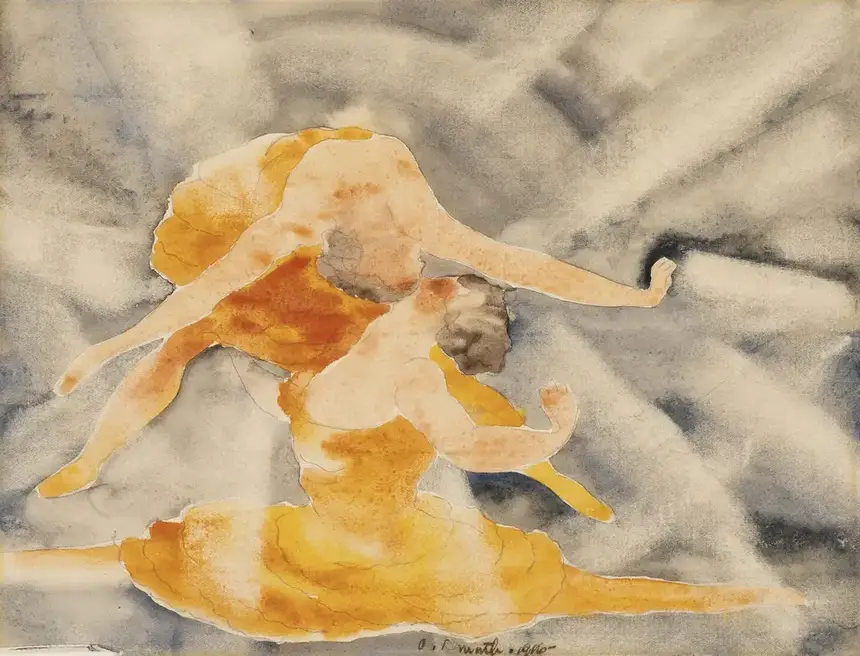
The light in Two Women Acrobats has a direction, and the painter keeps it consistent across every object in the picture.
Our painter mixes on the palette but finishes on the canvas, which is where the small variations come from.
Nothing here is blended flat. Blending is what makes a painting look printed.
The hardest passage is the quiet one, where a small mistake has nowhere to hide.
It wants a wall where the light rakes across it, because the surface is part of the picture.
| Artist | Charles Demuth |
|---|---|
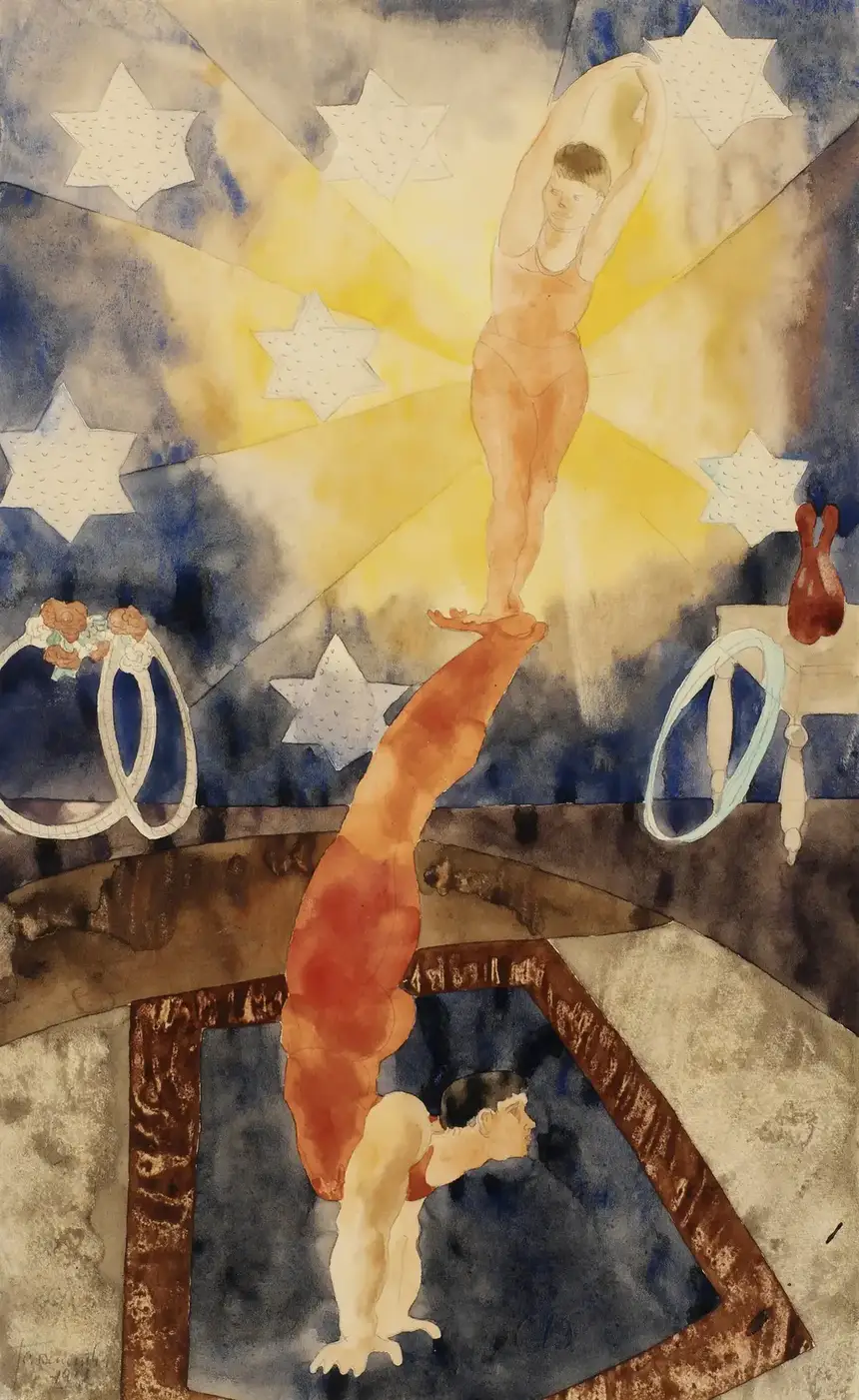
| Title | Two Women Acrobats |
| Created (original) | 1916 |
| Medium | Oil on canvas, hand-painted to order |
| What you receive | A hand-painted oil painting on canvas |
| Original status | Public domain (artist deceased) |
Hand-painted, not printed
The difference is not subtle when the two hang side by side. Ink sits on the surface; oil stands off it.
Where the original is loaded, ours is loaded. Where it is thin, ours is thin. Matching the weight of the paint matters more than matching the colour.
| Aspect | Hand-painted oil | Printed canvas |
|---|---|---|
| Edge quality | Soft where the form turns, sharp where it does not | Uniformly sharp or uniformly blurred |
| Corrections | We adjust it and repaint the passage | The file is reprinted or it is not |
| Colour | Mixed for each passage, warm and cool versions | One flat value per area |
| The surface | Built up with brushes and knives | Printed flat in one pass |
| Available sizes | Whatever you need, painted to order | What the printer can output |
Anyone can copy the shapes. The skill is in the transitions, and that is what takes the days.
Every canvas is painted to order, so the quote follows your size, frame and destination rather than a fixed list. Tell us what you need on WhatsApp and we reply with an exact figure, usually within the hour. There is no agency in between; the studio that paints your canvas is the one answering your messages.
The sequence on our floor
This is how the painting is built, in the order our painters build it:
- Stretching and priming the support — cotton duck or linen goes onto the bars and gets its ground.
- Laying in the drawing — done by eye from the reference, not traced or projected.
- The first colour pass — thin and simple, establishing the main shapes only.
- Setting the key — how dark the darks go determines everything that follows.
- Colour is built up — warmer and cooler versions of each passage, laid over the underpainting.
- The detail and highlights go on — last, loaded, and left alone once they are down.
- It dries, then gets varnished — and only then is it photographed for you.
The passage that will take longest is the one that looks simplest.
What it is made of
The ground is a proper acrylic sizing, so the oil does not rot the fabric over time. Each painter works on one canvas at a time — the painting you ordered is not shared with another order.
We do not use a printer at any stage. There is no giclée, no canvas transfer, no digital underlayer. The paint is built in layers, fat over lean, which is what stops it cracking later.
Looking after it
Oil paint needs very little: no water, no cleaners, no sprays. A dry brush and a stable room.
On framing
If you are shipping, an unframed canvas rolled in a tube is considerably cheaper to move than a framed one.
Most clients wait for the photographs before choosing a frame, which is the sensible order.
Getting the size right
You are not choosing from a list; you are telling us a measurement. These are the common ones:
| Size (inches) | Size (cm) | Best for |
|---|---|---|
| 24 × 20 in | 60 × 50 cm | Study, home office, above a desk |
| 20 × 16 in | 50 × 40 cm | Bedroom, hallway, above a console |
| 16 × 12 in | 40 × 30 cm | A shelf, a small wall, a gallery group |
| 64 × 48 in | 163 × 122 cm | Villa scale, lobby, hospitality wall |
If your wall is an odd shape, send the measurement and we will work to it. Proportions from the original are kept unless you ask us to change them. Our terms are DAP, meaning the freight is paid by us and any import charges are yours to settle. We will not estimate them, because the figure is your customs authority's to set.
Hang it at eye level — roughly 145 cm from the floor to the centre — and it will hold the wall.
Tell us where it will hang and how big it needs to be — we will price it properly.
💬 Get a Quote for Two Women AcrobatsGetting it to you
Painting takes 9–15 days. Freight is quoted as its own line on the quote, agreed before you pay anything, and never added afterwards.
Transit is usually 7–10 business days, tracked all the way. Rolled in a tube it travels cheaper and safer than framed; most overseas clients take it that way.
Nothing ships before you have seen it. Photographs of the finished painting go to you first. Changes are handled by telling us what to change; we change it and send new photographs.
Shipments go out DAP. If your customs office charges duty or tax on arrival, that is between you and them — we do not collect it and we do not put a number on it.
A deposit starts the canvas and books the painter's time; the balance is due before the crate leaves. Report any transit damage within 48 hours with photographs and we will deal with the carrier. We will not promise a payout, but we will not leave you to argue alone either.
Before you order
What size should I order?
You choose the size. Each canvas is cut to your measurements rather than pulled from stock, so tell us the wall dimensions and we will tell you what proportion works.
Is there a rush option?
It depends on the canvas and what else is in the studio. Ask on WhatsApp with your size and we will tell you straight what is possible.
Is owning a reproduction legal?
Yes. Charles Demuth died more than 70 years ago, so the work is in the public domain and owning a hand-painted version is legal anywhere. We never pass ours off as the original.
How long does it take?
Painting takes 9–15 days. Air freight is usually 7–10 business days on top of that, tracked.
Do you take a deposit?
Work begins on a deposit and ships once the balance is paid. Nothing is charged that is not on the quote.
Do you sell prints?
No prints at all — no giclée, no canvas transfer, nothing machine-made.
What does it cost?
Every canvas is quoted on size, frame and destination rather than a fixed list. Tell us what you need and we reply with an exact figure.
Can you paint a different work by Charles Demuth?
Yes — send us the image, or look through the other Charles Demuth works on the site.
Who pays the import duty?
You do. We sell DAP, so any duty or tax your customs authority charges is settled by you at import. We do not collect it and we do not estimate it.
Will I see it before it ships?
Yes — photographs of the actual painting go to you first, and nothing is packed until you have seen them.
Can I change the size?
Any size you like. We paint to the number you give us rather than to a standard range.