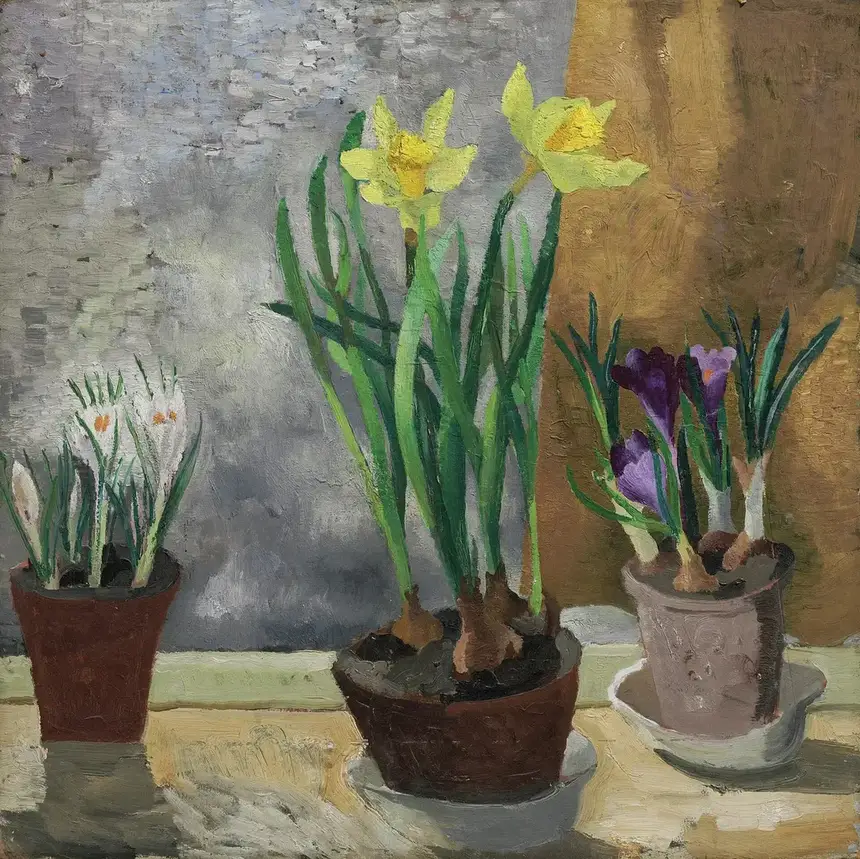
What you are buying into
Because Christopher Wood died in 1930, this work is in the public domain. We are painting a copy of a painting — we never pass it off as the original, and neither should anyone selling you one.
We paint it in oil on canvas, one at a time, in Dafen Village. Nothing is printed, scanned or transferred.
The painting was made in the years before 1930, and what we reproduce is the record of it, not the object.
What arrives is a canvas with paint on it, made by a person. That is the only thing we sell.
What to look at
There is a reason a wooded subject is the hardest thing to print and the easiest thing to paint: the paint itself carries the depth.
Where the original has an awkward crop, we keep it. Correcting it would be painting a different picture.
The brightest passage is kept small. That is what makes it read as bright.
The saturation is deliberately uneven: strongest at the focal point, weaker everywhere else.
The thick paint is kept for the light and the thin paint for the dark, which is the traditional way round.
Anyone can copy the shapes. The skill is in the transitions, and that is what takes the days.
It suits a room with warm, low light. Strong downlighting flattens the surface.
| Artist | Christopher Wood |
|---|---|
| Title | Crocuses and Daffodils in Pots |
| Created (original) | 1929 |
| Medium | Oil on canvas, hand-painted to order |
| How it is made | Painted by hand in oil on canvas, to your size |
| Original status | Public domain (artist deceased) |
What a print loses
The difference is not subtle when the two hang side by side. Ink sits on the surface; oil stands off it.
Our painter follows the same logic rather than copying a photograph of it: the far distances go down cool and weak, the near ground stays loaded, and nothing is blended flat.
| Aspect | Hand-painted oil | Printed canvas |
|---|---|---|
| What it takes | One painter, several days, start to finish | A machine, a few minutes |
| Available sizes | Whatever you need, painted to order | What the printer can output |
| Value over time | Can be re-stretched, cleaned and re-framed | Little value beyond the print |
| Edge quality | Soft where the form turns, sharp where it does not | Uniformly sharp or uniformly blurred |
| Sense of depth | Real, created by layers of paint | Simulated by darker ink |
The risk with a wooded subject is overworking, and the way to avoid it is knowing when to stop.
Every canvas is painted to order, so the quote follows your size, frame and destination rather than a fixed list. Tell us what you need on WhatsApp and we reply with an exact figure, usually within the hour. You are buying from the workshop, not a catalogue.
The sequence on our floor
This is how the painting is built, in the order our painters build it:
- We start with the canvas itself — stretched, sized and left to settle before any colour is mixed.
- The drawing goes down — charcoal or thin paint, done by eye rather than traced from a printout.
- Blocking the masses — thin paint, working the whole surface rather than one corner at a time.
- Setting the key — how dark the darks go determines everything that follows.
- Colour is built up — warmer and cooler versions of each passage, laid over the underpainting.
- Finishing passes — the loaded highlights go on at the end and stay there.
- Left to dry before varnish — nothing is photographed or packed until the surface is ready.
The difficult part is not the detail. It is keeping the whole canvas at the same stage of finish.
Whether to frame it
Most clients wait for the photographs before choosing a frame, which is the sensible order.
Frames are priced once you have chosen them, not estimated in advance.
Living with it
Once the varnish has cured the surface can be cleaned by a conservator, but in a normal house it will not need it for decades.
Materials
Each painter works on one canvas at a time — the painting you ordered is not shared with another order. We do not use a printer at any stage. There is no giclée, no canvas transfer, no digital underlayer.
The varnish is removable, so a conservator can clean the painting in fifty years without touching the paint. We use cotton duck for most sizes and linen where the canvas is large or the client asks for it.
Canvas sizes
Any size is possible. These are simply the ones that come up most often in quotes:
| Size (inches) | Size (cm) | Best for |
|---|---|---|
| 40 × 30 in | 102 × 76 cm | Living room focal wall, above a sofa |
| 32 × 24 in | 81 × 61 cm | Living room, above a sideboard |
| 30 × 24 in | 76 × 61 cm | Dining room, bedroom feature wall |
| 24 × 20 in | 60 × 50 cm | Study, home office, above a desk |
We will size the canvas to the room, not to a stock list. Send us the measurement. Our terms are DAP, meaning the freight is paid by us and any import charges are yours to settle. We will not estimate them, because the figure is your customs authority's to set.
This reads well above a sofa or a sideboard, where it will be seen from two to three metres.
Tell us the size and frame — exact quote back, usually within the hour.
💬 Get a Quote for Crocuses and Daffodils in PotsGetting it to you
From order to finished canvas is 9–15 days. Freight appears as a separate line on the quote and is fixed before you pay.
Air freight runs about 7–10 business days, tracked, to your door. Rolled in a tube it travels cheaper and safer than framed; most overseas clients take it that way.
Before anything is packed, you get photographs of the actual canvas and a chance to ask for changes. Changes are handled by telling us what to change; we change it and send new photographs.
Duties and import taxes are the buyer's account (DAP). Your customs authority sets them; we do not.
Work begins on a deposit and ships on the balance. Both figures are on the quote. If a crate arrives damaged, send us photographs within 48 hours and contact us directly — we will sort it out with you.
Before you order
Can I resell the reproduction?
Yes. Because the underlying work is in the public domain, the hand-painted canvas is yours to sell, gift or install commercially.
Can I change something in the composition?
Often yes — background, cropping, or adapting the proportions to your wall. Tell us what you have in mind and we will say honestly whether it will work.
Does changing the size change the composition?
No — we keep the original's proportions and scale from there, rather than cropping the image to fit a standard frame.
Do you ship to my country?
We ship to over 20 countries. Give us your city and the freight appears as its own line on the quote.
Is owning a reproduction legal?
Yes. The painting is out of copyright because Christopher Wood died more than 70 years ago. We paint copies honestly and never claim they are originals.
Does it come framed?
Frames are priced on their own line. Most clients choose after seeing the photographs.
What does it cost?
Every canvas is quoted on size, frame and destination rather than a fixed list. Tell us what you need and we reply with an exact figure.
Do you take a deposit?
Work begins on a deposit and ships once the balance is paid. Nothing is charged that is not on the quote.
What is the canvas made of?
Cotton duck as standard, linen on request, artist-grade oil paint, and a final varnish once the paint is fully dry.
Will I see it before it ships?
Yes — photographs of the actual painting go to you first, and nothing is packed until you have seen them.
Can you paint a different work by Christopher Wood?
Yes. Send the image and we will quote it, or browse the other paintings we have listed.
What if it arrives damaged?
Report damage within 48 hours with photographs. We deal with the carrier rather than leaving you to argue alone.