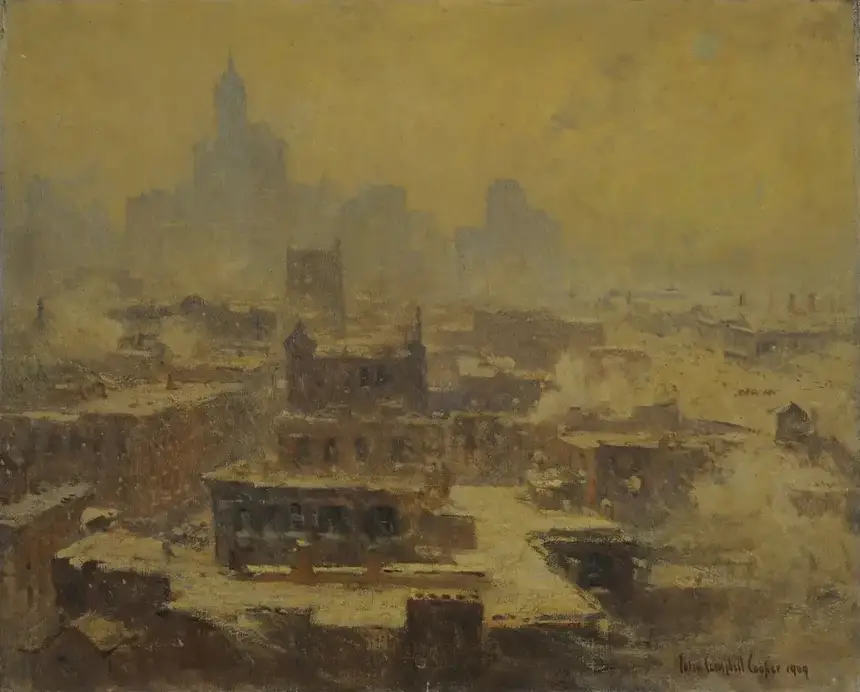
About Tormenta de nieve en Nueva York
Because Colin Campbell Cooper died in 1937, this work is in the public domain. We are painting a copy of a painting — we never pass it off as the original, and neither should anyone selling you one.
We paint it in oil on canvas, one at a time, in Dafen Village. Nothing is printed, scanned or transferred.
The painting was made in the years before 1937, and what we reproduce is the record of it, not the object.
You are buying a painting, not a file. That distinction is the whole business we are in.
What to look at
Ours is painted from the source image, stroke by stroke, so Tormenta de nieve en Nueva York keeps the order it was originally built in.
Nothing in Tormenta de nieve en Nueva York is centred for the sake of being centred; the weight sits where the painter wanted it.
The sky sets the light for everything below it, so it is painted first.
The darks are mixed, not blackened — black straight from the tube would kill the passage.
Nothing here is blended flat. Blending is what makes a painting look printed.
Matching the original's degree of finish is harder than matching its colours.
It wants a wall where the light rakes across it, because the surface is part of the picture.
| Artist | Colin Campbell Cooper |
|---|---|
| Title | Tormenta de nieve en Nueva York |
| Medium | Oil on canvas, hand-painted to order |
| How it is made | Painted by hand in oil on canvas, to your size |
| Copyright | Public domain; the original is out of copyright |
The case for painting it by hand
A print reproduces the shapes and drops the substance. It is the substance you are buying.
Edges are left soft where the form turns away and sharp where it does not. That single habit is what separates a painting from a copy.
| Aspect | Hand-painted oil | Printed canvas |
|---|---|---|
| Value over time | Can be re-stretched, cleaned and re-framed | Little value beyond the print |
| Changing something | Tell us and the passage gets repainted | Usually means starting the file again |
| Edge quality | Soft where the form turns, sharp where it does not | Uniformly sharp or uniformly blurred |
| Available sizes | Whatever you need, painted to order | What the printer can output |
| What it takes | One painter, several days, start to finish | A machine, a few minutes |
The difficulty is restraint: leaving out most of what a photograph would show.
Every canvas is painted to order, so the quote follows your size, frame and destination rather than a fixed list. Tell us what you need on WhatsApp and we reply with an exact figure, usually within the hour. No resellers, no drop-shipper. The painter's studio handles your commission from first message to final crate.
The sequence on our floor
No two canvases are painted the same way, but the sequence is always this:
- The canvas is stretched and primed — cotton or linen, sized and ready before any paint goes near it.
- A loose underdrawing — proportions checked by eye against the source image.
- The first colour pass — thin and simple, establishing the main shapes only.
- Setting the key — how dark the darks go determines everything that follows.
- Building the colour — a warm and a cool version of each passage, put down in order.
- Detail and highlights last — put on thickly and then not touched again.
- Left to dry before varnish — nothing is photographed or packed until the surface is ready.
The hardest passage is the quiet one, where a small mistake has nowhere to hide.
Whether to frame it
We can supply a simple floater frame, a traditional gilt, or nothing at all. It is your call.
Most clients wait for the photographs before choosing a frame, which is the sensible order.
Living with it
Dust it with a dry, soft brush. Keep it out of direct sun and away from radiators, and it will outlive you.
What goes into it
Large canvases get a cross-brace; anything over about a metre and a half needs one. The ground is a proper acrylic sizing, so the oil does not rot the fabric over time.
Nothing is sprayed, sealed or laminated. The surface you see is paint and varnish, and that is all. Oil paint dries by oxidation, not evaporation, which is why a finished canvas needs weeks before it travels.
Getting the size right
You are not choosing from a list; you are telling us a measurement. These are the common ones:
| Size (inches) | Size (cm) | Best for |
|---|---|---|
| 20 × 16 in | 50 × 40 cm | Bedroom, hallway, above a console |
| 16 × 12 in | 40 × 30 cm | A shelf, a small wall, a gallery group |
| 64 × 48 in | 163 × 122 cm | Villa scale, lobby, hospitality wall |
| 48 × 36 in | 122 × 91 cm | Large living room, stairwell, loft |
| 40 × 30 in | 102 × 76 cm | Living room focal wall, above a sofa |
| 32 × 24 in | 81 × 61 cm | Living room, above a sideboard |
If your wall is an odd shape, send the measurement and we will work to it. Proportions from the original are kept unless you ask us to change them. Our terms are DAP, meaning the freight is paid by us and any import charges are yours to settle. We will not estimate them, because the figure is your customs authority's to set.
A plain wall is better than a busy one; the painting supplies the interest.
Give us your size and framing preference and you will have a quote shortly.
💬 Get a Quote for Tormenta de nieve en Nueva YorkOrder, painting, shipping
From order to finished canvas is 9–15 days. Freight appears as a separate line on the quote and is fixed before you pay.
In transit it is typically 7–10 business days by air, tracked door to door. We send photographs of the finished painting before it is packed, and again once it is boxed.
You approve the painting from photographs before it is packed — that is the checkpoint. Adjustments are part of the process. Say what you want different and it gets done.
We sell DAP: the price covers the painting and the freight, and any import duties or taxes are the buyer's to settle with customs. We do not collect them and we do not estimate them.
You pay a deposit to start and the remainder before shipping. Nothing is hidden in between. Damage in transit should be reported to us within 48 hours, with photographs. We pursue it with the carrier rather than promising a refund.
Before you order
Can I resell the reproduction?
Yes. Because the underlying work is in the public domain, the hand-painted canvas is yours to sell, gift or install commercially.
Will it look exactly like the image?
Not exactly, and that is the point — it is a painting, not a scan. Composition, colour and drawing follow the original closely; the surface is where a painter's own decisions show.
Can I change something in the composition?
Often yes — background, cropping, or adapting the proportions to your wall. Tell us what you have in mind and we will say honestly whether it will work.
Can you paint it from a different photograph of the same work?
Send your own reference image and we will paint from that instead.
Can you paint a different work by Colin Campbell Cooper?
Yes — send us the image, or look through the other Colin Campbell Cooper works on the site.
Is owning a reproduction legal?
Yes. The painting is out of copyright because Colin Campbell Cooper died more than 70 years ago. We paint copies honestly and never claim they are originals.
Do you sell prints?
No prints at all — no giclée, no canvas transfer, nothing machine-made.
Who pays the import duty?
The buyer does. Terms are DAP: duties and taxes, where they apply, are paid on arrival. We never add a tax line of our own.
Will I see it before it ships?
Yes. We send photographs of the finished canvas and wait for your reply before packing.
Is it really painted by hand?
Yes — oil on canvas, brush and knife. There is no printing, no giclée and no canvas transfer at any stage.
What is the canvas made of?
Cotton duck as standard, linen on request, artist-grade oil paint, and a final varnish once the paint is fully dry.
Can you change the colours to suit my room?
Sometimes. We will adjust the palette if it can be done without ruining the picture, and say so if it cannot.