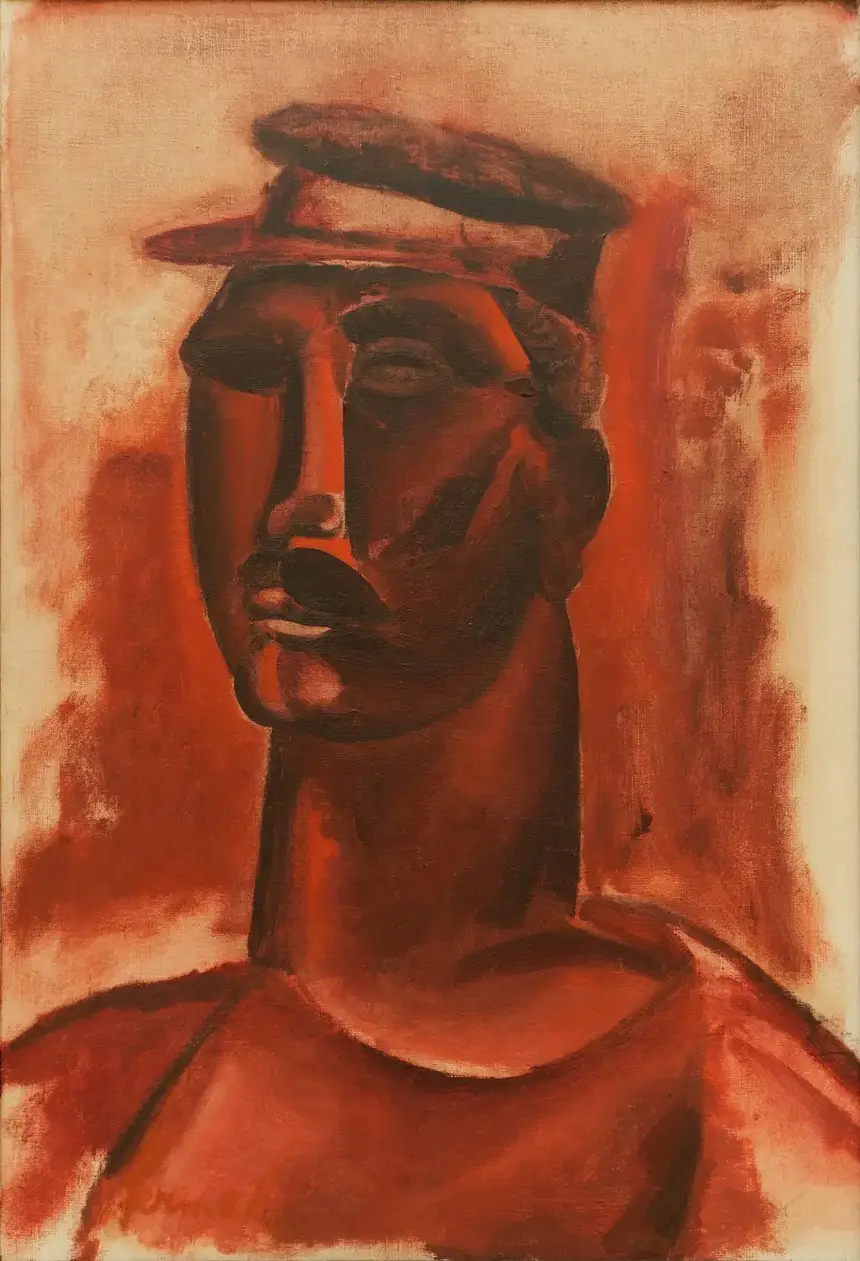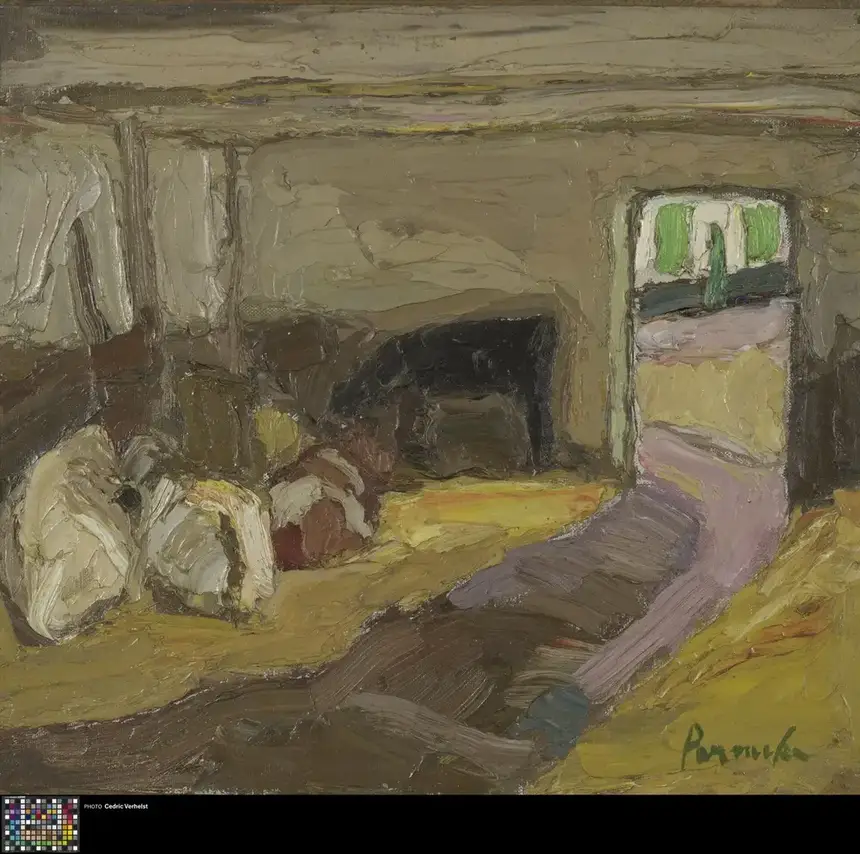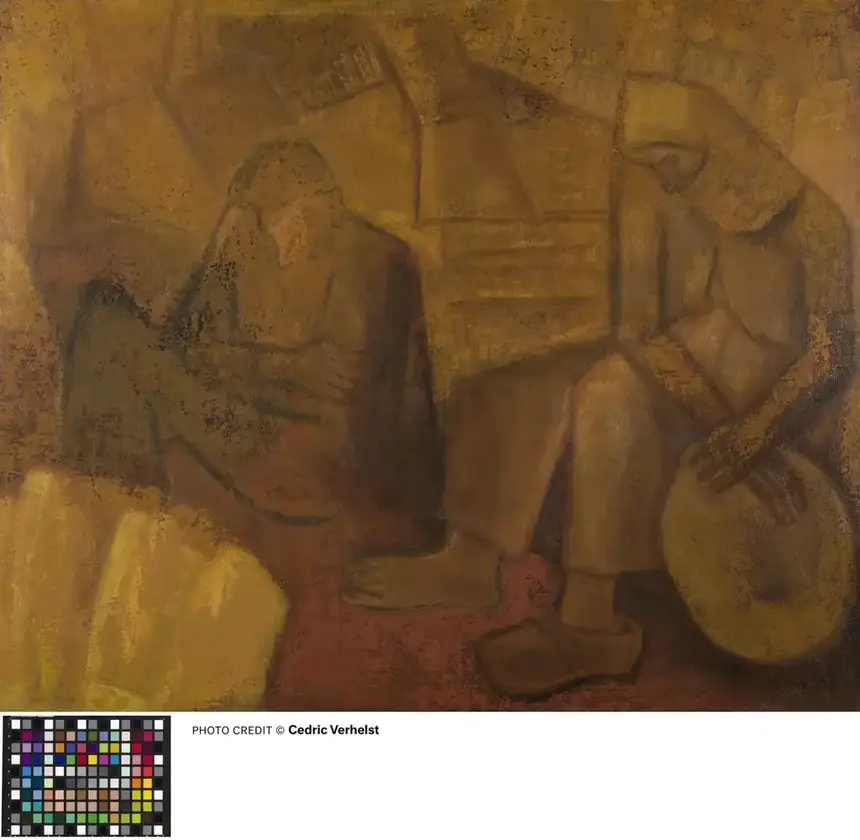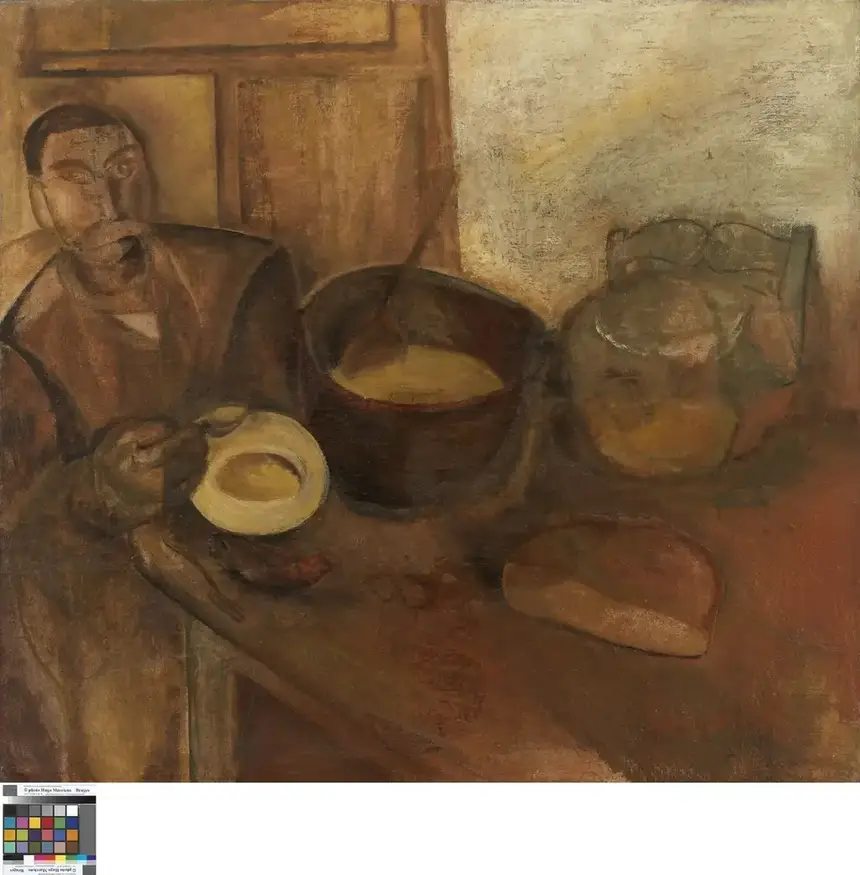
The original, and why we can paint it
Constant Permeke died in 1952, so the work has been in the public domain for decades. Reproducing it by hand is legal, and so is owning one.
We paint it in oil on canvas, one at a time, in Dafen Village. Nothing is printed, scanned or transferred.
It is an original composition painted before 1952, and our version is painted from the surviving image of it.
If you want something printed, we are the wrong workshop. We do not own a printer that touches canvas.
What the painting is doing
De papeters rewards a second look because the light is doing something specific, and it only does it in oil.
Where the original has an awkward crop, we keep it. Correcting it would be painting a different picture.
We do not brighten the picture for reproduction. The original's key is kept as it is.
The darks are mixed, not blackened — black straight from the tube would kill the passage.
The marks have a direction, and the direction follows the form.
Matching the original's degree of finish is harder than matching its colours.
In a bedroom it works above a headboard, sized to about two-thirds of the furniture width.
| Artist | Constant Permeke |
|---|---|
| Title | De papeters |
| Created (original) | 1922 |
| Medium | Oil on canvas, hand-painted to order |
| Reproduction | Hand-painted oil on canvas, made to order |
| Original status | Public domain (artist deceased) |
The case for painting it by hand
The difference is not subtle when the two hang side by side. Ink sits on the surface; oil stands off it.
Edges are left soft where the form turns away and sharp where it does not. That single habit is what separates a painting from a copy.
| Aspect | Hand-painted oil | Printed canvas |
|---|---|---|
| Corrections | We adjust it and repaint the passage | The file is reprinted or it is not |
| Edges | Chosen by the painter, passage by passage | Whatever the file happens to contain |
| Time to make | Days of one painter's working time | Minutes |
| Depth | Built in layers, catches light from the side | Flat; highlights are printed as pale ink |
| Value over time | Can be re-stretched, cleaned and re-framed | Little value beyond the print |
Getting De papeters right means painting it in the right order, and the order is not obvious.
Every canvas is painted to order, so the quote follows your size, frame and destination rather than a fixed list. Tell us what you need on WhatsApp and we reply with an exact figure, usually within the hour. You deal directly with the studio that paints it — no reseller layer.
From blank canvas to finished painting
Every canvas is painted to order, so nothing is pulled off a shelf. This is the sequence:
- Stretching and priming the support — cotton duck or linen goes onto the bars and gets its ground.
- Laying in the drawing — done by eye from the reference, not traced or projected.
- The first colour pass — thin and simple, establishing the main shapes only.
- The values are established — this is the stage that decides whether the painting works.
- The colour passes — each area gets its own mixture rather than one colour used throughout.
- Detail and highlights last — put on thickly and then not touched again.
- Drying and varnishing — the final varnish goes on once the paint has set, before we photograph it.
The risk with a landscape is overworking, and the way to avoid it is knowing when to stop.
Looking after it
Dust it with a dry, soft brush. Keep it out of direct sun and away from radiators, and it will outlive you.
What it is made of
Stretcher bars are kiln-dried and wedged, so the canvas can be re-tensioned years later. Oil paint dries by oxidation, not evaporation, which is why a finished canvas needs weeks before it travels.
The paint is built in layers, fat over lean, which is what stops it cracking later. Large canvases get a cross-brace; anything over about a metre and a half needs one.
Frames
Framing is quoted separately, so you can decide after you have seen the finished canvas in photographs.
Framing is quoted separately, so you can decide after you have seen the finished canvas in photographs.
Getting the size right
Because each piece is painted from scratch, you are not limited to stock dimensions. These are the sizes clients ask for most:
| Size (inches) | Size (cm) | Best for |
|---|---|---|
| 30 × 24 in | 76 × 61 cm | Dining room, bedroom feature wall |
| 24 × 20 in | 60 × 50 cm | Study, home office, above a desk |
| 20 × 16 in | 50 × 40 cm | Bedroom, hallway, above a console |
| 16 × 12 in | 40 × 30 cm | A shelf, a small wall, a gallery group |
Tell us the wall width and we will tell you what looks right rather than what is standard. Shipments go out DAP. If your customs office charges duty or tax on arrival, that is between you and them — we do not collect it and we do not put a number on it.
It wants a wall where the light rakes across it, because the surface is part of the picture.
Send the wall, the size and whether you want a frame, and we will quote.
💬 Get a Quote for De papetersGetting it to you
The painting takes 9–15 days, and delivery is priced separately on the quote so there is no surprise later.
Air freight runs about 7–10 business days, tracked, to your door. Unframed canvases are rolled face-out on a tube; framed ones are corner-protected and crated.
You approve the painting from photographs before it is packed — that is the checkpoint. Changes are handled by telling us what to change; we change it and send new photographs.
DAP terms: we pay the freight, you settle any duty or tax your country applies. We do not collect taxes on anyone's behalf.
You pay a deposit to start and the remainder before shipping. Nothing is hidden in between. Damage in transit should be reported to us within 48 hours, with photographs. We pursue it with the carrier rather than promising a refund.
Before you order
Is there a rush option?
It depends on the canvas and what else is in the studio. Ask on WhatsApp with your size and we will tell you straight what is possible.
Why not just print it?
A print flattens the surface into a poster: the distance collapses and the highlights turn to grey. Paint keeps the depth and the texture the original was built from.
Can I get this in a size that is not listed?
Yes — the listed sizes are the common requests, not a limit. Very wide or unusually tall proportions are routine for us.
How long does it take?
Painting takes 9–15 days. Air freight is usually 7–10 business days on top of that, tracked.
Can I change the size?
Yes. The canvas is painted to your measurement, not taken from a stock list.
What if it arrives damaged?
Report damage within 48 hours with photographs. We deal with the carrier rather than leaving you to argue alone.
Will I see it before it ships?
Yes. We send photographs of the finished canvas and wait for your reply before packing.
Is it really painted by hand?
Yes. One painter, oil paint, brushes. We do not own a printer that touches canvas.
How do I hang it?
Roughly 145 cm from floor to centre works for most rooms. Tell us your wall and we will give you the measurement.
Who pays the import duty?
You do. We sell DAP, so any duty or tax your customs authority charges is settled by you at import. We do not collect it and we do not estimate it.
Do you take a deposit?
Work begins on a deposit and ships once the balance is paid. Nothing is charged that is not on the quote.
What is the canvas made of?
Cotton or linen, oil colour, and varnish. Stretcher bars are wedged so the canvas can be re-tensioned later.