What you are buying into
Because David Roberts died in 1864, this work is in the public domain. We are painting a copy of a painting — we never pass it off as the original, and neither should anyone selling you one.
We paint it in oil on canvas, one at a time, in Dafen Village. Nothing is printed, scanned or transferred.
The painting was made in the years before 1864, and what we reproduce is the record of it, not the object.
What arrives is a canvas with paint on it, made by a person. That is the only thing we sell.
Looking at it properly
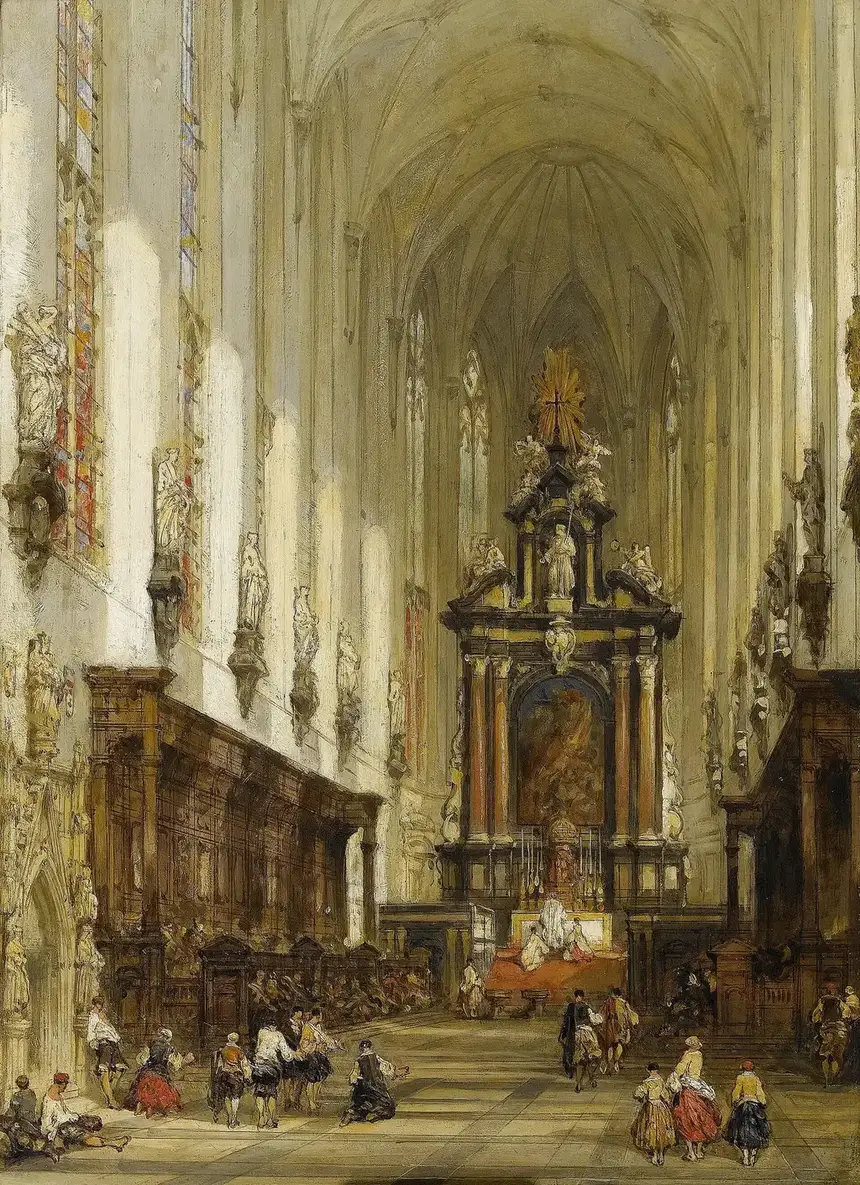
Church Interior is worth having made by hand because the interest sits in transitions, and transitions are exactly what printing flattens.
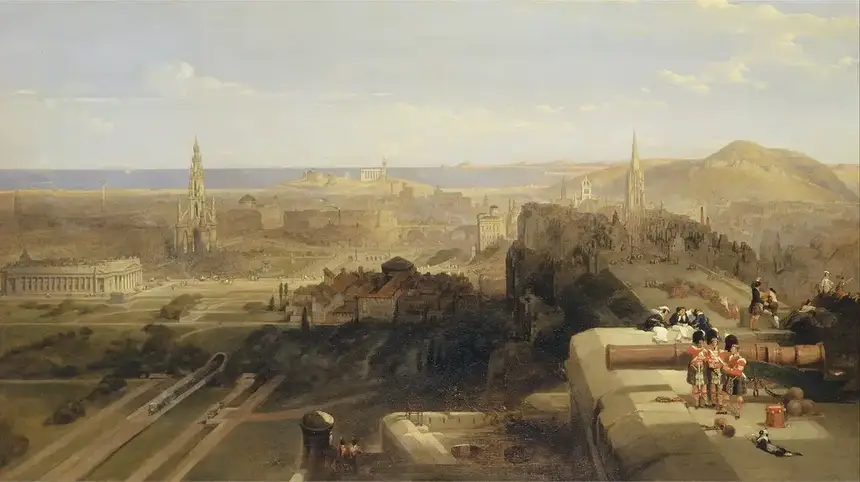
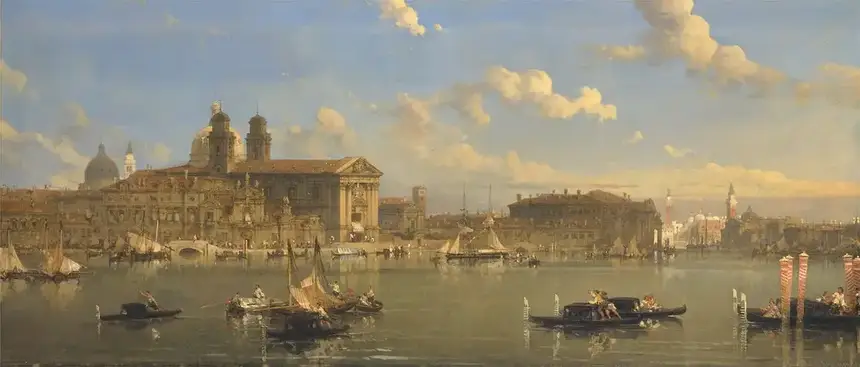
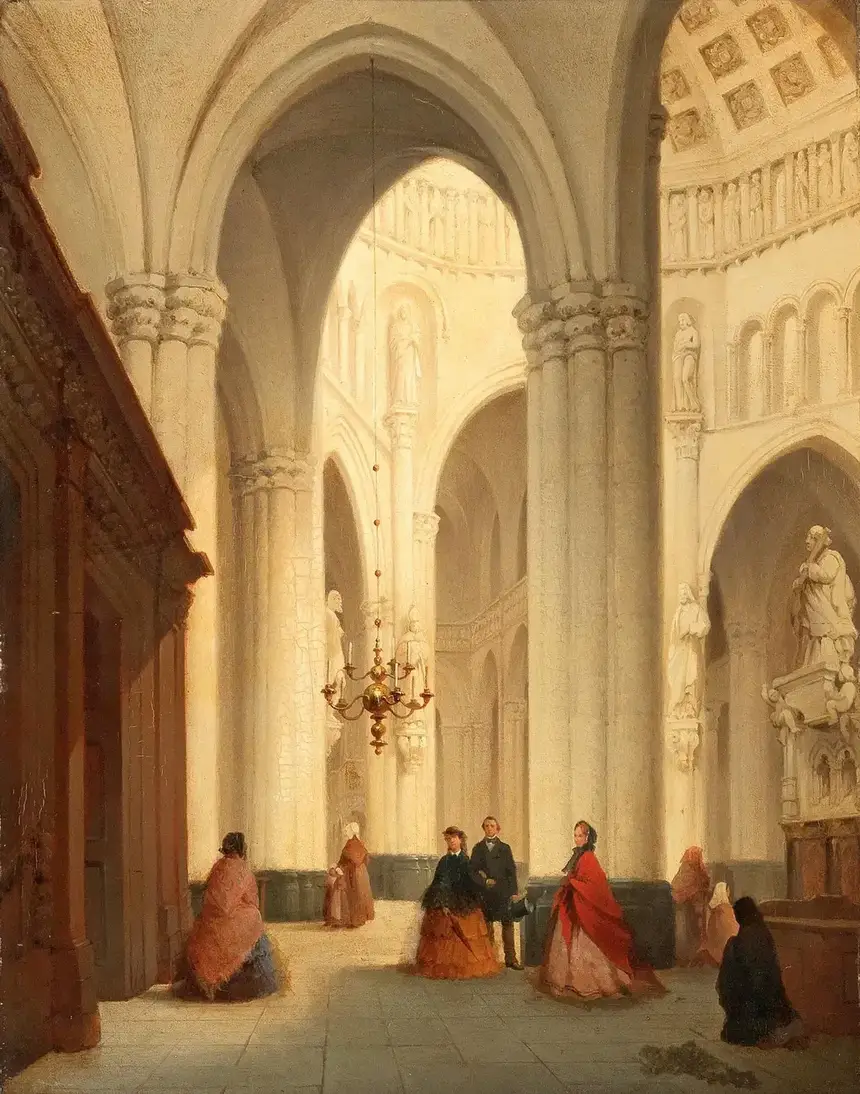
The composition is kept as the source has it, including the crop and the empty space around the subject.
The fall-off from light to shadow is gradual, and gradual transitions are what printing compresses first.
Saturated colour is kept for a small area; the rest is deliberately knocked back.
The thick paint is kept for the light and the thin paint for the dark, which is the traditional way round.
Matching the original's degree of finish is harder than matching its colours.
It wants a wall where the light rakes across it, because the surface is part of the picture.
| Artist | David Roberts |
|---|---|
| Title | Church Interior |
| Medium | Oil on canvas, hand-painted to order |
| What you receive | A hand-painted oil painting on canvas |
| Public domain | Yes — the artist died over 70 years ago |
The case for painting it by hand
The difference is not subtle when the two hang side by side. Ink sits on the surface; oil stands off it.
Where the original is loaded, ours is loaded. Where it is thin, ours is thin. Matching the weight of the paint matters more than matching the colour.
| Aspect | Hand-painted oil | Printed canvas |
|---|---|---|
| Corrections | We adjust it and repaint the passage | The file is reprinted or it is not |
| Texture | Ridges and drag you can see from across a room | None, or a printed imitation of it |
| Handling of colour | Mixed on the palette and finished on the canvas | Fixed by the colour profile |
| Value over time | Can be re-stretched, cleaned and re-framed | Little value beyond the print |
| Sense of depth | Real, created by layers of paint | Simulated by darker ink |
This one repaints badly, so our painter gets the values right early and leaves them.
Every canvas is painted to order, so the quote follows your size, frame and destination rather than a fixed list. Tell us what you need on WhatsApp and we reply with an exact figure, usually within the hour. There is no agency in between; the studio that paints your canvas is the one answering your messages.
How your painting is made
Here is what actually happens between your message and the crate:
- The canvas is stretched and primed — cotton or linen, sized and ready before any paint goes near it.
- The drawing goes down — charcoal or thin paint, done by eye rather than traced from a printout.
- Blocking the masses — thin paint, working the whole surface rather than one corner at a time.
- The values are established — this is the stage that decides whether the painting works.
- Building the colour — a warm and a cool version of each passage, put down in order.
- The detail and highlights go on — last, loaded, and left alone once they are down.
- Left to dry before varnish — nothing is photographed or packed until the surface is ready.
The risk with a city view is overworking, and the way to avoid it is knowing when to stop.
Frames
A frame is a separate line on the quote, not a bundle. You choose it once the painting exists.
A frame is a separate line on the quote, not a bundle. You choose it once the painting exists.
What it is made of
Stretcher bars are kiln-dried and wedged, so the canvas can be re-tensioned years later. Nothing is sprayed, sealed or laminated. The surface you see is paint and varnish, and that is all.
Varnish goes on only once the paint is properly dry, months after the last stroke, not before. Large canvases get a cross-brace; anything over about a metre and a half needs one.
Looking after it
Dust it with a dry, soft brush. Keep it out of direct sun and away from radiators, and it will outlive you.
Sizing it
Any size is possible. These are simply the ones that come up most often in quotes:
| Size (inches) | Size (cm) | Best for |
|---|---|---|
| 24 × 20 in | 60 × 50 cm | Study, home office, above a desk |
| 20 × 16 in | 50 × 40 cm | Bedroom, hallway, above a console |
| 16 × 12 in | 40 × 30 cm | A shelf, a small wall, a gallery group |
| 64 × 48 in | 163 × 122 cm | Villa scale, lobby, hospitality wall |
| 48 × 36 in | 122 × 91 cm | Large living room, stairwell, loft |
If your wall is an odd shape, send the measurement and we will work to it. Proportions from the original are kept unless you ask us to change them. Shipments go out DAP. If your customs office charges duty or tax on arrival, that is between you and them — we do not collect it and we do not put a number on it.
It suits a room with warm, low light. Strong downlighting flattens the surface.
Tell us where it will hang and how big it needs to be — we will price it properly.
💬 Get a Quote for Church InteriorTimeline and shipping
The painting takes 9–15 days, and delivery is priced separately on the quote so there is no surprise later.
Transit is usually 7–10 business days, tracked all the way. We send photographs of the finished painting before it is packed, and again once it is boxed.
You see photographs of the finished painting before it ships, and you tell us what to adjust. If something is not right, tell us what to adjust and we adjust it.
Duties and import taxes are the buyer's account (DAP). Your customs authority sets them; we do not.
You pay a deposit to start and the remainder before shipping. Nothing is hidden in between. If a crate arrives damaged, send us photographs within 48 hours and contact us directly — we will sort it out with you.
The practical questions
How do I clean and care for it?
Dust lightly with a dry, soft brush and keep it out of direct sun. Nothing else is needed for decades; oil paint is slow to change and easy to live with.
Do you frame it?
Framing is quoted separately, so you can decide once you have seen the finished canvas in photographs.
How do I hang it?
Centre it at about 145 cm from the floor, or two-thirds the width of the furniture below it. We will tell you the exact number for your wall.
Can I change the size?
Any size you like. We paint to the number you give us rather than to a standard range.
Do you take a deposit?
A deposit starts the canvas and the balance falls due before it ships. Both figures appear on the quote.
Is it really painted by hand?
Yes. One painter, oil paint, brushes. We do not own a printer that touches canvas.
Can you paint it from a different photograph of the same work?
Yes. If you have a better reference, send it on WhatsApp and we will work from yours.
What is the canvas made of?
Cotton duck as standard, linen on request, artist-grade oil paint, and a final varnish once the paint is fully dry.
Is owning a reproduction legal?
Yes. David Roberts died more than 70 years ago, so the work is in the public domain and owning a hand-painted version is legal anywhere. We never pass ours off as the original.
What does it cost?
There is no price list, because the number depends on your size and frame. Message us and we will quote exactly.
Do you sell prints?
No prints at all — no giclée, no canvas transfer, nothing machine-made.