Where this painting comes from
Edgar Degas died in 1917. That puts the painting well outside copyright, which is why we can paint it and you can own it anywhere in the world.
Ours is a painting made with brushes. There is no giclée, no canvas transfer and no digital underlayer anywhere in the process.
The painting was made in the years before 1917, and what we reproduce is the record of it, not the object.
You are buying a painting, not a file. That distinction is the whole business we are in.
How to read it
A painted a landscape is an argument about air. Copy the shapes and you still have not copied the argument.
Our painter works freehand on a blank canvas, so the scale of the original survives the enlargement.
The brightest passage is kept small. That is what makes it read as bright.
The darks are mixed, not blackened — black straight from the tube would kill the passage.
The last marks are the ones that are left alone. Overworking is the enemy.
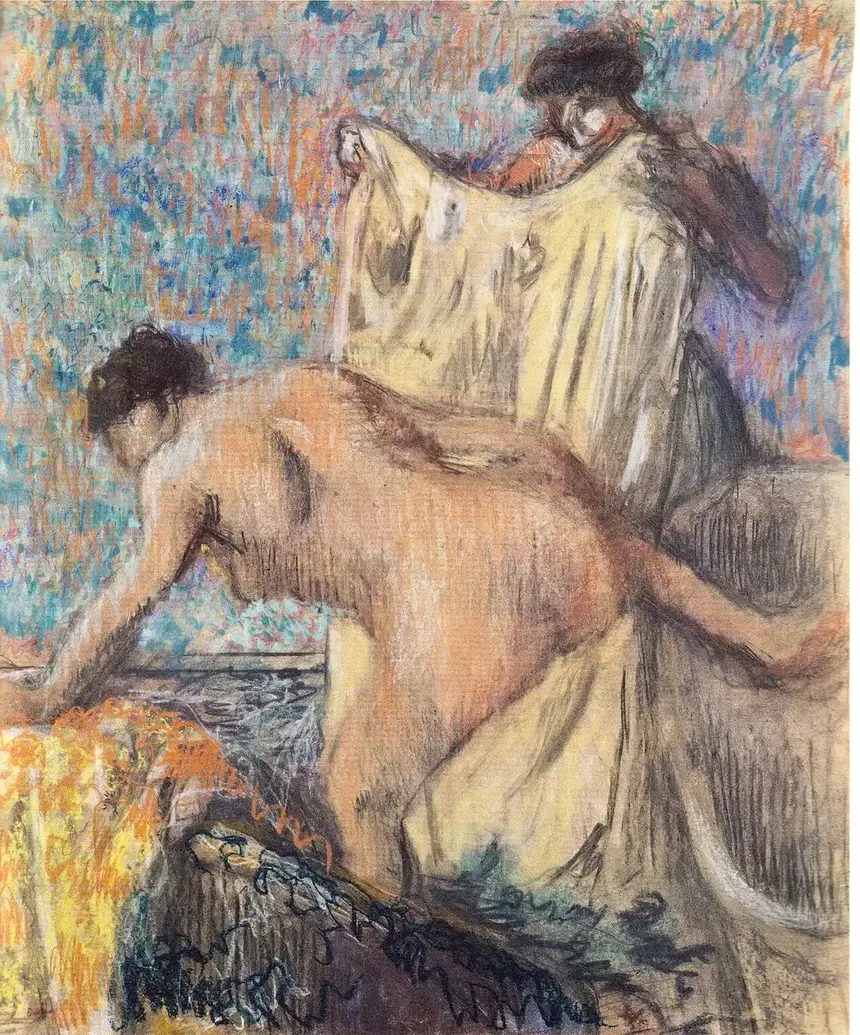
Getting Frau aus dem Bade steigend um right means painting it in the right order, and the order is not obvious.
It is a picture for a room you use, not a corridor you walk through.
| Artist | Edgar Degas |
|---|---|
| Title | Frau aus dem Bade steigend um |
| Medium | Oil on canvas, hand-painted to order |
| Reproduction | Hand-painted oil on canvas, made to order |
| Public domain | Yes — the artist died over 70 years ago |
Hand-painted, not printed
A print reproduces the shapes and drops the substance. It is the substance you are buying.
Our painter follows the same logic rather than copying a photograph of it: the far distances go down cool and weak, the near ground stays loaded, and nothing is blended flat.
| Aspect | Hand-painted oil | Printed canvas |
|---|---|---|
| Sense of depth | Real, created by layers of paint | Simulated by darker ink |
| Handling of colour | Mixed on the palette and finished on the canvas | Fixed by the colour profile |
| Edges | Chosen by the painter, passage by passage | Whatever the file happens to contain |
| How it ages | Warms and settles; cleanable by a conservator | Fades, then cracks at the stretcher |
| Value over time | Can be re-stretched, cleaned and re-framed | Little value beyond the print |
The hardest passage is the quiet one, where a small mistake has nowhere to hide.
Every canvas is painted to order, so the quote follows your size, frame and destination rather than a fixed list. Tell us what you need on WhatsApp and we reply with an exact figure, usually within the hour. You are buying from the workshop, not a catalogue.
From blank canvas to finished painting
Here is what actually happens between your message and the crate:
- We start with the canvas itself — stretched, sized and left to settle before any colour is mixed.
- A loose underdrawing — proportions checked by eye against the source image.
- Blocking the masses — thin paint, working the whole surface rather than one corner at a time.
- The values are established — this is the stage that decides whether the painting works.
- Building the colour — a warm and a cool version of each passage, put down in order.
- Finishing passes — the loaded highlights go on at the end and stay there.
- Drying and varnishing — the final varnish goes on once the paint has set, before we photograph it.
The difficulty is restraint: leaving out most of what a photograph would show.
Framing
Framing is quoted separately, so you can decide after you have seen the finished canvas in photographs.
Most clients wait for the photographs before choosing a frame, which is the sensible order.
Living with it
Do not wipe it with anything wet. Dust lightly, hang it somewhere stable, and forget about it.
What goes into it
We do not use a printer at any stage. There is no giclée, no canvas transfer, no digital underlayer. The varnish is removable, so a conservator can clean the painting in fifty years without touching the paint.
The paint is built in layers, fat over lean, which is what stops it cracking later. The ground is a proper acrylic sizing, so the oil does not rot the fabric over time.
What size works
You are not choosing from a list; you are telling us a measurement. These are the common ones:
| Size (inches) | Size (cm) | Best for |
|---|---|---|
| 64 × 48 in | 163 × 122 cm | Villa scale, lobby, hospitality wall |
| 48 × 36 in | 122 × 91 cm | Large living room, stairwell, loft |
| 40 × 30 in | 102 × 76 cm | Living room focal wall, above a sofa |
| 32 × 24 in | 81 × 61 cm | Living room, above a sideboard |
| 30 × 24 in | 76 × 61 cm | Dining room, bedroom feature wall |
If your wall is an odd shape, send the measurement and we will work to it. Proportions from the original are kept unless you ask us to change them. We sell DAP: the price covers the painting and the freight, and any import duties or taxes are the buyer's to settle with customs. We do not collect them and we do not estimate them.
This reads well above a sofa or a sideboard, where it will be seen from two to three metres.
Tell us the size and frame — exact quote back, usually within the hour.
💬 Get a Quote for Frau aus dem Bade steigend umOrder, painting, shipping
Allow 9–15 days for the painting itself. Shipping is a separate line on your quote — you see it before payment, not after.
Expect 7–10 business days in transit, with tracking from our door to yours. Unframed canvases are rolled face-out on a tube; framed ones are corner-protected and crated.
You approve the painting from photographs before it is packed — that is the checkpoint. Changes are handled by telling us what to change; we change it and send new photographs.
Shipments go out DAP. If your customs office charges duty or tax on arrival, that is between you and them — we do not collect it and we do not put a number on it.
A deposit starts the canvas and books the painter's time; the balance is due before the crate leaves. Damage in transit should be reported to us within 48 hours, with photographs. We pursue it with the carrier rather than promising a refund.
Questions worth asking
Can I see progress photos while it is being painted?
We send photographs of the finished painting for approval before it ships. Mid-process images are not part of the standard workflow.
Can I get this in a size that is not listed?
Yes — the listed sizes are the common requests, not a limit. Very wide or unusually tall proportions are routine for us.
Why not just print it?
A print flattens the surface into a poster: the distance collapses and the highlights turn to grey. Paint keeps the depth and the texture the original was built from.
Who pays the import duty?
The buyer does. Terms are DAP: duties and taxes, where they apply, are paid on arrival. We never add a tax line of our own.
Do you take a deposit?
A deposit starts the canvas and the balance falls due before it ships. Both figures appear on the quote.
What if it arrives damaged?
send us photographs within 48 hours and contact us directly — we will sort it out with you.
What does it cost?
Every canvas is quoted on size, frame and destination rather than a fixed list. Tell us what you need and we reply with an exact figure.
Is owning a reproduction legal?
Yes. The painting is out of copyright because Edgar Degas died more than 70 years ago. We paint copies honestly and never claim they are originals.
Will I see it before it ships?
Yes. We send photographs of the finished canvas and wait for your reply before packing.
Can I change the size?
Yes. The canvas is painted to your measurement, not taken from a stock list.
How long does it take?
From order to finished canvas is 9–15 days; delivery adds about 7–10 business days by air.
Do you ship to my country?
We ship to over 20 countries. Give us your city and the freight appears as its own line on the quote.