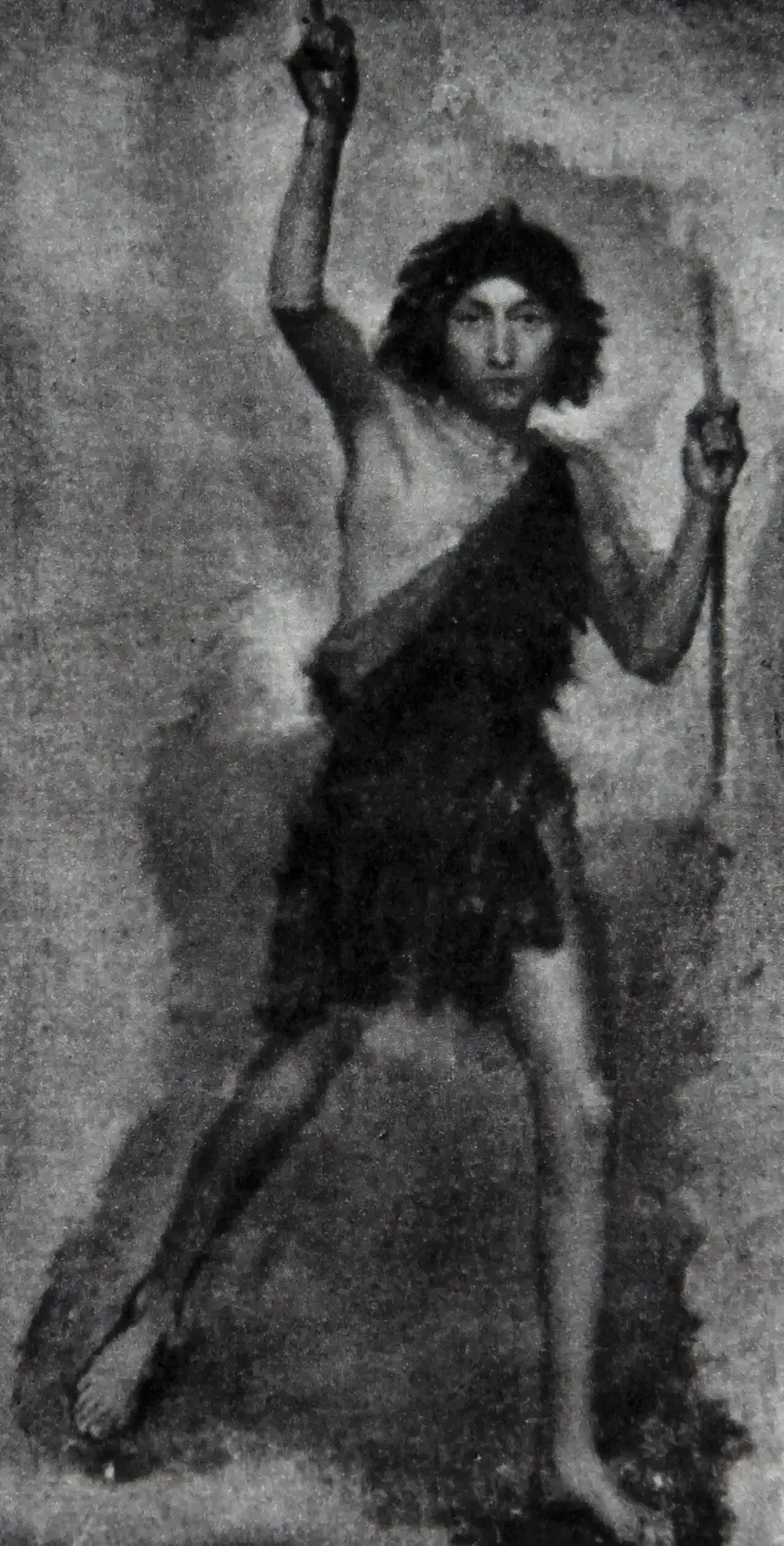
About Saint Jean-Baptiste, Circa
Because Edgar Degas died in 1917, this work is in the public domain. We are painting a copy of a painting — we never pass it off as the original, and neither should anyone selling you one.
Ours is a painting made with brushes. There is no giclée, no canvas transfer and no digital underlayer anywhere in the process.
It is an original composition painted before 1917, and our version is painted from the surviving image of it.
You are buying a painting, not a file. That distinction is the whole business we are in.
What to look at
Saint Jean-Baptiste, Circa was made to be looked at for a long time, and the paint is built to survive that.
Light is used as a device here, and we paint it as light rather than as pale paint.
Candle or window light, where present, is local and does not light the whole scene.
Whites here are never white. They are warm or cool depending on the light, and that is what makes them read.
The thick paint is kept for the light and the thin paint for the dark, which is the traditional way round.
What takes time here is the number of separate decisions, not the size of the canvas.
Hang it at eye level — roughly 145 cm from the floor to the centre — and it will hold the wall.
| Artist | Edgar Degas |
|---|---|
| Title | Saint Jean-Baptiste, Circa |
| Medium | Oil on canvas, hand-painted to order |
| How it is made | Painted by hand in oil on canvas, to your size |
| Original status | Public domain (artist deceased) |
What a print loses
A print reproduces the shapes and drops the substance. It is the substance you are buying.
Edges are left soft where the form turns away and sharp where it does not. That single habit is what separates a painting from a copy.
| Aspect | Hand-painted oil | Printed canvas |
|---|---|---|
| Available sizes | Whatever you need, painted to order | What the printer can output |
| Texture | Ridges and drag you can see from across a room | None, or a printed imitation of it |
| Later on | Can be restored, re-framed, handed on | Replaceable, and usually replaced |
| Changing something | Tell us and the passage gets repainted | Usually means starting the file again |
| Colour | Mixed for each passage, warm and cool versions | One flat value per area |
The difficulty is restraint: leaving out most of what a photograph would show.
Every canvas is painted to order, so the quote follows your size, frame and destination rather than a fixed list. Tell us what you need on WhatsApp and we reply with an exact figure, usually within the hour. You deal directly with the studio that paints it — no reseller layer.
How it gets painted
This is how the painting is built, in the order our painters build it:
- We start with the canvas itself — stretched, sized and left to settle before any colour is mixed.
- The drawing goes down — charcoal or thin paint, done by eye rather than traced from a printout.
- The big shapes are blocked in — thin paint, one colour at a time, the whole canvas at once.
- Getting the values right — the stage that decides whether the finished painting holds together.
- The colour passes — each area gets its own mixture rather than one colour used throughout.
- Detail and highlights last — put on thickly and then not touched again.
- Drying and varnishing — the final varnish goes on once the paint has set, before we photograph it.
The passage that will take longest is the one that looks simplest.
On framing
If you are shipping, an unframed canvas rolled in a tube is considerably cheaper to move than a framed one.
We can supply a simple floater frame, a traditional gilt, or nothing at all. It is your call.
Living with it
Oil paint needs very little: no water, no cleaners, no sprays. A dry brush and a stable room.
What goes into it
Each painter works on one canvas at a time — the painting you ordered is not shared with another order. Brushes, knives and rags. That is the equipment list; there is no machine in the process.
Varnish goes on only once the paint is properly dry, months after the last stroke, not before. Nothing is sprayed, sealed or laminated. The surface you see is paint and varnish, and that is all.
What size works
The canvas is cut to your wall, not the other way round. For reference, these are the dimensions most often requested:
| Size (inches) | Size (cm) | Best for |
|---|---|---|
| 20 × 16 in | 50 × 40 cm | Bedroom, hallway, above a console |
| 16 × 12 in | 40 × 30 cm | A shelf, a small wall, a gallery group |
| 64 × 48 in | 163 × 122 cm | Villa scale, lobby, hospitality wall |
| 48 × 36 in | 122 × 91 cm | Large living room, stairwell, loft |
If your wall is an odd shape, send the measurement and we will work to it. Proportions from the original are kept unless you ask us to change them. Shipments go out DAP. If your customs office charges duty or tax on arrival, that is between you and them — we do not collect it and we do not put a number on it.
In a bedroom it works above a headboard, sized to about two-thirds of the furniture width.
Send the wall, the size and whether you want a frame, and we will quote.
💬 Get a Quote for Saint Jean-Baptiste, CircaOrder, painting, shipping
Painting takes 9–15 days. Freight is quoted as its own line on the quote, agreed before you pay anything, and never added afterwards.
In transit it is typically 7–10 business days by air, tracked door to door. Every shipment goes out with tracking. We do not send anything untracked.
Before anything is packed, you get photographs of the actual canvas and a chance to ask for changes. Changes are handled by telling us what to change; we change it and send new photographs.
We sell DAP: the price covers the painting and the freight, and any import duties or taxes are the buyer's to settle with customs. We do not collect them and we do not estimate them.
You pay a deposit to start and the remainder before shipping. Nothing is hidden in between. Report any transit damage within 48 hours with photographs and we will deal with the carrier. We will not promise a payout, but we will not leave you to argue alone either.
Questions worth asking
Will it look exactly like the image?
Not exactly, and that is the point — it is a painting, not a scan. Composition, colour and drawing follow the original closely; the surface is where a painter's own decisions show.
Can I change something in the composition?
Often yes — background, cropping, or adapting the proportions to your wall. Tell us what you have in mind and we will say honestly whether it will work.
Does changing the size change the composition?
No — we keep the original's proportions and scale from there, rather than cropping the image to fit a standard frame.
Do you take a deposit?
Work begins on a deposit and ships once the balance is paid. Nothing is charged that is not on the quote.
Is it really painted by hand?
Yes. One painter, oil paint, brushes. We do not own a printer that touches canvas.
Who pays the import duty?
You do. We sell DAP, so any duty or tax your customs authority charges is settled by you at import. We do not collect it and we do not estimate it.
What if it arrives damaged?
Report damage within 48 hours with photographs. We deal with the carrier rather than leaving you to argue alone.
How do I hang it?
Centre it at about 145 cm from the floor, or two-thirds the width of the furniture below it. We will tell you the exact number for your wall.
Does it come framed?
Frames are priced on their own line. Most clients choose after seeing the photographs.
Can you paint it from a different photograph of the same work?
Yes. If you have a better reference, send it on WhatsApp and we will work from yours.
Can you change the colours to suit my room?
Sometimes. We will adjust the palette if it can be done without ruining the picture, and say so if it cannot.
What is the canvas made of?
Cotton or linen, oil colour, and varnish. Stretcher bars are wedged so the canvas can be re-tensioned later.