About the original
Edmund Tarbell died in 1938, so the work has been in the public domain for decades. Reproducing it by hand is legal, and so is owning one.
Every version we make is oil on canvas, painted by one painter from start to finish. No printing is involved at any stage.
It is an original composition painted before 1938, and our version is painted from the surviving image of it.
If you want something printed, we are the wrong workshop. We do not own a printer that touches canvas.
Where the painting lives
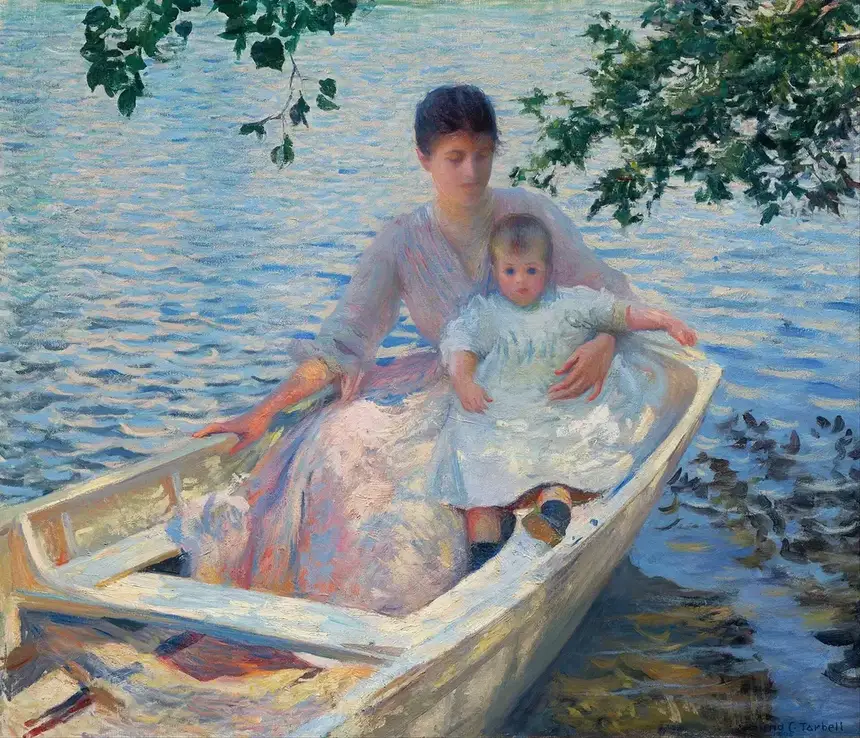
Reproducing a painting like Mother and Child in a Boat means reproducing decisions rather than shapes, and decisions are the part a press cannot carry.
Scale comes from the size of the marks, not from the size of the canvas — which is why enlarging it works.
Where the source relies on reflected light, we put it in. Removing it makes the form look like cardboard.
The saturation is deliberately uneven: strongest at the focal point, weaker everywhere else.
The last marks are the ones that are left alone. Overworking is the enemy.
The hardest passage is the quiet one, where a small mistake has nowhere to hide.
Given the subject, this sits naturally in a living room or a study rather than a hallway.
| Artist | Edmund Tarbell |
|---|---|
| Title | Mother and Child in a Boat |
| Created (original) | 1892 |
| Medium | Oil on canvas, hand-painted to order |
| Reproduction | Hand-painted oil on canvas, made to order |
| Public domain | Yes — the artist died over 70 years ago |
What a print loses
A print reproduces the shapes and drops the substance. It is the substance you are buying.
Edges are left soft where the form turns away and sharp where it does not. That single habit is what separates a painting from a copy.
| Aspect | Hand-painted oil | Printed canvas |
|---|---|---|
| How it ages | Warms and settles; cleanable by a conservator | Fades, then cracks at the stretcher |
| Later on | Can be restored, re-framed, handed on | Replaceable, and usually replaced |
| Handling of colour | Mixed on the palette and finished on the canvas | Fixed by the colour profile |
| Time to make | Days of one painter's working time | Minutes |
| Texture | Ridges and drag you can see from across a room | None, or a printed imitation of it |
Matching the original's degree of finish is harder than matching its colours.
Every canvas is painted to order, so the quote follows your size, frame and destination rather than a fixed list. Tell us what you need on WhatsApp and we reply with an exact figure, usually within the hour. You are buying from the workshop, not a catalogue.
How it gets painted
Every canvas is painted to order, so nothing is pulled off a shelf. This is the sequence:
- We start with the canvas itself — stretched, sized and left to settle before any colour is mixed.
- A loose underdrawing — proportions checked by eye against the source image.
- The first colour pass — thin and simple, establishing the main shapes only.
- The values are established — this is the stage that decides whether the painting works.
- Colour is built up — warmer and cooler versions of each passage, laid over the underpainting.
- Detail and highlights last — put on thickly and then not touched again.
- Left to dry before varnish — nothing is photographed or packed until the surface is ready.
What takes time here is the number of separate decisions, not the size of the canvas.
What it is made of
Large canvases get a cross-brace; anything over about a metre and a half needs one. Each painter works on one canvas at a time — the painting you ordered is not shared with another order.
We use cotton duck for most sizes and linen where the canvas is large or the client asks for it. Linen is worth the extra cost above about a metre across, because it holds tension better in humid rooms.
Keeping it
Once the varnish has cured the surface can be cleaned by a conservator, but in a normal house it will not need it for decades.
Framing
A frame is a separate line on the quote, not a bundle. You choose it once the painting exists.
If you are shipping, an unframed canvas rolled in a tube is considerably cheaper to move than a framed one.
What size works
You are not choosing from a list; you are telling us a measurement. These are the common ones:
| Size (inches) | Size (cm) | Best for |
|---|---|---|
| 64 × 48 in | 163 × 122 cm | Villa scale, lobby, hospitality wall |
| 48 × 36 in | 122 × 91 cm | Large living room, stairwell, loft |
| 40 × 30 in | 102 × 76 cm | Living room focal wall, above a sofa |
| 32 × 24 in | 81 × 61 cm | Living room, above a sideboard |
| 30 × 24 in | 76 × 61 cm | Dining room, bedroom feature wall |
If your wall is an odd shape, send the measurement and we will work to it. Proportions from the original are kept unless you ask us to change them. Shipments go out DAP. If your customs office charges duty or tax on arrival, that is between you and them — we do not collect it and we do not put a number on it.
Hang it at eye level — roughly 145 cm from the floor to the centre — and it will hold the wall.
Tell us the size and frame — exact quote back, usually within the hour.
💬 Get a Quote for Mother and Child in a BoatTimeline and shipping
Allow 9–15 days for the painting itself. Shipping is a separate line on your quote — you see it before payment, not after.
In transit it is typically 7–10 business days by air, tracked door to door. Every shipment goes out with tracking. We do not send anything untracked.
You approve the painting from photographs before it is packed — that is the checkpoint. Adjustments are part of the process. Say what you want different and it gets done.
Import charges, where they exist, are the buyer's responsibility (DAP). We never add them to the quote and never guess what they will be.
A deposit starts the canvas and books the painter's time; the balance is due before the crate leaves. Damage in transit should be reported to us within 48 hours, with photographs. We pursue it with the carrier rather than promising a refund.
Questions worth asking
Why not just print it?
A print flattens the surface into a poster: the distance collapses and the highlights turn to grey. Paint keeps the depth and the texture the original was built from.
Can I see progress photos while it is being painted?
We send photographs of the finished painting for approval before it ships. Mid-process images are not part of the standard workflow.
Can I get this in a size that is not listed?
Yes — the listed sizes are the common requests, not a limit. Very wide or unusually tall proportions are routine for us.
Can you paint a different work by Edmund Tarbell?
Yes. Send the image and we will quote it, or browse the other paintings we have listed.
What if it arrives damaged?
Report damage within 48 hours with photographs. We deal with the carrier rather than leaving you to argue alone.
What does it cost?
Every canvas is quoted on size, frame and destination rather than a fixed list. Tell us what you need and we reply with an exact figure.
Can you change the colours to suit my room?
Sometimes. We will adjust the palette if it can be done without ruining the picture, and say so if it cannot.
Who pays the import duty?
You do. We sell DAP, so any duty or tax your customs authority charges is settled by you at import. We do not collect it and we do not estimate it.
Will I see it before it ships?
Yes. We send photographs of the finished canvas and wait for your reply before packing.
Can you paint it from a different photograph of the same work?
Send your own reference image and we will paint from that instead.
Is owning a reproduction legal?
Yes. Edmund Tarbell died more than 70 years ago, so the work is in the public domain and owning a hand-painted version is legal anywhere. We never pass ours off as the original.
Does it come framed?
Framing is quoted separately, so you can decide once you have seen the finished painting in photographs.