The original, and why we can paint it
Because Édouard Manet died in 1883, this work is in the public domain. We are painting a copy of a painting — we never pass it off as the original, and neither should anyone selling you one.
Ours is a painting made with brushes. There is no giclée, no canvas transfer and no digital underlayer anywhere in the process.
It is an original composition painted before 1883, and our version is painted from the surviving image of it.
If you want something printed, we are the wrong workshop. We do not own a printer that touches canvas.
What to look at
Most reproductions of a landscape flatten it into a view. This one keeps the weather in it.
Where the original has an awkward crop, we keep it. Correcting it would be painting a different picture.
Our painter keeps the shadows transparent, because a shadow in a landscape is lit by the sky, not by nothing.
We keep the original's palette rather than brightening it, even where a modern eye would.
Our painter loads the brush differently for the near and far passages, and you can read the difference.
The hardest passage is the quiet one, where a small mistake has nowhere to hide.
It wants a wall where the light rakes across it, because the surface is part of the picture.
| Artist | Édouard Manet |
|---|---|
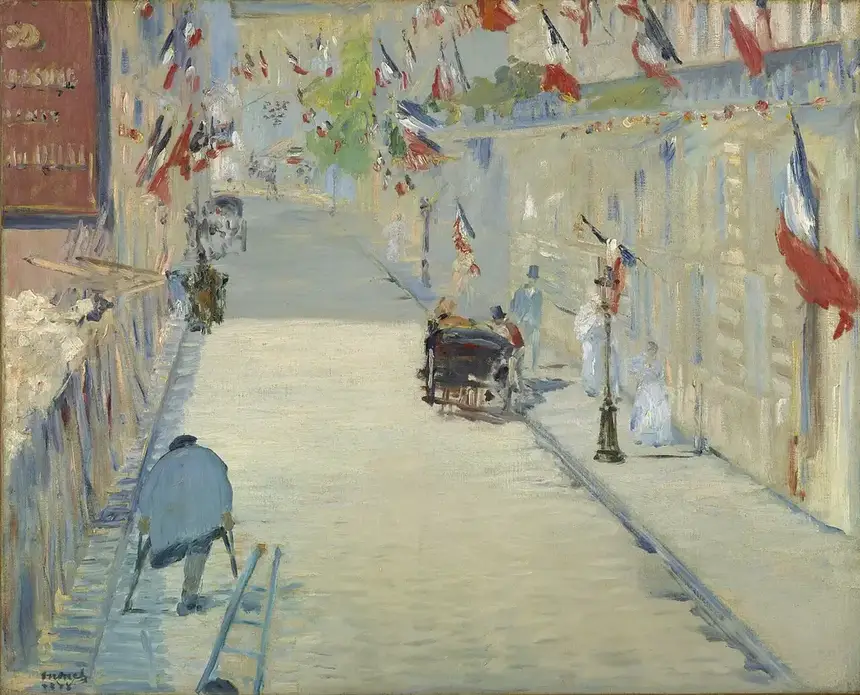
| Title | Édouard Manet, The Rue Mosnier with Flags |
| Created (original) | 1878 |
| Medium | Oil on canvas, hand-painted to order |
| What you receive | A hand-painted oil painting on canvas |
| Original status | Public domain (artist deceased) |
Why this one cannot be printed
A print reproduces the shapes and drops the substance. It is the substance you are buying.
Paint goes on in the original's order — thin first, thick last — so the surface behaves the way the painter intended.
| Aspect | Hand-painted oil | Printed canvas |
|---|---|---|
| The surface | Built up with brushes and knives | Printed flat in one pass |
| Changing something | Tell us and the passage gets repainted | Usually means starting the file again |
| Time to make | Days of one painter's working time | Minutes |
| Sense of depth | Real, created by layers of paint | Simulated by darker ink |
| Lifespan | Slow to change; varnish can be refreshed decades later | Fades and cracks sooner |
The difficulty is restraint: leaving out most of what a photograph would show.
Every canvas is painted to order, so the quote follows your size, frame and destination rather than a fixed list. Tell us what you need on WhatsApp and we reply with an exact figure, usually within the hour. You deal directly with the studio that paints it — no reseller layer.
How your painting is made
This is how the painting is built, in the order our painters build it:
- We start with the canvas itself — stretched, sized and left to settle before any colour is mixed.
- A loose underdrawing — proportions checked by eye against the source image.
- The first colour pass — thin and simple, establishing the main shapes only.
- Getting the values right — the stage that decides whether the finished painting holds together.
- Colour is built up — warmer and cooler versions of each passage, laid over the underpainting.
- Finishing passes — the loaded highlights go on at the end and stay there.
- It dries, then gets varnished — and only then is it photographed for you.
What takes time here is the number of separate decisions, not the size of the canvas.
Whether to frame it
If you are shipping, an unframed canvas rolled in a tube is considerably cheaper to move than a framed one.
Most clients wait for the photographs before choosing a frame, which is the sensible order.
Living with it
Do not wipe it with anything wet. Dust lightly, hang it somewhere stable, and forget about it.
Materials
The ground is a proper acrylic sizing, so the oil does not rot the fabric over time. We use a neutral-sized ground so the whites stay warm rather than going blue over time.
Varnish goes on only once the paint is properly dry, months after the last stroke, not before. The varnish is removable, so a conservator can clean the painting in fifty years without touching the paint.
Getting the size right
You are not choosing from a list; you are telling us a measurement. These are the common ones:
| Size (inches) | Size (cm) | Best for |
|---|---|---|
| 24 × 20 in | 60 × 50 cm | Study, home office, above a desk |
| 20 × 16 in | 50 × 40 cm | Bedroom, hallway, above a console |
| 16 × 12 in | 40 × 30 cm | A shelf, a small wall, a gallery group |
| 64 × 48 in | 163 × 122 cm | Villa scale, lobby, hospitality wall |
If your wall is an odd shape, send the measurement and we will work to it. Proportions from the original are kept unless you ask us to change them. Import charges, where they exist, are the buyer's responsibility (DAP). We never add them to the quote and never guess what they will be.
A plain wall is better than a busy one; the painting supplies the interest.
Send the wall, the size and whether you want a frame, and we will quote.
💬 Get a Quote for Édouard Manet, The Rue Mosnier with FlagsTimeline and shipping
The painting takes 9–15 days, and delivery is priced separately on the quote so there is no surprise later.
Transit is usually 7–10 business days, tracked all the way. We send photographs of the finished painting before it is packed, and again once it is boxed.
You approve the painting from photographs before it is packed — that is the checkpoint. Adjustments are part of the process. Say what you want different and it gets done.
Terms are DAP. Import duties and taxes, where they apply, are paid by the buyer on arrival — we never collect them in advance and never guess at the amount.
Work begins on a deposit and ships on the balance. Both figures are on the quote. If a crate arrives damaged, send us photographs within 48 hours and contact us directly — we will sort it out with you.
Before you order
What size should I order?
You choose the size. Each canvas is cut to your measurements rather than pulled from stock, so tell us the wall dimensions and we will tell you what proportion works.
Is it legal to own a reproduction?
Yes. The painting is in the public domain, so reproducing it is legal and owning one is legal anywhere in the world. We never pass ours off as the original.
Is there a rush option?
It depends on the canvas and what else is in the studio. Ask on WhatsApp with your size and we will tell you straight what is possible.
What does it cost?
Every canvas is quoted on size, frame and destination rather than a fixed list. Tell us what you need and we reply with an exact figure.
Does it come framed?
Framing is quoted separately, so you can decide once you have seen the finished painting in photographs.
Can you paint a different work by Édouard Manet?
Yes. Send the image and we will quote it, or browse the other paintings we have listed.
How do I hang it?
Roughly 145 cm from floor to centre works for most rooms. Tell us your wall and we will give you the measurement.
Do you take a deposit?
Work begins on a deposit and ships once the balance is paid. Nothing is charged that is not on the quote.
Who pays the import duty?
You do. We sell DAP, so any duty or tax your customs authority charges is settled by you at import. We do not collect it and we do not estimate it.
How long does it take?
Allow 9–15 days for the painting itself, then roughly 7–10 business days in transit.
Can I change the size?
Any size you like. We paint to the number you give us rather than to a standard range.
Can you change the colours to suit my room?
Sometimes. We will adjust the palette if it can be done without ruining the picture, and say so if it cannot.