What you are buying into
Édouard Vuillard died in 1940, so the work has been in the public domain for decades. Reproducing it by hand is legal, and so is owning one.
Every version we make is oil on canvas, painted by one painter from start to finish. No printing is involved at any stage.
The painting was made in the years before 1940, and what we reproduce is the record of it, not the object.
What arrives is a canvas with paint on it, made by a person. That is the only thing we sell.
What to look at
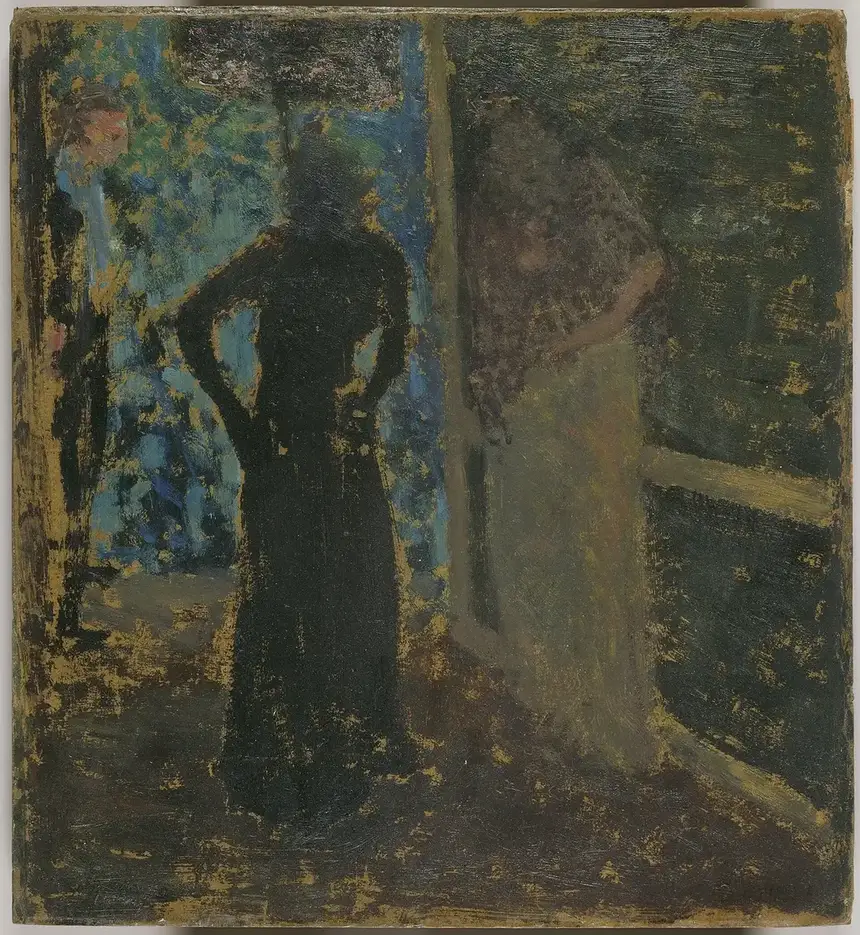
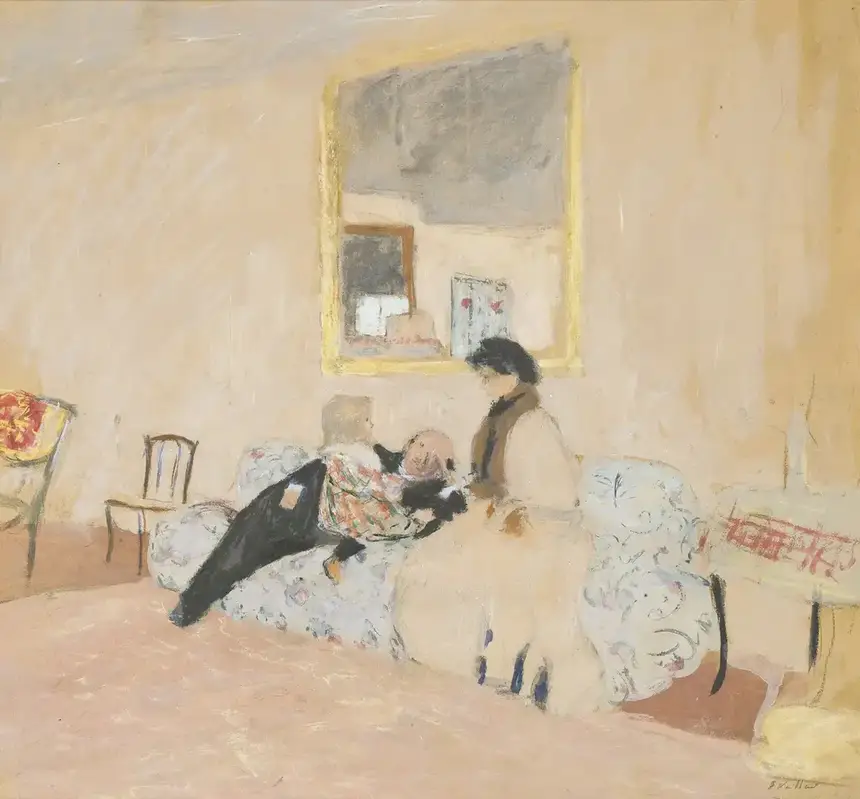
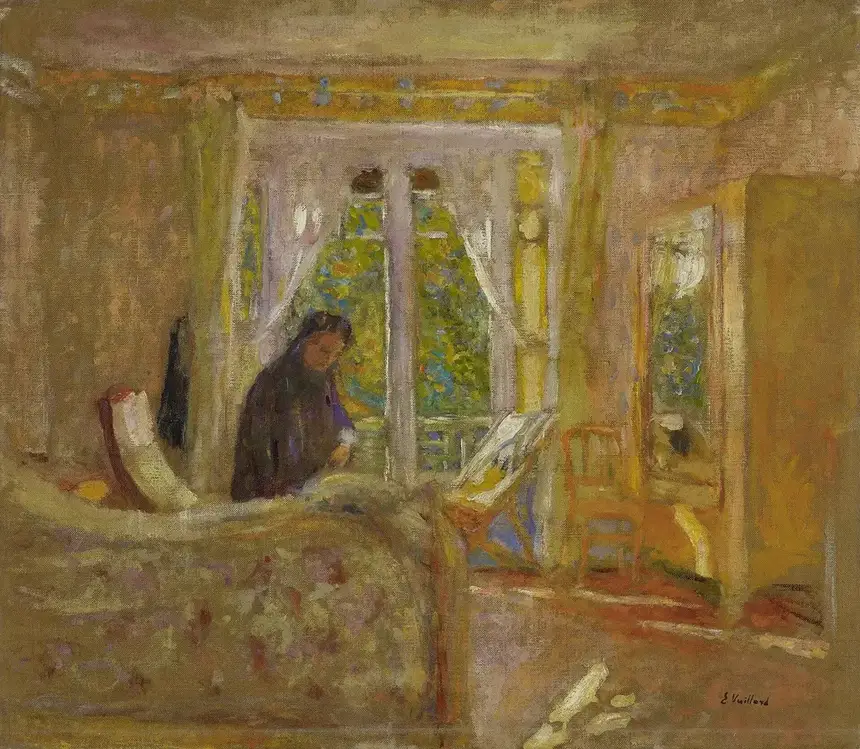
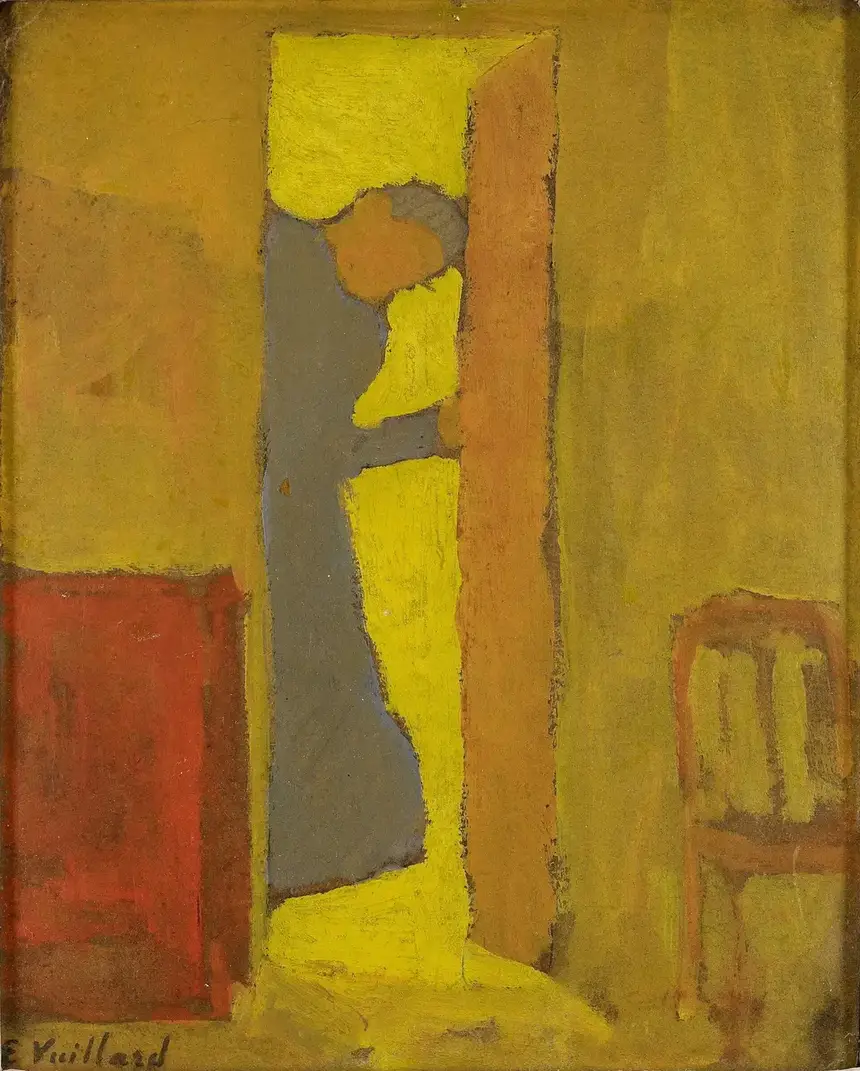
We paint The Artist’s Mother Opening a Door from the source image with the same layering a portraitist would use, which is why the skin stays alive.
The sitter's turn is the composition. We paint the turn rather than the outline.
Skin here is translucent: light goes in, bounces, and comes back warm. That is done with thin paint over a lighter ground.
Saturated colour is kept for a small area; the rest is deliberately knocked back.
The thick paint is kept for the light and the thin paint for the dark, which is the traditional way round.
The difficulty is restraint: leaving out most of what a photograph would show.
It wants a wall where the light rakes across it, because the surface is part of the picture.
| Artist | Édouard Vuillard |
|---|---|
| Title | The Artist’s Mother Opening a Door |
| Created (original) | 1886 |
| Medium | Oil on canvas, hand-painted to order |
| How it is made | Painted by hand in oil on canvas, to your size |
| Copyright | Public domain; the original is out of copyright |
Why hand-painting matters here
A print reproduces the shapes and drops the substance. It is the substance you are buying.
Paint goes on in the original's order — thin first, thick last — so the surface behaves the way the painter intended.
| Aspect | Hand-painted oil | Printed canvas |
|---|---|---|
| Later on | Can be restored, re-framed, handed on | Replaceable, and usually replaced |
| Edge quality | Soft where the form turns, sharp where it does not | Uniformly sharp or uniformly blurred |
| The surface | Built up with brushes and knives | Printed flat in one pass |
| Depth | Built in layers, catches light from the side | Flat; highlights are printed as pale ink |
| Changing something | Tell us and the passage gets repainted | Usually means starting the file again |
Getting The Artist’s Mother Opening a Door right means painting it in the right order, and the order is not obvious.
Every canvas is painted to order, so the quote follows your size, frame and destination rather than a fixed list. Tell us what you need on WhatsApp and we reply with an exact figure, usually within the hour. You are talking to the people who will actually paint it, not a middleman.
How your painting is made
Here is what actually happens between your message and the crate:
- We start with the canvas itself — stretched, sized and left to settle before any colour is mixed.
- The drawing goes down — charcoal or thin paint, done by eye rather than traced from a printout.
- The first colour pass — thin and simple, establishing the main shapes only.
- Getting the values right — the stage that decides whether the finished painting holds together.
- Colour is built up — warmer and cooler versions of each passage, laid over the underpainting.
- The detail and highlights go on — last, loaded, and left alone once they are down.
- Drying and varnishing — the final varnish goes on once the paint has set, before we photograph it.
What takes time here is the number of separate decisions, not the size of the canvas.
On framing
Most clients wait for the photographs before choosing a frame, which is the sensible order.
Framing is quoted separately, so you can decide after you have seen the finished canvas in photographs.
Care and cleaning
Dust it with a dry, soft brush. Keep it out of direct sun and away from radiators, and it will outlive you.
Materials
Pigment is artist-grade oil colour, not acrylic and not house paint. It behaves differently and it lasts. Varnish goes on only once the paint is properly dry, months after the last stroke, not before.
We do not use a printer at any stage. There is no giclée, no canvas transfer, no digital underlayer. Large canvases get a cross-brace; anything over about a metre and a half needs one.
What size works
Any size is possible. These are simply the ones that come up most often in quotes:
| Size (inches) | Size (cm) | Best for |
|---|---|---|
| 40 × 30 in | 102 × 76 cm | Living room focal wall, above a sofa |
| 32 × 24 in | 81 × 61 cm | Living room, above a sideboard |
| 30 × 24 in | 76 × 61 cm | Dining room, bedroom feature wall |
| 24 × 20 in | 60 × 50 cm | Study, home office, above a desk |
| 20 × 16 in | 50 × 40 cm | Bedroom, hallway, above a console |
| 16 × 12 in | 40 × 30 cm | A shelf, a small wall, a gallery group |
Anything outside this table is fine — we paint to the number you give us. Import charges, where they exist, are the buyer's responsibility (DAP). We never add them to the quote and never guess what they will be.
It suits a room with warm, low light. Strong downlighting flattens the surface.
Message us the dimensions you have in mind and we will come back with a figure.
💬 Get a Quote for The Artist’s Mother Opening a DoorTimeline and shipping
The painting takes 9–15 days, and delivery is priced separately on the quote so there is no surprise later.
Expect 7–10 business days in transit, with tracking from our door to yours. Rolled in a tube it travels cheaper and safer than framed; most overseas clients take it that way.
Before anything is packed, you get photographs of the actual canvas and a chance to ask for changes. Adjustments are part of the process. Say what you want different and it gets done.
Terms are DAP. Import duties and taxes, where they apply, are paid by the buyer on arrival — we never collect them in advance and never guess at the amount.
You pay a deposit to start and the remainder before shipping. Nothing is hidden in between. Report any transit damage within 48 hours with photographs and we will deal with the carrier. We will not promise a payout, but we will not leave you to argue alone either.
Questions worth asking
Will it look exactly like the image?
Not exactly, and that is the point — it is a painting, not a scan. Composition, colour and drawing follow the original closely; the surface is where a painter's own decisions show.
When will it actually arrive?
Studio time is 9–15 days, then a few more days for the oil to set before we can photograph and pack it. We tell you where your canvas is at each stage.
Will I see it before it ships?
Yes — photographs of the actual painting go to you first, and nothing is packed until you have seen them.
Is it really painted by hand?
Yes — oil on canvas, brush and knife. There is no printing, no giclée and no canvas transfer at any stage.
Can I change the size?
Any size you like. We paint to the number you give us rather than to a standard range.
Is owning a reproduction legal?
Yes. Édouard Vuillard died more than 70 years ago, so the work is in the public domain and owning a hand-painted version is legal anywhere. We never pass ours off as the original.
Can you change the colours to suit my room?
Sometimes. We will adjust the palette if it can be done without ruining the picture, and say so if it cannot.
Can you paint it from a different photograph of the same work?
Yes. If you have a better reference, send it on WhatsApp and we will work from yours.
Do you take a deposit?
A deposit starts the canvas and the balance falls due before it ships. Both figures appear on the quote.
What if it arrives damaged?
send us photographs within 48 hours and contact us directly — we will sort it out with you.
What is the canvas made of?
Cotton or linen, oil colour, and varnish. Stretcher bars are wedged so the canvas can be re-tensioned later.