What you are buying into
Edvard Munch died in 1944, so the work has been in the public domain for decades. Reproducing it by hand is legal, and so is owning one.
Ours is a painting made with brushes. There is no giclée, no canvas transfer and no digital underlayer anywhere in the process.
It is an original composition painted before 1944, and our version is painted from the surviving image of it.
What arrives is a canvas with paint on it, made by a person. That is the only thing we sell.
Looking at it properly
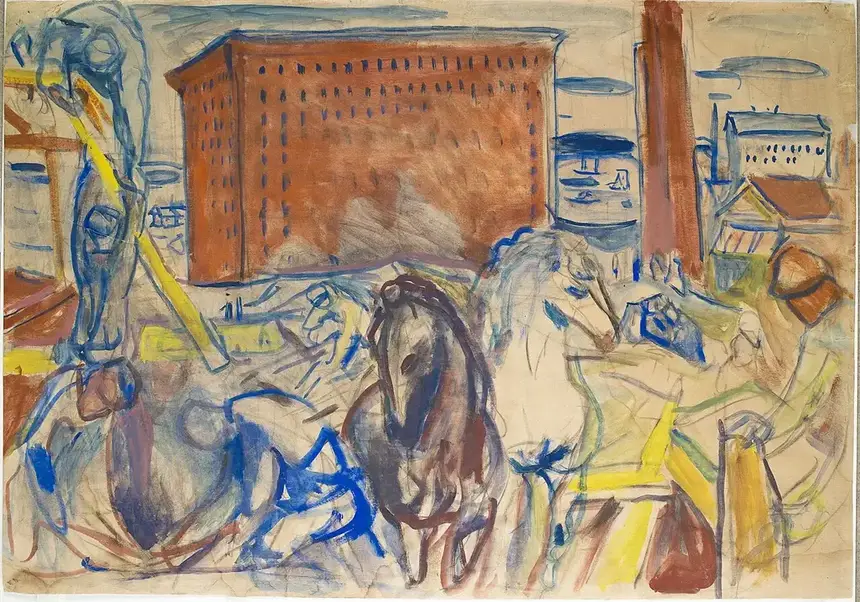
Animals are hard because the edge has to be both accurate and soft. Prints make it hard or soft, never both.
The composition is built on the line of the back or neck, and everything else follows it.
Highlights on bone and muscle are put on last with a loaded brush.
Temperature does the work of contrast in the quiet areas, where value differences are small.
Nothing here is blended flat. Blending is what makes a painting look printed.
The difficult part is not the detail. It is keeping the whole canvas at the same stage of finish.
Hang it at eye level — roughly 145 cm from the floor to the centre — and it will hold the wall.
| Artist | Edvard Munch |
|---|---|
| Title | Horse Team on a Building Site, 1928 |
| Medium | Oil on canvas, hand-painted to order |
| Year | 1928 |
| How it is made | Painted by hand in oil on canvas, to your size |
| Public domain | Yes — the artist died over 70 years ago |
Why this one cannot be printed
A print reproduces the shapes and drops the substance. It is the substance you are buying.
Our painter follows the same logic rather than copying a photograph of it: the far distances go down cool and weak, the near ground stays loaded, and nothing is blended flat.
| Aspect | Hand-painted oil | Printed canvas |
|---|---|---|
| Corrections | We adjust it and repaint the passage | The file is reprinted or it is not |
| Size | Any size, painted to your wall | Limited by the printer |
| Surface | Hand-painted oil on canvas | Ink on canvas, flat |
| How it ages | Warms and settles; cleanable by a conservator | Fades, then cracks at the stretcher |
| Colour | Mixed for each passage, warm and cool versions | One flat value per area |
This one repaints badly, so our painter gets the values right early and leaves them.
Every canvas is painted to order, so the quote follows your size, frame and destination rather than a fixed list. Tell us what you need on WhatsApp and we reply with an exact figure, usually within the hour. You deal directly with the studio that paints it — no reseller layer.
How it gets painted
No two canvases are painted the same way, but the sequence is always this:
- Stretching and priming the support — cotton duck or linen goes onto the bars and gets its ground.
- A loose underdrawing — proportions checked by eye against the source image.
- The big shapes are blocked in — thin paint, one colour at a time, the whole canvas at once.
- Getting the values right — the stage that decides whether the finished painting holds together.
- The colour passes — each area gets its own mixture rather than one colour used throughout.
- The detail and highlights go on — last, loaded, and left alone once they are down.
- It dries, then gets varnished — and only then is it photographed for you.
Anyone can copy the shapes. The skill is in the transitions, and that is what takes the days.
Framing
If you are shipping, an unframed canvas rolled in a tube is considerably cheaper to move than a framed one.
If you are shipping, an unframed canvas rolled in a tube is considerably cheaper to move than a framed one.
What goes into it
Pigment is artist-grade oil colour, not acrylic and not house paint. It behaves differently and it lasts. We buy pigment in tubes from the same suppliers the village has used for years, not in bulk drums.
We do not use a printer at any stage. There is no giclée, no canvas transfer, no digital underlayer. The varnish is removable, so a conservator can clean the painting in fifty years without touching the paint.
Care and cleaning
Oil paint needs very little: no water, no cleaners, no sprays. A dry brush and a stable room.
Sizing it
Because each piece is painted from scratch, you are not limited to stock dimensions. These are the sizes clients ask for most:
| Size (inches) | Size (cm) | Best for |
|---|---|---|
| 20 × 16 in | 50 × 40 cm | Bedroom, hallway, above a console |
| 16 × 12 in | 40 × 30 cm | A shelf, a small wall, a gallery group |
| 64 × 48 in | 163 × 122 cm | Villa scale, lobby, hospitality wall |
| 48 × 36 in | 122 × 91 cm | Large living room, stairwell, loft |
| 40 × 30 in | 102 × 76 cm | Living room focal wall, above a sofa |
If your wall is an odd shape, send the measurement and we will work to it. Proportions from the original are kept unless you ask us to change them. Shipments go out DAP. If your customs office charges duty or tax on arrival, that is between you and them — we do not collect it and we do not put a number on it.
It is a picture for a room you use, not a corridor you walk through.
Send the wall, the size and whether you want a frame, and we will quote.
💬 Get a Quote for Horse Team on a Building Site, 1928–1929, MM.M.0From order to your wall
Allow 9–15 days for the painting itself. Shipping is a separate line on your quote — you see it before payment, not after.
Transit is usually 7–10 business days, tracked all the way. We send photographs of the finished painting before it is packed, and again once it is boxed.
You see photographs of the finished painting before it ships, and you tell us what to adjust. If something is not right, tell us what to adjust and we adjust it.
Duties and import taxes are the buyer's account (DAP). Your customs authority sets them; we do not.
You pay a deposit to start and the remainder before shipping. Nothing is hidden in between. If a crate arrives damaged, send us photographs within 48 hours and contact us directly — we will sort it out with you.
What people ask us
Does changing the size change the composition?
No — we keep the original's proportions and scale from there, rather than cropping the image to fit a standard frame.
Can I resell the reproduction?
Yes. Because the underlying work is in the public domain, the hand-painted canvas is yours to sell, gift or install commercially.
How long does it take?
Allow 9–15 days for the painting itself, then roughly 7–10 business days in transit.
Can you change the colours to suit my room?
Sometimes. We will adjust the palette if it can be done without ruining the picture, and say so if it cannot.
Do you sell prints?
No prints at all — no giclée, no canvas transfer, nothing machine-made.
Who pays the import duty?
The buyer does. Terms are DAP: duties and taxes, where they apply, are paid on arrival. We never add a tax line of our own.
Can you paint a different work by Edvard Munch?
Yes — send us the image, or look through the other Edvard Munch works on the site.
How do I hang it?
Roughly 145 cm from floor to centre works for most rooms. Tell us your wall and we will give you the measurement.
Does it come framed?
Framing is quoted separately, so you can decide once you have seen the finished painting in photographs.
Can you paint it from a different photograph of the same work?
Send your own reference image and we will paint from that instead.
Is it really painted by hand?
Yes — oil on canvas, brush and knife. There is no printing, no giclée and no canvas transfer at any stage.