Where this painting comes from
Edward Henry Potthast died in 1927, so the work has been in the public domain for decades. Reproducing it by hand is legal, and so is owning one.
Every version we make is oil on canvas, painted by one painter from start to finish. No printing is involved at any stage.
The painting was made in the years before 1927, and what we reproduce is the record of it, not the object.
If you want something printed, we are the wrong workshop. We do not own a printer that touches canvas.
Looking at it properly
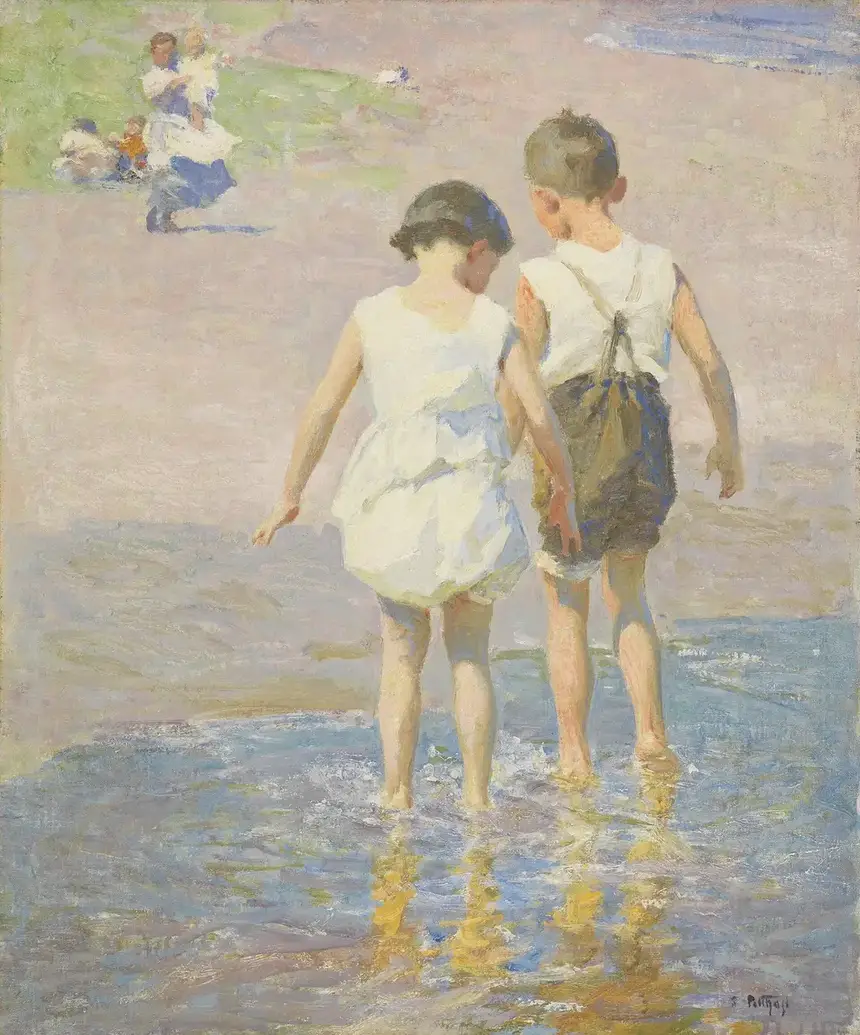
We paint Brother and Sister from the source image with the same layering a portraitist would use, which is why the skin stays alive.
We do not enlarge a photograph and trace it. The drawing is done by eye, which is why the features stay related.
The shadow under the jaw is kept warm and transparent, never black.
We keep the original's palette rather than brightening it, even where a modern eye would.
The last marks are the ones that are left alone. Overworking is the enemy.
This one repaints badly, so our painter gets the values right early and leaves them.
Hang it at eye level — roughly 145 cm from the floor to the centre — and it will hold the wall.
| Artist | Edward Henry Potthast |
|---|---|
| Title | Brother and Sister |
| Medium | Oil on canvas, hand-painted to order |
| Our version | Oil on canvas, painted by hand to order |
| Original status | Public domain (artist deceased) |
Why hand-painting matters here
What you lose in a print is the air. A press lays ink flat; a painter builds depth in layers, and the depth is what you actually see.
Our painter follows the same logic rather than copying a photograph of it: the far distances go down cool and weak, the near ground stays loaded, and nothing is blended flat.
| Aspect | Hand-painted oil | Printed canvas |
|---|---|---|
| Edges | Chosen by the painter, passage by passage | Whatever the file happens to contain |
| Later on | Can be restored, re-framed, handed on | Replaceable, and usually replaced |
| Time to make | Days of one painter's working time | Minutes |
| Handling of colour | Mixed on the palette and finished on the canvas | Fixed by the colour profile |
| Texture | Ridges and drag you can see from across a room | None, or a printed imitation of it |
The passage that will take longest is the one that looks simplest.
Every canvas is painted to order, so the quote follows your size, frame and destination rather than a fixed list. Tell us what you need on WhatsApp and we reply with an exact figure, usually within the hour. You are buying from the workshop, not a catalogue.
The sequence on our floor
Every canvas is painted to order, so nothing is pulled off a shelf. This is the sequence:
- Stretching and priming the support — cotton duck or linen goes onto the bars and gets its ground.
- The drawing goes down — charcoal or thin paint, done by eye rather than traced from a printout.
- The big shapes are blocked in — thin paint, one colour at a time, the whole canvas at once.
- Setting the key — how dark the darks go determines everything that follows.
- The colour passes — each area gets its own mixture rather than one colour used throughout.
- The detail and highlights go on — last, loaded, and left alone once they are down.
- It dries, then gets varnished — and only then is it photographed for you.
The difficult part is not the detail. It is keeping the whole canvas at the same stage of finish.
Keeping it
Once the varnish has cured the surface can be cleaned by a conservator, but in a normal house it will not need it for decades.
Materials
Linen is worth the extra cost above about a metre across, because it holds tension better in humid rooms. We use cotton duck for most sizes and linen where the canvas is large or the client asks for it.
The varnish is removable, so a conservator can clean the painting in fifty years without touching the paint. We do not use a printer at any stage. There is no giclée, no canvas transfer, no digital underlayer.
On framing
We can supply a simple floater frame, a traditional gilt, or nothing at all. It is your call.
A frame is a separate line on the quote, not a bundle. You choose it once the painting exists.
Choosing a size
You are not choosing from a list; you are telling us a measurement. These are the common ones:
| Size (inches) | Size (cm) | Best for |
|---|---|---|
| 16 × 12 in | 40 × 30 cm | A shelf, a small wall, a gallery group |
| 64 × 48 in | 163 × 122 cm | Villa scale, lobby, hospitality wall |
| 48 × 36 in | 122 × 91 cm | Large living room, stairwell, loft |
| 40 × 30 in | 102 × 76 cm | Living room focal wall, above a sofa |
If your wall is an odd shape, send the measurement and we will work to it. Proportions from the original are kept unless you ask us to change them. Our terms are DAP, meaning the freight is paid by us and any import charges are yours to settle. We will not estimate them, because the figure is your customs authority's to set.
A plain wall is better than a busy one; the painting supplies the interest.
Tell us the size and frame — exact quote back, usually within the hour.
💬 Get a Quote for Brother and SisterHow it reaches you
From order to finished canvas is 9–15 days. Freight appears as a separate line on the quote and is fixed before you pay.
Air freight runs about 7–10 business days, tracked, to your door. Unframed canvases are rolled face-out on a tube; framed ones are corner-protected and crated.
Nothing ships before you have seen it. Photographs of the finished painting go to you first. Changes are handled by telling us what to change; we change it and send new photographs.
DAP terms: we pay the freight, you settle any duty or tax your country applies. We do not collect taxes on anyone's behalf.
Work begins on a deposit and ships on the balance. Both figures are on the quote. If a crate arrives damaged, send us photographs within 48 hours and contact us directly — we will sort it out with you.
What people ask us
How do I know what size will look right?
Measure the wall and send a photograph. We will say honestly if the canvas you have in mind is too small for the space, which is the most common mistake.
Is there a rush option?
It depends on the canvas and what else is in the studio. Ask on WhatsApp with your size and we will tell you straight what is possible.
How close will it be to the original?
The composition, colour and drawing follow the original closely; the brushwork carries the painter's own hand. The painter works freehand on a blank canvas, following the same logic as the original rather than copying a photograph.
Will I see it before it ships?
Yes — photographs of the actual painting go to you first, and nothing is packed until you have seen them.
Does it come framed?
Frames are priced on their own line. Most clients choose after seeing the photographs.
What does it cost?
There is no price list, because the number depends on your size and frame. Message us and we will quote exactly.
Who pays the import duty?
You do. We sell DAP, so any duty or tax your customs authority charges is settled by you at import. We do not collect it and we do not estimate it.
Do you ship to my country?
We export to more than 20 countries. Tell us where you are and we will quote the freight as a separate line.
Do you sell prints?
No prints at all — no giclée, no canvas transfer, nothing machine-made.
Can I change the size?
Yes. The canvas is painted to your measurement, not taken from a stock list.
Is owning a reproduction legal?
Yes. Edward Henry Potthast died more than 70 years ago, so the work is in the public domain and owning a hand-painted version is legal anywhere. We never pass ours off as the original.
Do you take a deposit?
Work begins on a deposit and ships once the balance is paid. Nothing is charged that is not on the quote.