Where this painting comes from
Because Egon Schiele died in 1918, this work is in the public domain. We are painting a copy of a painting — we never pass it off as the original, and neither should anyone selling you one.
Ours is a painting made with brushes. There is no giclée, no canvas transfer and no digital underlayer anywhere in the process.
It is an original composition painted before 1918, and our version is painted from the surviving image of it.
What arrives is a canvas with paint on it, made by a person. That is the only thing we sell.
What the painting is doing
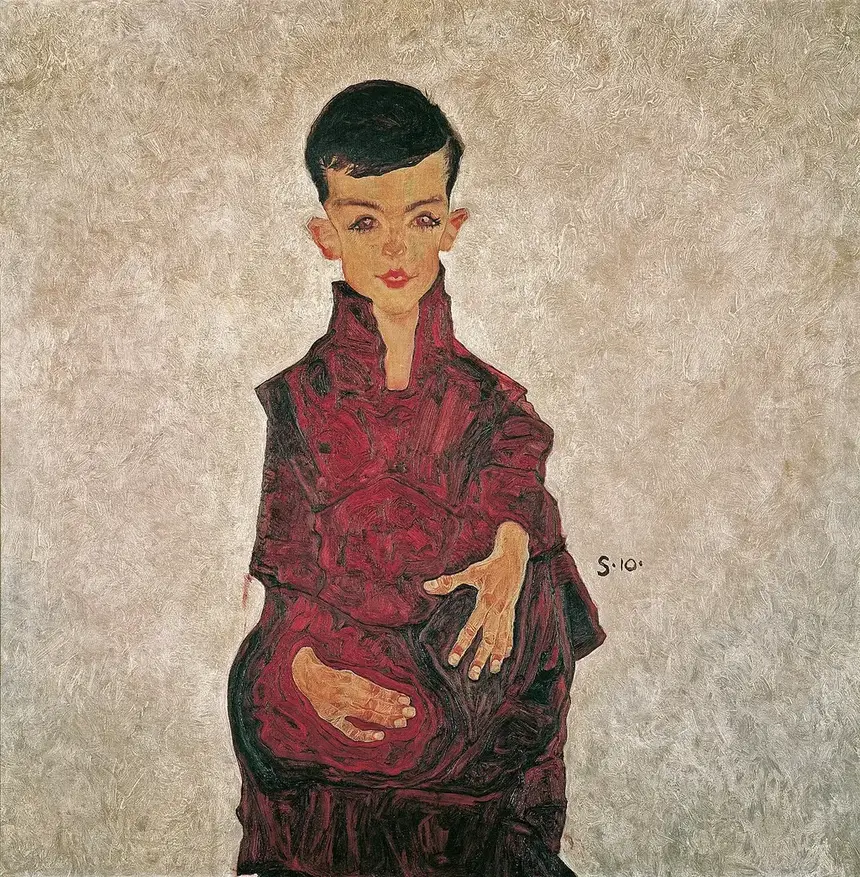
We paint Reinerbub (Bildnis Herbert from the source image with the same layering a portraitist would use, which is why the skin stays alive.
Scale matters in a portrait: we size it so the head reads at life size or larger, which is when it starts to work.
Light does the modelling; the outline does almost nothing.
Temperature does the work of contrast in the quiet areas, where value differences are small.
The marks have a direction, and the direction follows the form.
Matching the original's degree of finish is harder than matching its colours.
It is a picture for a room you use, not a corridor you walk through.
| Artist | Egon Schiele |
|---|---|
| Title | Reinerbub (Bildnis Herbert |
| Created (original) | 1910 |
| Medium | Oil on canvas, hand-painted to order |
| Our version | Oil on canvas, painted by hand to order |
| Public domain | Yes — the artist died over 70 years ago |
What a print loses
The difference is not subtle when the two hang side by side. Ink sits on the surface; oil stands off it.
Edges are left soft where the form turns away and sharp where it does not. That single habit is what separates a painting from a copy.
| Aspect | Hand-painted oil | Printed canvas |
|---|---|---|
| The surface | Built up with brushes and knives | Printed flat in one pass |
| Texture | Ridges and drag you can see from across a room | None, or a printed imitation of it |
| Handling of colour | Mixed on the palette and finished on the canvas | Fixed by the colour profile |
| How it ages | Warms and settles; cleanable by a conservator | Fades, then cracks at the stretcher |
| Value over time | Can be re-stretched, cleaned and re-framed | Little value beyond the print |
The difficult part is not the detail. It is keeping the whole canvas at the same stage of finish.
Every canvas is painted to order, so the quote follows your size, frame and destination rather than a fixed list. Tell us what you need on WhatsApp and we reply with an exact figure, usually within the hour. You deal directly with the studio that paints it — no reseller layer.
From blank canvas to finished painting
No two canvases are painted the same way, but the sequence is always this:
- We start with the canvas itself — stretched, sized and left to settle before any colour is mixed.
- The drawing goes down — charcoal or thin paint, done by eye rather than traced from a printout.
- Blocking the masses — thin paint, working the whole surface rather than one corner at a time.
- Setting the key — how dark the darks go determines everything that follows.
- The colour passes — each area gets its own mixture rather than one colour used throughout.
- The detail and highlights go on — last, loaded, and left alone once they are down.
- Left to dry before varnish — nothing is photographed or packed until the surface is ready.
The risk with a portrait is overworking, and the way to avoid it is knowing when to stop.
Whether to frame it
Most clients wait for the photographs before choosing a frame, which is the sensible order.
We can supply a simple floater frame, a traditional gilt, or nothing at all. It is your call.
Care and cleaning
Dust it with a dry, soft brush. Keep it out of direct sun and away from radiators, and it will outlive you.
Materials
We use a neutral-sized ground so the whites stay warm rather than going blue over time. Large canvases get a cross-brace; anything over about a metre and a half needs one.
The paint is built in layers, fat over lean, which is what stops it cracking later. We use cotton duck for most sizes and linen where the canvas is large or the client asks for it.
Getting the size right
You are not choosing from a list; you are telling us a measurement. These are the common ones:
| Size (inches) | Size (cm) | Best for |
|---|---|---|
| 32 × 24 in | 81 × 61 cm | Living room, above a sideboard |
| 30 × 24 in | 76 × 61 cm | Dining room, bedroom feature wall |
| 24 × 20 in | 60 × 50 cm | Study, home office, above a desk |
| 20 × 16 in | 50 × 40 cm | Bedroom, hallway, above a console |
| 16 × 12 in | 40 × 30 cm | A shelf, a small wall, a gallery group |
We will size the canvas to the room, not to a stock list. Send us the measurement. Shipments go out DAP. If your customs office charges duty or tax on arrival, that is between you and them — we do not collect it and we do not put a number on it.
Given the subject, this sits naturally in a living room or a study rather than a hallway.
Send the wall, the size and whether you want a frame, and we will quote.
💬 Get a Quote for Reinerbub (Bildnis Herbert Reiner) Portrait of Herbert ReinertitleGetting it to you
Allow 9–15 days for the painting itself. Shipping is a separate line on your quote — you see it before payment, not after.
Transit is usually 7–10 business days, tracked all the way. Unframed canvases are rolled face-out on a tube; framed ones are corner-protected and crated.
You see photographs of the finished painting before it ships, and you tell us what to adjust. Changes are handled by telling us what to change; we change it and send new photographs.
Duties and import taxes are the buyer's account (DAP). Your customs authority sets them; we do not.
A deposit starts the canvas and books the painter's time; the balance is due before the crate leaves. Damage in transit should be reported to us within 48 hours, with photographs. We pursue it with the carrier rather than promising a refund.
Questions worth asking
How long does a hand-painted version take?
9–15 days of studio time, depending mostly on size and how much impasto the surface carries, then several more days for the oil to set before we photograph, pack and send.
How close will it be to the original?
The composition, colour and drawing follow the original closely; the brushwork carries the painter's own hand. The painter works freehand on a blank canvas, following the same logic as the original rather than copying a photograph.
Do you work from my own photograph?
Yes, though that is a separate service. This page is for a hand-painted version of {title}; for a photo-to-painting commission, send the image on WhatsApp.
Can you paint it from a different photograph of the same work?
Yes. If you have a better reference, send it on WhatsApp and we will work from yours.
Is owning a reproduction legal?
Yes. The painting is out of copyright because Egon Schiele died more than 70 years ago. We paint copies honestly and never claim they are originals.
Do you take a deposit?
Work begins on a deposit and ships once the balance is paid. Nothing is charged that is not on the quote.
Will I see it before it ships?
Yes. We send photographs of the finished canvas and wait for your reply before packing.
Can I change the size?
Yes. The canvas is painted to your measurement, not taken from a stock list.
Can you paint a different work by Egon Schiele?
Yes — send us the image, or look through the other Egon Schiele works on the site.
Does it come framed?
Framing is quoted separately, so you can decide once you have seen the finished painting in photographs.
Is it really painted by hand?
Yes. One painter, oil paint, brushes. We do not own a printer that touches canvas.
How do I hang it?
Centre it at about 145 cm from the floor, or two-thirds the width of the furniture below it. We will tell you the exact number for your wall.