About the original
Emil Filla died in 1953. That puts the painting well outside copyright, which is why we can paint it and you can own it anywhere in the world.
Ours is a painting made with brushes. There is no giclée, no canvas transfer and no digital underlayer anywhere in the process.
The painting was made in the years before 1953, and what we reproduce is the record of it, not the object.
If you want something printed, we are the wrong workshop. We do not own a printer that touches canvas.
How to read it
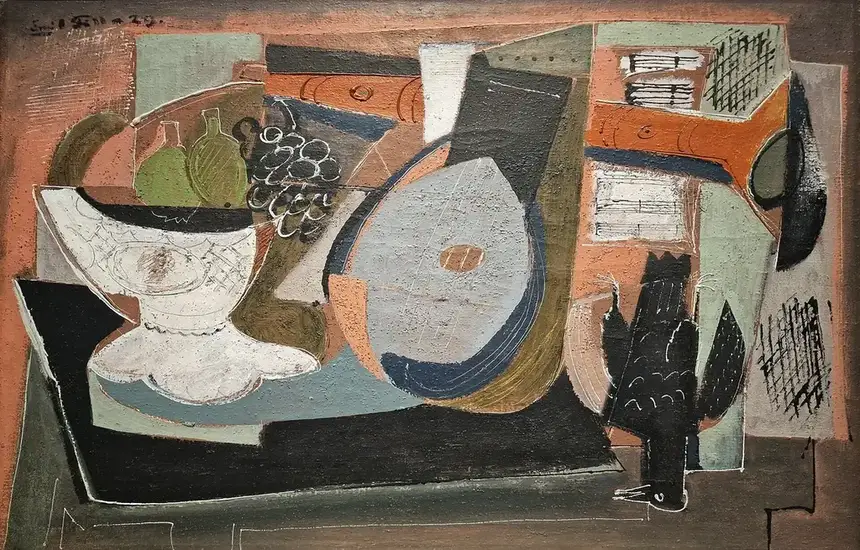
Ours is painted from the source image, stroke by stroke, so Stillleben mit toter Taube keeps the order it was originally built in.
Depth here is a matter of edges: sharp in front, lost at the back. It is the hardest thing to print and the easiest to paint.
The light in Stillleben mit toter Taube has a direction, and the painter keeps it consistent across every object in the picture.
Colour here is mixed for the passage, not for the object, which is why nothing looks like it was filled in.
The last marks are the ones that are left alone. Overworking is the enemy.
Getting Stillleben mit toter Taube right means painting it in the right order, and the order is not obvious.
A plain wall is better than a busy one; the painting supplies the interest.
| Artist | Emil Filla |
|---|---|
| Title | Stillleben mit toter Taube |
| Created (original) | 1929 |
| Medium | Oil on canvas, hand-painted to order |
| What you receive | A hand-painted oil painting on canvas |
| Original status | Public domain (artist deceased) |
What a print loses
A print reproduces the shapes and drops the substance. It is the substance you are buying.
Paint goes on in the original's order — thin first, thick last — so the surface behaves the way the painter intended.
| Aspect | Hand-painted oil | Printed canvas |
|---|---|---|
| Size | Any size, painted to your wall | Limited by the printer |
| Edge quality | Soft where the form turns, sharp where it does not | Uniformly sharp or uniformly blurred |
| Depth | Built in layers, catches light from the side | Flat; highlights are printed as pale ink |
| Corrections | We adjust it and repaint the passage | The file is reprinted or it is not |
| Handling of colour | Mixed on the palette and finished on the canvas | Fixed by the colour profile |
Anyone can copy the shapes. The skill is in the transitions, and that is what takes the days.
Every canvas is painted to order, so the quote follows your size, frame and destination rather than a fixed list. Tell us what you need on WhatsApp and we reply with an exact figure, usually within the hour. There is no agency in between; the studio that paints your canvas is the one answering your messages.
How your painting is made
The order of work matters as much as the work itself. Ours runs like this:
- Stretching and priming the support — cotton duck or linen goes onto the bars and gets its ground.
- The drawing goes down — charcoal or thin paint, done by eye rather than traced from a printout.
- The big shapes are blocked in — thin paint, one colour at a time, the whole canvas at once.
- The values are established — this is the stage that decides whether the painting works.
- The colour passes — each area gets its own mixture rather than one colour used throughout.
- Finishing passes — the loaded highlights go on at the end and stay there.
- Drying and varnishing — the final varnish goes on once the paint has set, before we photograph it.
This one repaints badly, so our painter gets the values right early and leaves them.
Care and cleaning
Once the varnish has cured the surface can be cleaned by a conservator, but in a normal house it will not need it for decades.
What it is made of
The paint is built in layers, fat over lean, which is what stops it cracking later. Each painter works on one canvas at a time — the painting you ordered is not shared with another order.
Brushes, knives and rags. That is the equipment list; there is no machine in the process. Pigment is artist-grade oil colour, not acrylic and not house paint. It behaves differently and it lasts.
On framing
We can supply a simple floater frame, a traditional gilt, or nothing at all. It is your call.
We can supply a simple floater frame, a traditional gilt, or nothing at all. It is your call.
What size works
Because each piece is painted from scratch, you are not limited to stock dimensions. These are the sizes clients ask for most:
| Size (inches) | Size (cm) | Best for |
|---|---|---|
| 24 × 20 in | 60 × 50 cm | Study, home office, above a desk |
| 20 × 16 in | 50 × 40 cm | Bedroom, hallway, above a console |
| 16 × 12 in | 40 × 30 cm | A shelf, a small wall, a gallery group |
| 64 × 48 in | 163 × 122 cm | Villa scale, lobby, hospitality wall |
Tell us the wall width and we will tell you what looks right rather than what is standard. We quote DAP, so any duty or tax your country charges is settled by you at import. We do not add a tax line of our own.
Hang it at eye level — roughly 145 cm from the floor to the centre — and it will hold the wall.
Tell us where it will hang and how big it needs to be — we will price it properly.
💬 Get a Quote for Stillleben mit toter Taube Nationalgalerie Prag anagoriaFrom order to your wall
Allow 9–15 days for the painting itself. Shipping is a separate line on your quote — you see it before payment, not after.
In transit it is typically 7–10 business days by air, tracked door to door. Every shipment goes out with tracking. We do not send anything untracked.
You see photographs of the finished painting before it ships, and you tell us what to adjust. Changes are handled by telling us what to change; we change it and send new photographs.
Terms are DAP. Import duties and taxes, where they apply, are paid by the buyer on arrival — we never collect them in advance and never guess at the amount.
Work begins on a deposit and ships on the balance. Both figures are on the quote. Damage in transit should be reported to us within 48 hours, with photographs. We pursue it with the carrier rather than promising a refund.
Before you order
What size should I order?
You choose the size. Each canvas is cut to your measurements rather than pulled from stock, so tell us the wall dimensions and we will tell you what proportion works.
Is there a rush option?
It depends on the canvas and what else is in the studio. Ask on WhatsApp with your size and we will tell you straight what is possible.
Will I see it before it ships?
Yes. We send photographs of the finished canvas and wait for your reply before packing.
Who pays the import duty?
You do. We sell DAP, so any duty or tax your customs authority charges is settled by you at import. We do not collect it and we do not estimate it.
Can you paint it from a different photograph of the same work?
Yes. If you have a better reference, send it on WhatsApp and we will work from yours.
Can you paint a different work by Emil Filla?
Yes — send us the image, or look through the other Emil Filla works on the site.
Is it really painted by hand?
Yes — oil on canvas, brush and knife. There is no printing, no giclée and no canvas transfer at any stage.
What is the canvas made of?
Cotton duck as standard, linen on request, artist-grade oil paint, and a final varnish once the paint is fully dry.
What does it cost?
There is no price list, because the number depends on your size and frame. Message us and we will quote exactly.
Can I change the size?
Yes. The canvas is painted to your measurement, not taken from a stock list.
Is owning a reproduction legal?
Yes. The painting is out of copyright because Emil Filla died more than 70 years ago. We paint copies honestly and never claim they are originals.