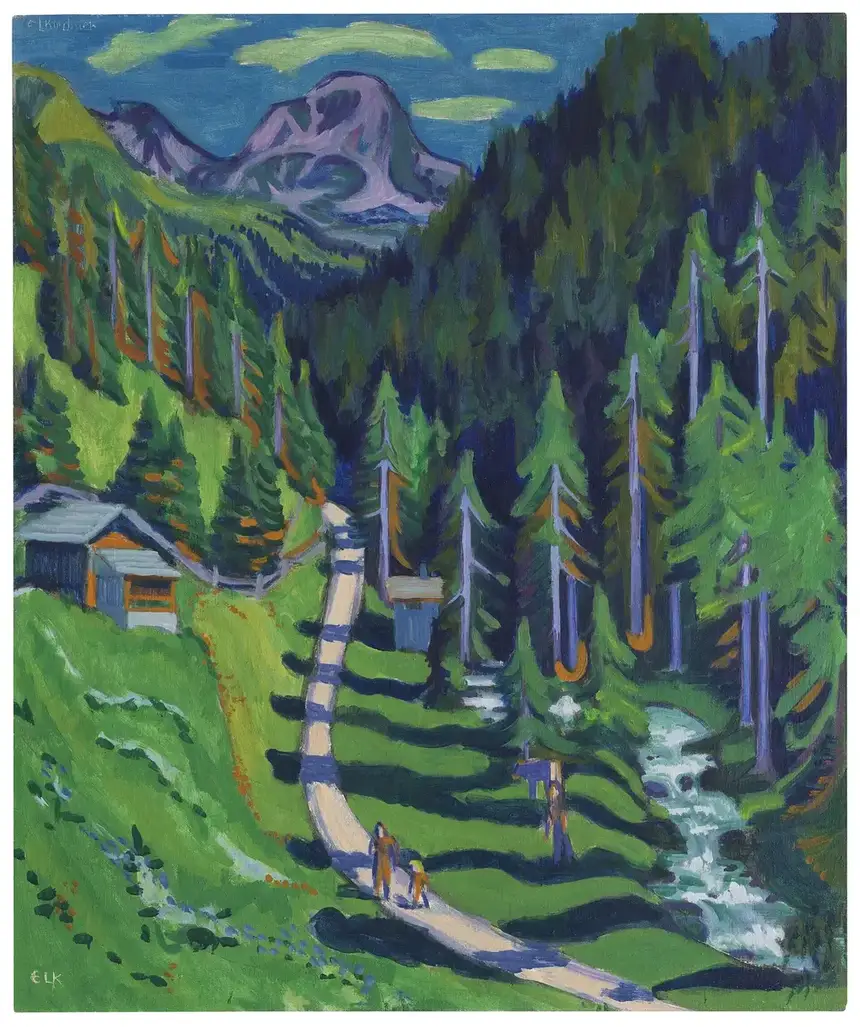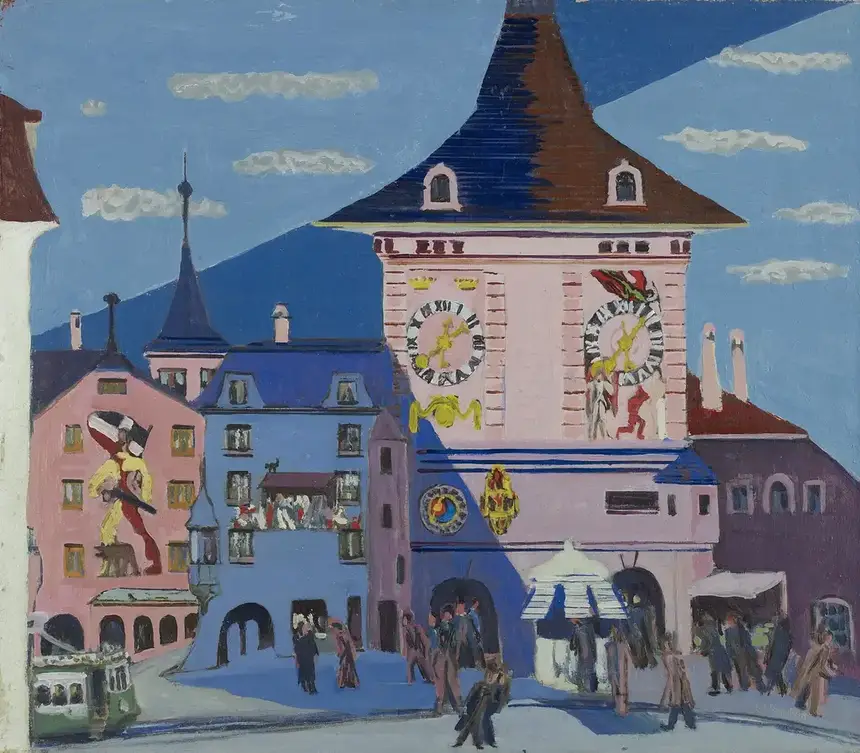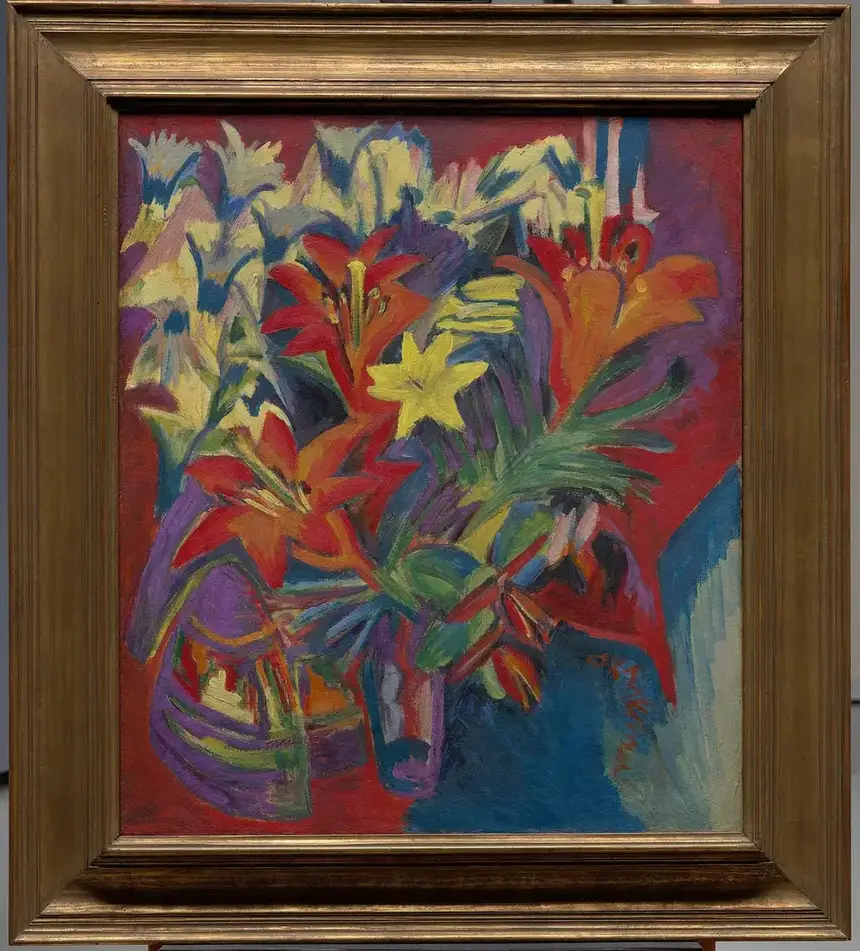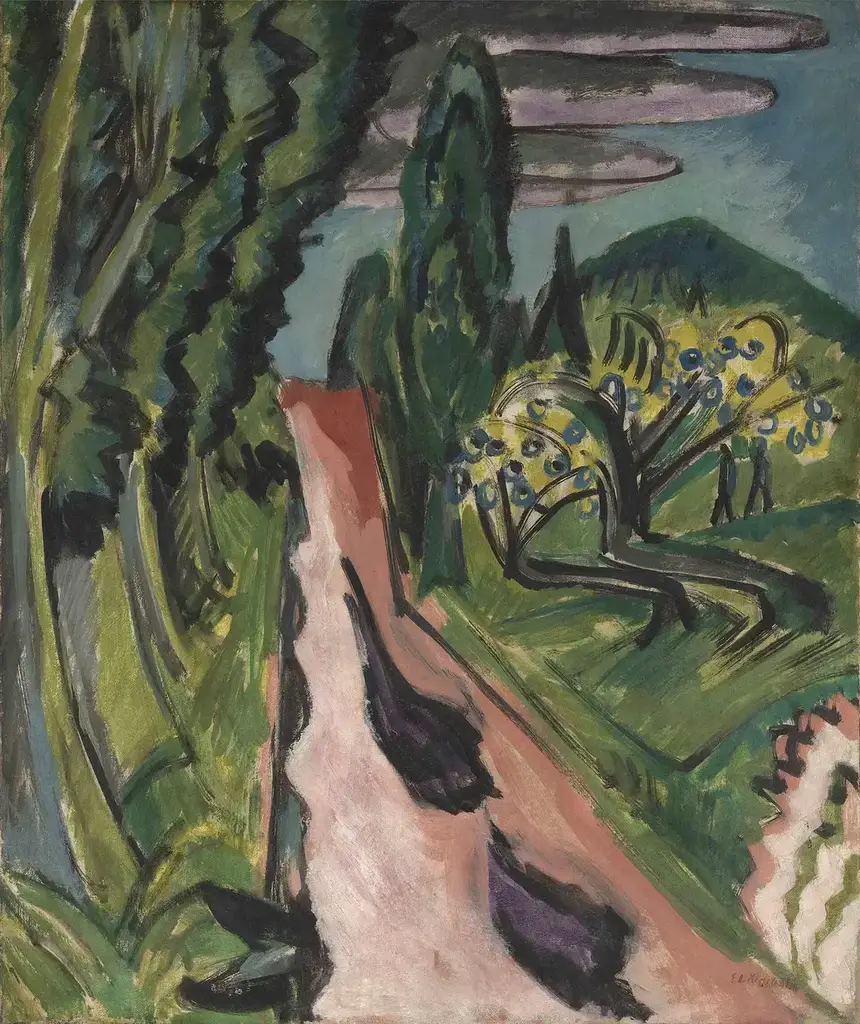
The original, and why we can paint it
Ernst Ludwig Kirchner died in 1938. That puts the painting well outside copyright, which is why we can paint it and you can own it anywhere in the world.
Every version we make is oil on canvas, painted by one painter from start to finish. No printing is involved at any stage.
The painting was made in the years before 1938, and what we reproduce is the record of it, not the object.
You are buying a painting, not a file. That distinction is the whole business we are in.
What the painting is doing
Most reproductions of a landscape flatten it into a view. This one keeps the weather in it.
The horizon does the work here, and it is placed deliberately rather than centred.
Our painter keeps the shadows transparent, because a shadow in a landscape is lit by the sky, not by nothing.
Temperature does the work of contrast in the quiet areas, where value differences are small.
The last marks are the ones that are left alone. Overworking is the enemy.
The passage that will take longest is the one that looks simplest.
For a stairwell or a double-height space, go larger than you think — the composition was built for distance.
| Artist | Ernst Ludwig Kirchner |
|---|---|
| Title | Taunus Road |
| Created (original) | 1916 |
| Medium | Oil on canvas, hand-painted to order |
| Reproduction | Hand-painted oil on canvas, made to order |
| Public domain | Yes — the artist died over 70 years ago |
Why this one cannot be printed
What you lose in a print is the air. A press lays ink flat; a painter builds depth in layers, and the depth is what you actually see.
Where the original is loaded, ours is loaded. Where it is thin, ours is thin. Matching the weight of the paint matters more than matching the colour.
| Aspect | Hand-painted oil | Printed canvas |
|---|---|---|
| Texture | Ridges and drag you can see from across a room | None, or a printed imitation of it |
| Sense of depth | Real, created by layers of paint | Simulated by darker ink |
| Colour | Mixed for each passage, warm and cool versions | One flat value per area |
| Edges | Chosen by the painter, passage by passage | Whatever the file happens to contain |
| Changing something | Tell us and the passage gets repainted | Usually means starting the file again |
The risk with a landscape is overworking, and the way to avoid it is knowing when to stop.
Every canvas is painted to order, so the quote follows your size, frame and destination rather than a fixed list. Tell us what you need on WhatsApp and we reply with an exact figure, usually within the hour. There is no agency in between; the studio that paints your canvas is the one answering your messages.
How the canvas is built
The order of work matters as much as the work itself. Ours runs like this:
- Stretching and priming the support — cotton duck or linen goes onto the bars and gets its ground.
- A loose underdrawing — proportions checked by eye against the source image.
- The big shapes are blocked in — thin paint, one colour at a time, the whole canvas at once.
- Getting the values right — the stage that decides whether the finished painting holds together.
- Colour is built up — warmer and cooler versions of each passage, laid over the underpainting.
- Detail and highlights last — put on thickly and then not touched again.
- Left to dry before varnish — nothing is photographed or packed until the surface is ready.
What takes time here is the number of separate decisions, not the size of the canvas.
Frames
Framing is quoted separately, so you can decide after you have seen the finished canvas in photographs.
If you are shipping, an unframed canvas rolled in a tube is considerably cheaper to move than a framed one.
Materials
Pigment is artist-grade oil colour, not acrylic and not house paint. It behaves differently and it lasts. Nothing is sprayed, sealed or laminated. The surface you see is paint and varnish, and that is all.
The varnish is removable, so a conservator can clean the painting in fifty years without touching the paint. Oil paint dries by oxidation, not evaporation, which is why a finished canvas needs weeks before it travels.
Looking after it
Dust it with a dry, soft brush. Keep it out of direct sun and away from radiators, and it will outlive you.
Canvas sizes
You are not choosing from a list; you are telling us a measurement. These are the common ones:
| Size (inches) | Size (cm) | Best for |
|---|---|---|
| 64 × 48 in | 163 × 122 cm | Villa scale, lobby, hospitality wall |
| 48 × 36 in | 122 × 91 cm | Large living room, stairwell, loft |
| 40 × 30 in | 102 × 76 cm | Living room focal wall, above a sofa |
| 32 × 24 in | 81 × 61 cm | Living room, above a sideboard |
| 30 × 24 in | 76 × 61 cm | Dining room, bedroom feature wall |
Tell us the wall width and we will tell you what looks right rather than what is standard. Duties and import taxes are the buyer's account (DAP). Your customs authority sets them; we do not.
Given the subject, this sits naturally in a living room or a study rather than a hallway.
Tell us where it will hang and how big it needs to be — we will price it properly.
💬 Get a Quote for Taunus RoadTimeline and shipping
Painting takes 9–15 days. Freight is quoted as its own line on the quote, agreed before you pay anything, and never added afterwards.
In transit it is typically 7–10 business days by air, tracked door to door. Unframed canvases are rolled face-out on a tube; framed ones are corner-protected and crated.
Before anything is packed, you get photographs of the actual canvas and a chance to ask for changes. If something is not right, tell us what to adjust and we adjust it.
Terms are DAP. Import duties and taxes, where they apply, are paid by the buyer on arrival — we never collect them in advance and never guess at the amount.
Work begins on a deposit and ships on the balance. Both figures are on the quote. If a crate arrives damaged, send us photographs within 48 hours and contact us directly — we will sort it out with you.
The practical questions
How long does a hand-painted version take?
9–15 days of studio time, depending mostly on size and how much impasto the surface carries, then several more days for the oil to set before we photograph, pack and send.
Can I get this in a size that is not listed?
Yes — the listed sizes are the common requests, not a limit. Very wide or unusually tall proportions are routine for us.
What happens after I message you?
You tell us the painting, size and whether you want a frame. We quote, a painter starts on your canvas, and you get photographs before it ships.
What if it arrives damaged?
Report damage within 48 hours with photographs. We deal with the carrier rather than leaving you to argue alone.
Does it come framed?
Frames are priced on their own line. Most clients choose after seeing the photographs.
Is it really painted by hand?
Yes. One painter, oil paint, brushes. We do not own a printer that touches canvas.
Can you paint a different work by Ernst Ludwig Kirchner?
Yes. Send the image and we will quote it, or browse the other paintings we have listed.
Do you sell prints?
No. Hand-painted oil on canvas only. No printing, no giclée, no canvas transfer.
What does it cost?
Every canvas is quoted on size, frame and destination rather than a fixed list. Tell us what you need and we reply with an exact figure.
Do you ship to my country?
We ship to over 20 countries. Give us your city and the freight appears as its own line on the quote.
Is owning a reproduction legal?
Yes. Ernst Ludwig Kirchner died more than 70 years ago, so the work is in the public domain and owning a hand-painted version is legal anywhere. We never pass ours off as the original.
Can I change the size?
Yes. The canvas is painted to your measurement, not taken from a stock list.