About Ramasseuses de coquillages
Eugène Delacroix died in 1863, so the work has been in the public domain for decades. Reproducing it by hand is legal, and so is owning one.
Every version we make is oil on canvas, painted by one painter from start to finish. No printing is involved at any stage.
It is an original composition painted before 1863, and our version is painted from the surviving image of it.
If you want something printed, we are the wrong workshop. We do not own a printer that touches canvas.
What the painting is doing
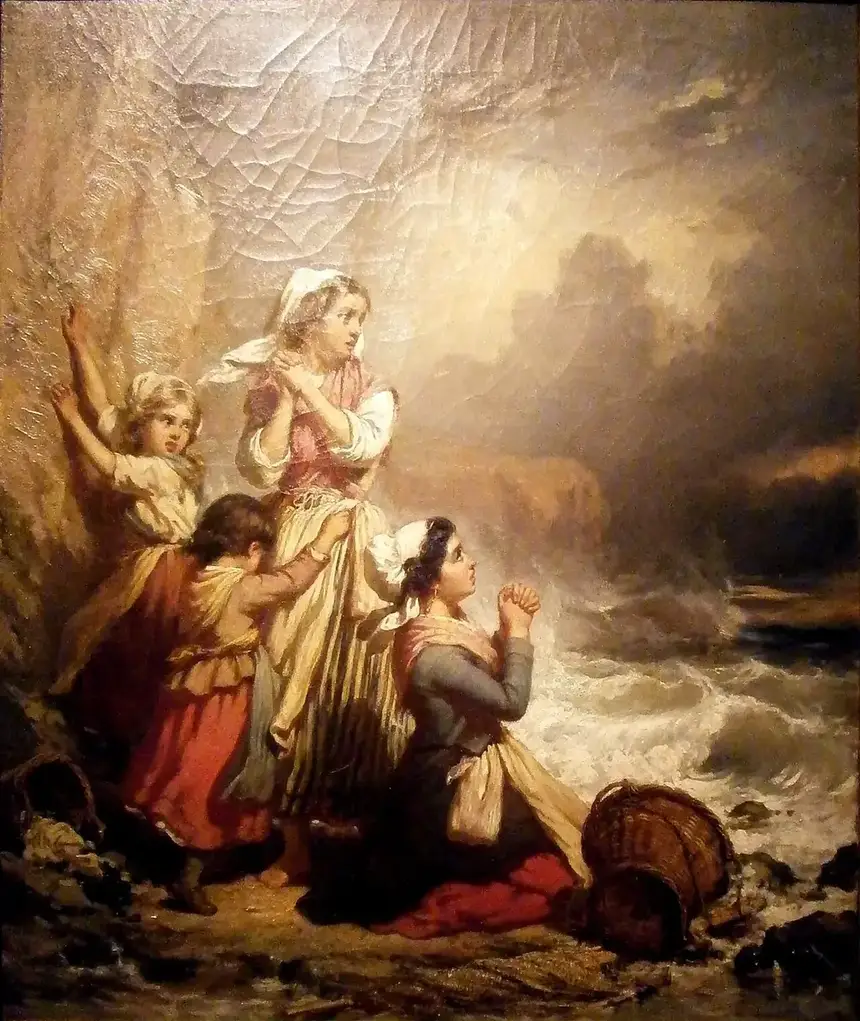
What makes a landscape worth painting by hand is the distance in it — the space between the near ground and the far one.
Our painter works freehand on a blank canvas, so the scale of the original survives the enlargement.
Dusk and overcast passages are the hardest and the most rewarding — they are all half-tones.
Our painter keeps the colour relationships rather than the exact hues, because relationships are what survive.
Where the source has a loaded passage, ours is loaded too — you will feel it from the side.
The difficulty is restraint: leaving out most of what a photograph would show.
It is a picture for a room you use, not a corridor you walk through.
| Artist | Eugène Delacroix |
|---|---|
| Title | Ramasseuses de coquillages |
| Created (original) | 1852 |
| Medium | Oil on canvas, hand-painted to order |
| Reproduction | Hand-painted oil on canvas, made to order |
| Public domain | Yes — the artist died over 70 years ago |
Why this one cannot be printed
Prints are good at information and bad at paint. This subject is mostly paint.
Our painter follows the same logic rather than copying a photograph of it: the far distances go down cool and weak, the near ground stays loaded, and nothing is blended flat.
| Aspect | Hand-painted oil | Printed canvas |
|---|---|---|
| Edges | Chosen by the painter, passage by passage | Whatever the file happens to contain |
| Lifespan | Slow to change; varnish can be refreshed decades later | Fades and cracks sooner |
| Sense of depth | Real, created by layers of paint | Simulated by darker ink |
| Time to make | Days of one painter's working time | Minutes |
| The surface | Built up with brushes and knives | Printed flat in one pass |
Matching the original's degree of finish is harder than matching its colours.
Every canvas is painted to order, so the quote follows your size, frame and destination rather than a fixed list. Tell us what you need on WhatsApp and we reply with an exact figure, usually within the hour. There is no agency in between; the studio that paints your canvas is the one answering your messages.
How the canvas is built
The order of work matters as much as the work itself. Ours runs like this:
- Stretching and priming the support — cotton duck or linen goes onto the bars and gets its ground.
- Laying in the drawing — done by eye from the reference, not traced or projected.
- The big shapes are blocked in — thin paint, one colour at a time, the whole canvas at once.
- Setting the key — how dark the darks go determines everything that follows.
- Colour is built up — warmer and cooler versions of each passage, laid over the underpainting.
- Detail and highlights last — put on thickly and then not touched again.
- Drying and varnishing — the final varnish goes on once the paint has set, before we photograph it.
This one repaints badly, so our painter gets the values right early and leaves them.
Frames
If you are shipping, an unframed canvas rolled in a tube is considerably cheaper to move than a framed one.
If you are shipping, an unframed canvas rolled in a tube is considerably cheaper to move than a framed one.
What goes into it
Nothing is sprayed, sealed or laminated. The surface you see is paint and varnish, and that is all. The paint is built in layers, fat over lean, which is what stops it cracking later.
Large canvases get a cross-brace; anything over about a metre and a half needs one. The ground is a proper acrylic sizing, so the oil does not rot the fabric over time.
Looking after it
Do not wipe it with anything wet. Dust lightly, hang it somewhere stable, and forget about it.
What size works
Because each piece is painted from scratch, you are not limited to stock dimensions. These are the sizes clients ask for most:
| Size (inches) | Size (cm) | Best for |
|---|---|---|
| 30 × 24 in | 76 × 61 cm | Dining room, bedroom feature wall |
| 24 × 20 in | 60 × 50 cm | Study, home office, above a desk |
| 20 × 16 in | 50 × 40 cm | Bedroom, hallway, above a console |
| 16 × 12 in | 40 × 30 cm | A shelf, a small wall, a gallery group |
| 64 × 48 in | 163 × 122 cm | Villa scale, lobby, hospitality wall |
We will size the canvas to the room, not to a stock list. Send us the measurement. We quote DAP, so any duty or tax your country charges is settled by you at import. We do not add a tax line of our own.
For a stairwell or a double-height space, go larger than you think — the composition was built for distance.
Tell us where it will hang and how big it needs to be — we will price it properly.
💬 Get a Quote for Ramasseuses de coquillages surprises par la maréeFrom order to your wall
Allow 9–15 days for the painting itself. Shipping is a separate line on your quote — you see it before payment, not after.
Air freight runs about 7–10 business days, tracked, to your door. Every shipment goes out with tracking. We do not send anything untracked.
You approve the painting from photographs before it is packed — that is the checkpoint. Adjustments are part of the process. Say what you want different and it gets done.
Terms are DAP. Import duties and taxes, where they apply, are paid by the buyer on arrival — we never collect them in advance and never guess at the amount.
A deposit starts the canvas and books the painter's time; the balance is due before the crate leaves. If a crate arrives damaged, send us photographs within 48 hours and contact us directly — we will sort it out with you.
Questions worth asking
Can I get this in a size that is not listed?
Yes — the listed sizes are the common requests, not a limit. Very wide or unusually tall proportions are routine for us.
Does it come with a certificate of authenticity?
No, and we would be wary of anyone who issues one for a public-domain reproduction. What you receive is a hand-painted canvas and photographs of it before it ships.
Is it really painted by hand?
Yes — oil on canvas, brush and knife. There is no printing, no giclée and no canvas transfer at any stage.
Can you paint it from a different photograph of the same work?
Yes. If you have a better reference, send it on WhatsApp and we will work from yours.
Does it come framed?
Frames are priced on their own line. Most clients choose after seeing the photographs.
How long does it take?
Allow 9–15 days for the painting itself, then roughly 7–10 business days in transit.
Do you take a deposit?
A deposit starts the canvas and the balance falls due before it ships. Both figures appear on the quote.
What if it arrives damaged?
send us photographs within 48 hours and contact us directly — we will sort it out with you.
Do you sell prints?
No prints at all — no giclée, no canvas transfer, nothing machine-made.
What does it cost?
Every canvas is quoted on size, frame and destination rather than a fixed list. Tell us what you need and we reply with an exact figure.
Can you paint a different work by Eugène Delacroix?
Yes — send us the image, or look through the other Eugène Delacroix works on the site.