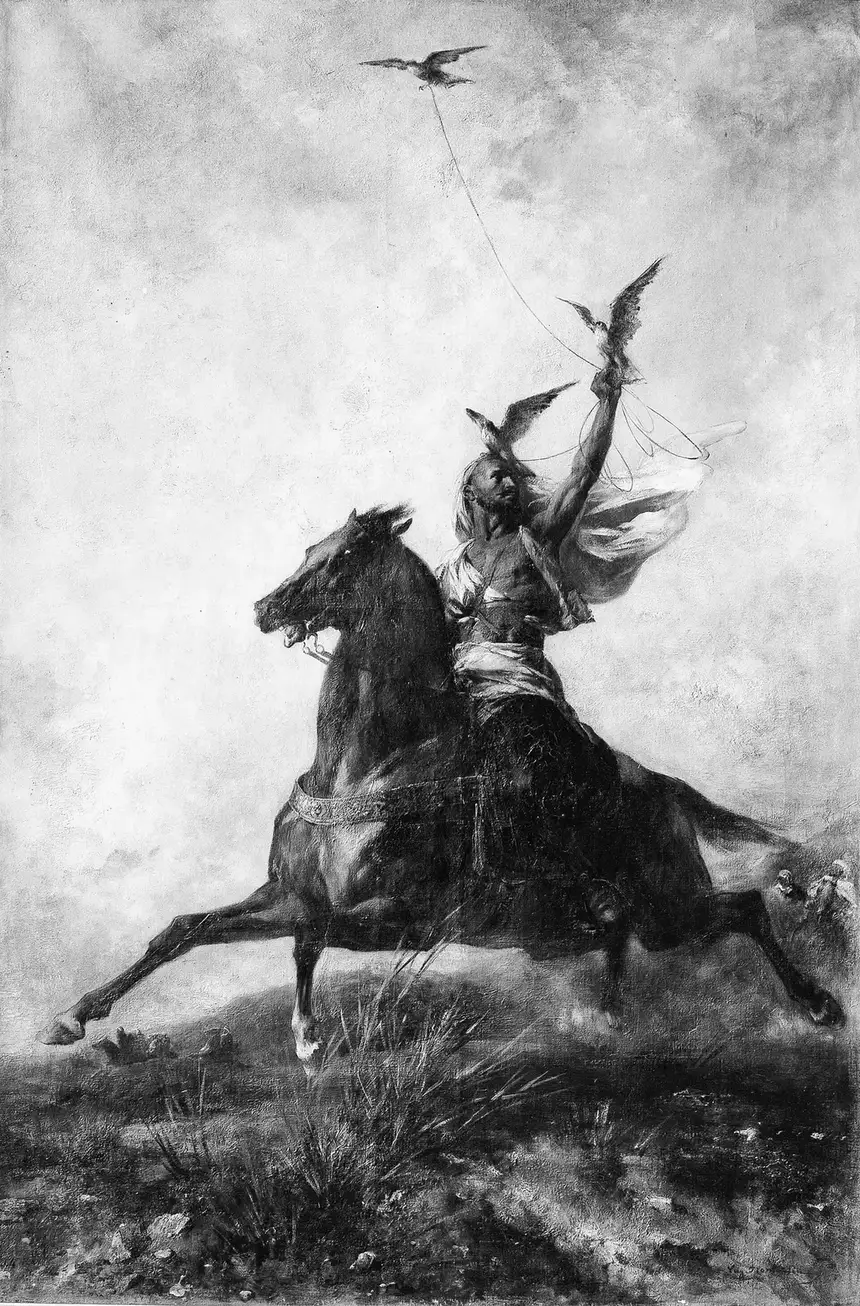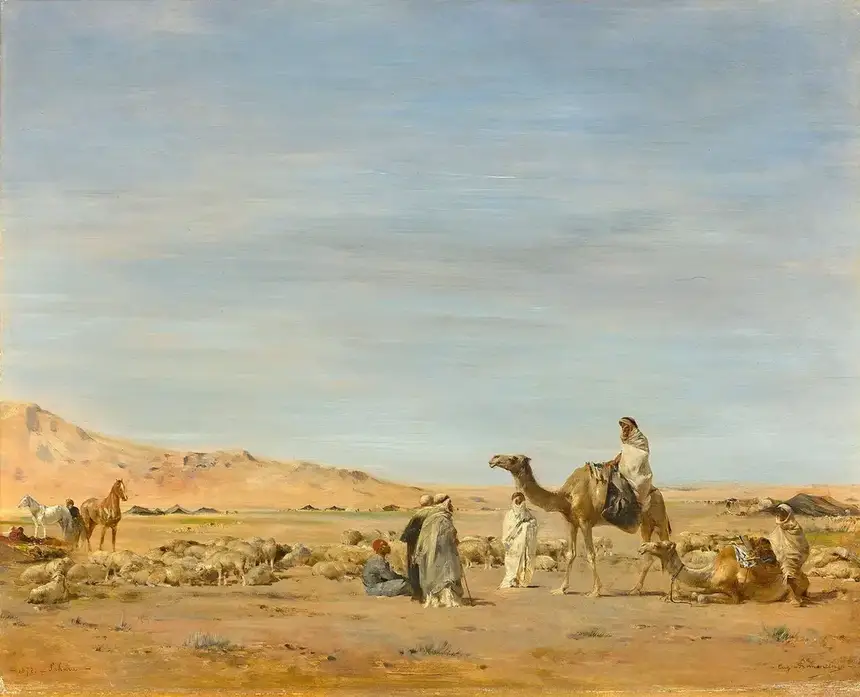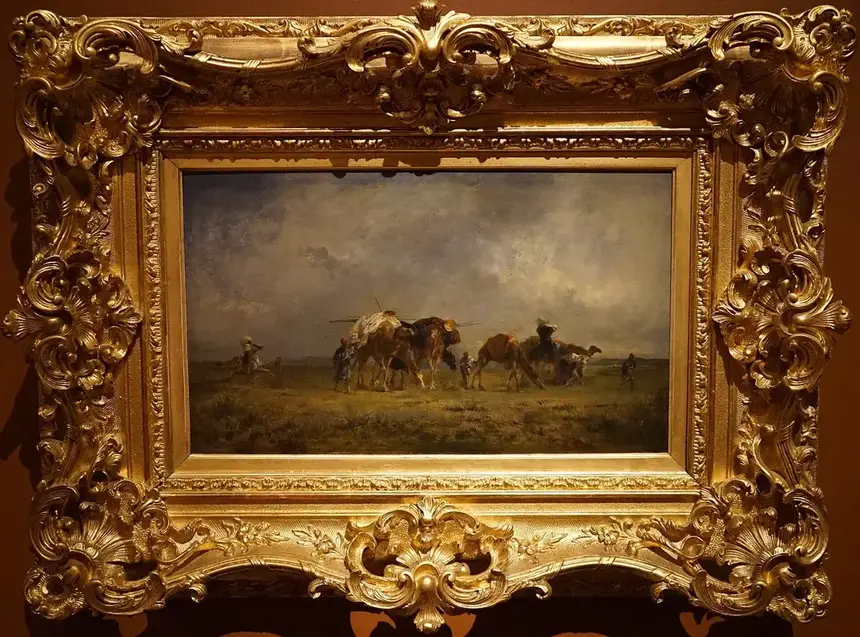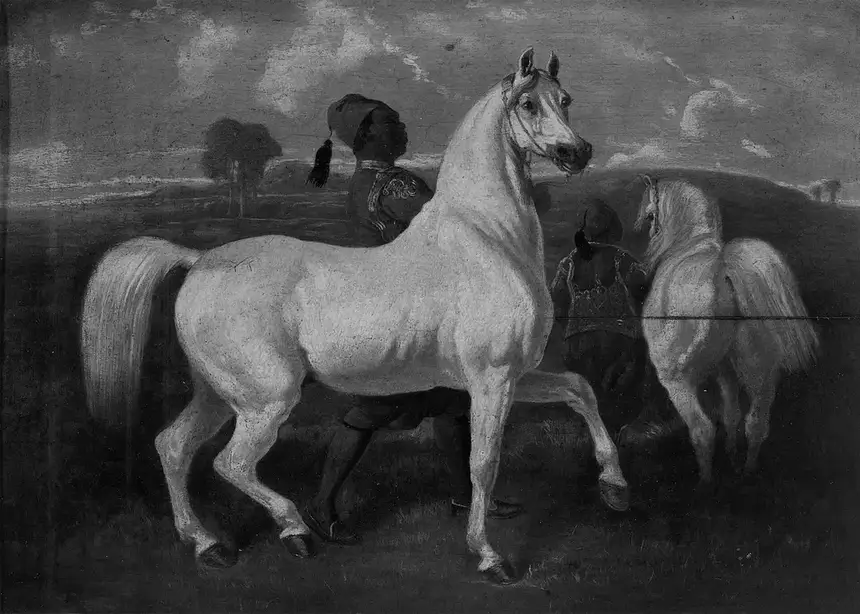
Where this painting comes from
Eugène Fromentin died in 1876, so the work has been in the public domain for decades. Reproducing it by hand is legal, and so is owning one.
Ours is a painting made with brushes. There is no giclée, no canvas transfer and no digital underlayer anywhere in the process.
The painting was made in the years before 1876, and what we reproduce is the record of it, not the object.
You are buying a painting, not a file. That distinction is the whole business we are in.
What to look at
Anonymous is not a postcard. There is a decision in every zone of the canvas, and the decision is visible.
Where the original has an awkward crop, we keep it. Correcting it would be painting a different picture.
Our painter leaves the highlights until last and puts them on thickly, so they stand off the surface.
The saturation is deliberately uneven: strongest at the focal point, weaker everywhere else.
Paint is laid on, not pushed around. That is what keeps it fresh.
The passage that will take longest is the one that looks simplest.
Given the subject, this sits naturally in a living room or a study rather than a hallway.
| Artist | Eugène Fromentin |
|---|---|
| Title | Anonymous |
| Medium | Oil on canvas, hand-painted to order |
| What you receive | A hand-painted oil painting on canvas |
| Copyright | Public domain; the original is out of copyright |
The case for painting it by hand
The difference is not subtle when the two hang side by side. Ink sits on the surface; oil stands off it.
Edges are left soft where the form turns away and sharp where it does not. That single habit is what separates a painting from a copy.
| Aspect | Hand-painted oil | Printed canvas |
|---|---|---|
| Later on | Can be restored, re-framed, handed on | Replaceable, and usually replaced |
| How it ages | Warms and settles; cleanable by a conservator | Fades, then cracks at the stretcher |
| Edge quality | Soft where the form turns, sharp where it does not | Uniformly sharp or uniformly blurred |
| Handling of colour | Mixed on the palette and finished on the canvas | Fixed by the colour profile |
| Available sizes | Whatever you need, painted to order | What the printer can output |
The hardest passage is the quiet one, where a small mistake has nowhere to hide.
Every canvas is painted to order, so the quote follows your size, frame and destination rather than a fixed list. Tell us what you need on WhatsApp and we reply with an exact figure, usually within the hour. You deal directly with the studio that paints it — no reseller layer.
How the canvas is built
No two canvases are painted the same way, but the sequence is always this:
- The canvas is stretched and primed — cotton or linen, sized and ready before any paint goes near it.
- The drawing goes down — charcoal or thin paint, done by eye rather than traced from a printout.
- Blocking the masses — thin paint, working the whole surface rather than one corner at a time.
- Getting the values right — the stage that decides whether the finished painting holds together.
- Colour is built up — warmer and cooler versions of each passage, laid over the underpainting.
- Finishing passes — the loaded highlights go on at the end and stay there.
- Drying and varnishing — the final varnish goes on once the paint has set, before we photograph it.
This one repaints badly, so our painter gets the values right early and leaves them.
Materials
The ground is a proper acrylic sizing, so the oil does not rot the fabric over time. Stretcher bars are kiln-dried and wedged, so the canvas can be re-tensioned years later.
Large canvases get a cross-brace; anything over about a metre and a half needs one. We buy pigment in tubes from the same suppliers the village has used for years, not in bulk drums.
Looking after it
Do not wipe it with anything wet. Dust lightly, hang it somewhere stable, and forget about it.
Frames
If you are shipping, an unframed canvas rolled in a tube is considerably cheaper to move than a framed one.
We can supply a simple floater frame, a traditional gilt, or nothing at all. It is your call.
Choosing a size
Because each piece is painted from scratch, you are not limited to stock dimensions. These are the sizes clients ask for most:
| Size (inches) | Size (cm) | Best for |
|---|---|---|
| 48 × 36 in | 122 × 91 cm | Large living room, stairwell, loft |
| 40 × 30 in | 102 × 76 cm | Living room focal wall, above a sofa |
| 32 × 24 in | 81 × 61 cm | Living room, above a sideboard |
| 30 × 24 in | 76 × 61 cm | Dining room, bedroom feature wall |
| 24 × 20 in | 60 × 50 cm | Study, home office, above a desk |
| 20 × 16 in | 50 × 40 cm | Bedroom, hallway, above a console |
We will size the canvas to the room, not to a stock list. Send us the measurement. We quote DAP, so any duty or tax your country charges is settled by you at import. We do not add a tax line of our own.
It is a picture for a room you use, not a corridor you walk through.
Send the wall, the size and whether you want a frame, and we will quote.
💬 Get a Quote for AnonymousTimeline and shipping
The painting takes 9–15 days, and delivery is priced separately on the quote so there is no surprise later.
Air freight runs about 7–10 business days, tracked, to your door. Unframed canvases are rolled face-out on a tube; framed ones are corner-protected and crated.
Nothing ships before you have seen it. Photographs of the finished painting go to you first. If something is not right, tell us what to adjust and we adjust it.
Duties and import taxes are the buyer's account (DAP). Your customs authority sets them; we do not.
You pay a deposit to start and the remainder before shipping. Nothing is hidden in between. Damage in transit should be reported to us within 48 hours, with photographs. We pursue it with the carrier rather than promising a refund.
Before you order
How do I clean and care for it?
Dust lightly with a dry, soft brush and keep it out of direct sun. Nothing else is needed for decades; oil paint is slow to change and easy to live with.
What size should I order?
You choose the size. Each canvas is cut to your measurements rather than pulled from stock, so tell us the wall dimensions and we will tell you what proportion works.
Is owning a reproduction legal?
Yes. Eugène Fromentin died more than 70 years ago, so the work is in the public domain and owning a hand-painted version is legal anywhere. We never pass ours off as the original.
What if it arrives damaged?
send us photographs within 48 hours and contact us directly — we will sort it out with you.
Will I see it before it ships?
Yes — photographs of the actual painting go to you first, and nothing is packed until you have seen them.
Who pays the import duty?
The buyer does. Terms are DAP: duties and taxes, where they apply, are paid on arrival. We never add a tax line of our own.
Is it really painted by hand?
Yes. One painter, oil paint, brushes. We do not own a printer that touches canvas.
What does it cost?
There is no price list, because the number depends on your size and frame. Message us and we will quote exactly.
Does it come framed?
Framing is quoted separately, so you can decide once you have seen the finished painting in photographs.
Can you paint it from a different photograph of the same work?
Send your own reference image and we will paint from that instead.
Do you take a deposit?
Work begins on a deposit and ships once the balance is paid. Nothing is charged that is not on the quote.