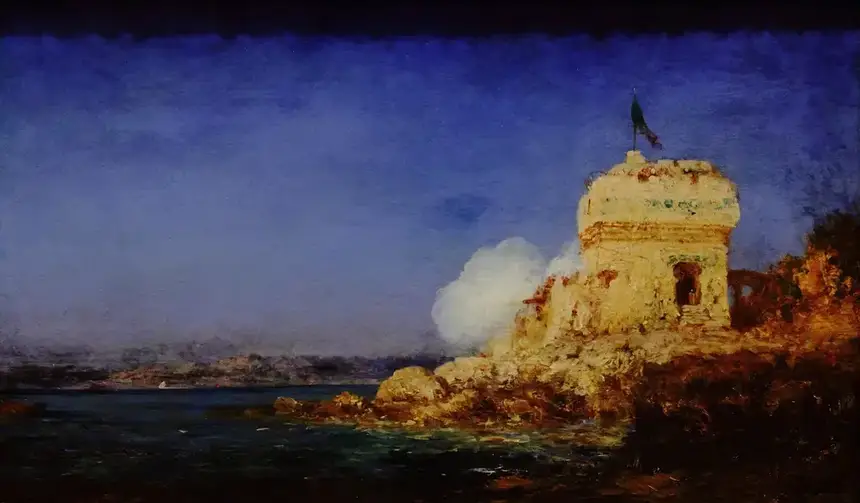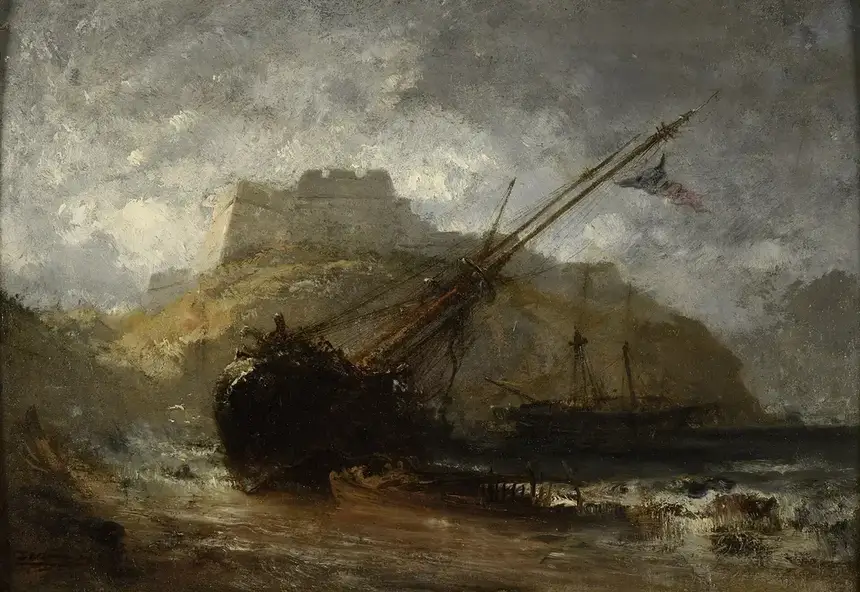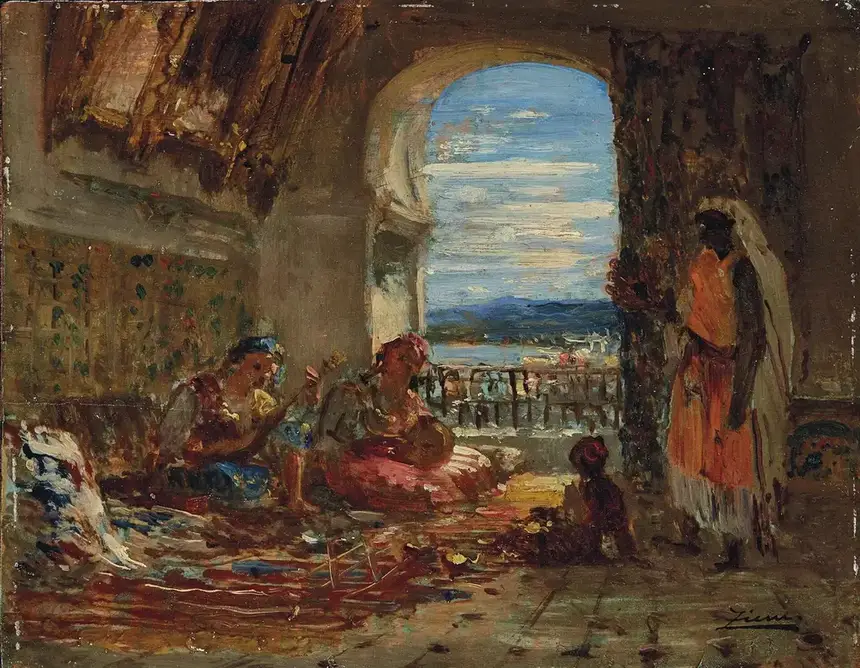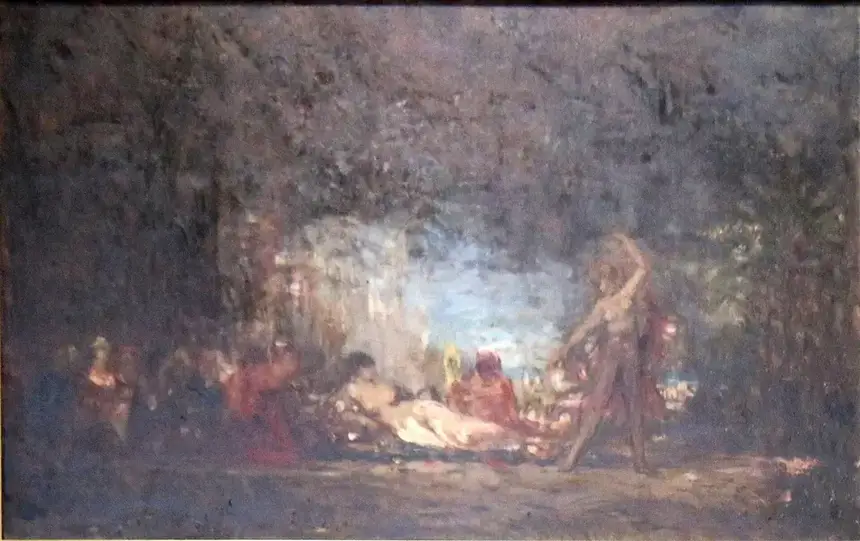
About the original
Félix Ziem died in 1911. That puts the painting well outside copyright, which is why we can paint it and you can own it anywhere in the world.
Every version we make is oil on canvas, painted by one painter from start to finish. No printing is involved at any stage.
The painting was made in the years before 1911, and what we reproduce is the record of it, not the object.
If you want something printed, we are the wrong workshop. We do not own a printer that touches canvas.
What the painting is doing
Cléopâtre is not a postcard. There is a decision in every zone of the canvas, and the decision is visible.
Where the original has an awkward crop, we keep it. Correcting it would be painting a different picture.
Light is handled as a value problem: how dark the darkest dark is determines the whole picture.
We keep the original's palette rather than brightening it, even where a modern eye would.
Where the source has a loaded passage, ours is loaded too — you will feel it from the side.
Getting Cléopâtre right means painting it in the right order, and the order is not obvious.
It works best on a wall you pass rather than one you sit and stare at — the paint rewards a moving eye.
| Artist | Félix Ziem |
|---|---|
| Title | Cléopâtre |
| Medium | Oil on canvas, hand-painted to order |
| What you receive | A hand-painted oil painting on canvas |
| Public domain | Yes — the artist died over 70 years ago |
What a print loses
What you lose in a print is the air. A press lays ink flat; a painter builds depth in layers, and the depth is what you actually see.
Where the original is loaded, ours is loaded. Where it is thin, ours is thin. Matching the weight of the paint matters more than matching the colour.
| Aspect | Hand-painted oil | Printed canvas |
|---|---|---|
| Handling of colour | Mixed on the palette and finished on the canvas | Fixed by the colour profile |
| Sense of depth | Real, created by layers of paint | Simulated by darker ink |
| Value over time | Can be re-stretched, cleaned and re-framed | Little value beyond the print |
| How it ages | Warms and settles; cleanable by a conservator | Fades, then cracks at the stretcher |
| Changing something | Tell us and the passage gets repainted | Usually means starting the file again |
The difficulty is restraint: leaving out most of what a photograph would show.
Every canvas is painted to order, so the quote follows your size, frame and destination rather than a fixed list. Tell us what you need on WhatsApp and we reply with an exact figure, usually within the hour. There is no agency in between; the studio that paints your canvas is the one answering your messages.
How your painting is made
Every canvas is painted to order, so nothing is pulled off a shelf. This is the sequence:
- Stretching and priming the support — cotton duck or linen goes onto the bars and gets its ground.
- A loose underdrawing — proportions checked by eye against the source image.
- The first colour pass — thin and simple, establishing the main shapes only.
- The values are established — this is the stage that decides whether the painting works.
- The colour passes — each area gets its own mixture rather than one colour used throughout.
- The detail and highlights go on — last, loaded, and left alone once they are down.
- Drying and varnishing — the final varnish goes on once the paint has set, before we photograph it.
The difficult part is not the detail. It is keeping the whole canvas at the same stage of finish.
Materials
We do not use a printer at any stage. There is no giclée, no canvas transfer, no digital underlayer. Stretcher bars are kiln-dried and wedged, so the canvas can be re-tensioned years later.
We buy pigment in tubes from the same suppliers the village has used for years, not in bulk drums. We use cotton duck for most sizes and linen where the canvas is large or the client asks for it.
On framing
Frames are priced once you have chosen them, not estimated in advance.
A frame is a separate line on the quote, not a bundle. You choose it once the painting exists.
Care and cleaning
Oil paint needs very little: no water, no cleaners, no sprays. A dry brush and a stable room.
Getting the size right
Because each piece is painted from scratch, you are not limited to stock dimensions. These are the sizes clients ask for most:
| Size (inches) | Size (cm) | Best for |
|---|---|---|
| 48 × 36 in | 122 × 91 cm | Large living room, stairwell, loft |
| 40 × 30 in | 102 × 76 cm | Living room focal wall, above a sofa |
| 32 × 24 in | 81 × 61 cm | Living room, above a sideboard |
| 30 × 24 in | 76 × 61 cm | Dining room, bedroom feature wall |
| 24 × 20 in | 60 × 50 cm | Study, home office, above a desk |
If your wall is an odd shape, send the measurement and we will work to it. Proportions from the original are kept unless you ask us to change them. Terms are DAP. Import duties and taxes, where they apply, are paid by the buyer on arrival — we never collect them in advance and never guess at the amount.
It is a picture for a room you use, not a corridor you walk through.
Tell us where it will hang and how big it needs to be — we will price it properly.
💬 Get a Quote for CléopâtreFrom order to your wall
Allow 9–15 days for the painting itself. Shipping is a separate line on your quote — you see it before payment, not after.
In transit it is typically 7–10 business days by air, tracked door to door. Unframed canvases are rolled face-out on a tube; framed ones are corner-protected and crated.
You approve the painting from photographs before it is packed — that is the checkpoint. If something is not right, tell us what to adjust and we adjust it.
We quote DAP, so any duty or tax your country charges is settled by you at import. We do not add a tax line of our own.
Work begins on a deposit and ships on the balance. Both figures are on the quote. Report any transit damage within 48 hours with photographs and we will deal with the carrier. We will not promise a payout, but we will not leave you to argue alone either.
Questions worth asking
What if it does not look right to me?
We send photographs of the actual painting for your approval before anything ships. That is the moment to tell us what to adjust.
How do I clean and care for it?
Dust lightly with a dry, soft brush and keep it out of direct sun. Nothing else is needed for decades; oil paint is slow to change and easy to live with.
Can you change the colours to suit my room?
We can shift the palette, but we will tell you honestly when a change would spoil the painting.
Is it really painted by hand?
Yes. One painter, oil paint, brushes. We do not own a printer that touches canvas.
Can I change the size?
Any size you like. We paint to the number you give us rather than to a standard range.
What if it arrives damaged?
send us photographs within 48 hours and contact us directly — we will sort it out with you.
Does it come framed?
Frames are priced on their own line. Most clients choose after seeing the photographs.
What is the canvas made of?
Cotton or linen, oil colour, and varnish. Stretcher bars are wedged so the canvas can be re-tensioned later.
Do you sell prints?
No. Hand-painted oil on canvas only. No printing, no giclée, no canvas transfer.
What does it cost?
Every canvas is quoted on size, frame and destination rather than a fixed list. Tell us what you need and we reply with an exact figure.
Will I see it before it ships?
Yes. We send photographs of the finished canvas and wait for your reply before packing.