The original, and why we can paint it
Félix Ziem died in 1911, so the work has been in the public domain for decades. Reproducing it by hand is legal, and so is owning one.
We paint it in oil on canvas, one at a time, in Dafen Village. Nothing is printed, scanned or transferred.
The painting was made in the years before 1911, and what we reproduce is the record of it, not the object.
You are buying a painting, not a file. That distinction is the whole business we are in.
What the painting is doing
A painted a landscape is an argument about air. Copy the shapes and you still have not copied the argument.
Space in a landscape is made with value, not perspective: things that are further away are painted cooler and weaker.
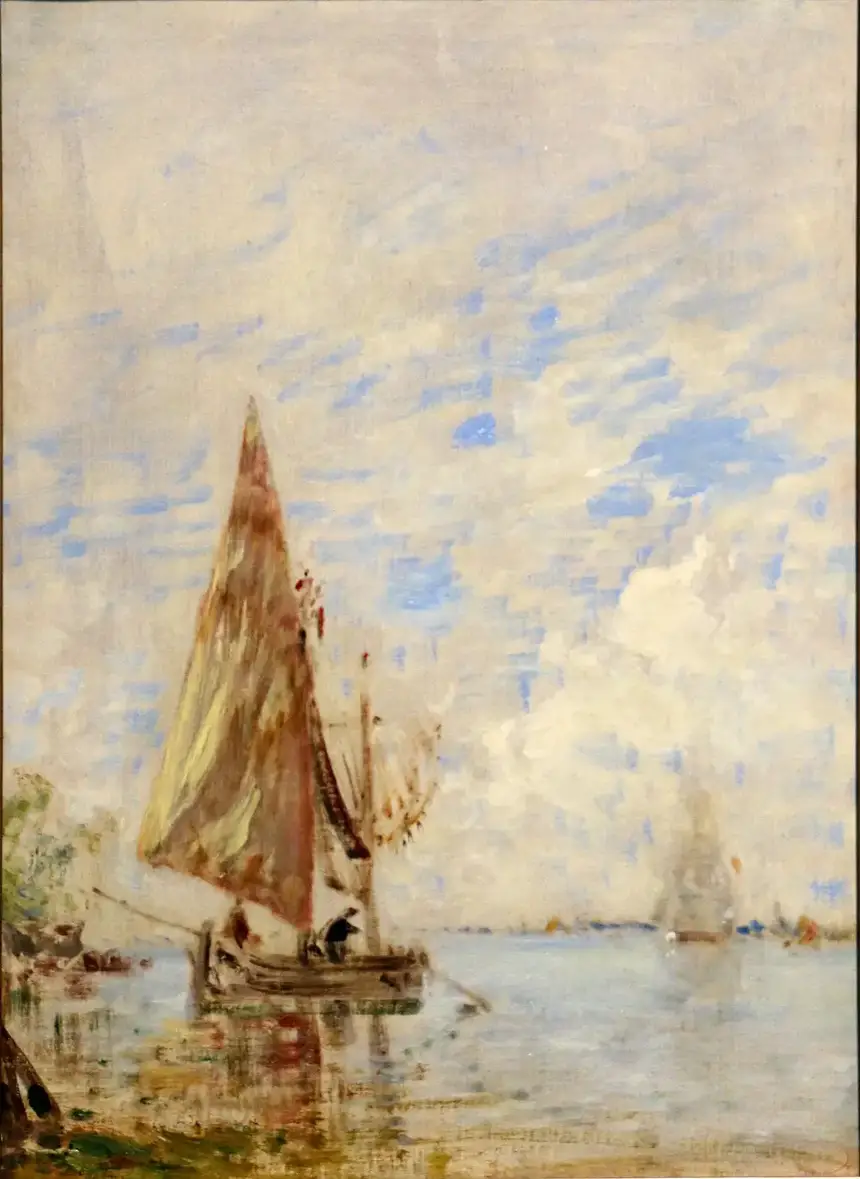
The light in Pêcheurs dans une barque has a direction, and the painter keeps it consistent across every object in the picture.
Temperature does the work of contrast in the quiet areas, where value differences are small.
Paint is laid on, not pushed around. That is what keeps it fresh.
The hardest passage is the quiet one, where a small mistake has nowhere to hide.
It suits a room with warm, low light. Strong downlighting flattens the surface.
| Artist | Félix Ziem |
|---|---|
| Title | Pêcheurs dans une barque |
| Medium | Oil on canvas, hand-painted to order |
| How it is made | Painted by hand in oil on canvas, to your size |
| Public domain | Yes — the artist died over 70 years ago |
Hand-painted, not printed
The difference is not subtle when the two hang side by side. Ink sits on the surface; oil stands off it.
Our painter follows the same logic rather than copying a photograph of it: the far distances go down cool and weak, the near ground stays loaded, and nothing is blended flat.
| Aspect | Hand-painted oil | Printed canvas |
|---|---|---|
| Texture | Ridges and drag you can see from across a room | None, or a printed imitation of it |
| Sense of depth | Real, created by layers of paint | Simulated by darker ink |
| Edges | Chosen by the painter, passage by passage | Whatever the file happens to contain |
| The surface | Built up with brushes and knives | Printed flat in one pass |
| What it takes | One painter, several days, start to finish | A machine, a few minutes |
Getting Pêcheurs dans une barque right means painting it in the right order, and the order is not obvious.
Every canvas is painted to order, so the quote follows your size, frame and destination rather than a fixed list. Tell us what you need on WhatsApp and we reply with an exact figure, usually within the hour. No resellers, no drop-shipper. The painter's studio handles your commission from first message to final crate.
How it gets painted
No two canvases are painted the same way, but the sequence is always this:
- Stretching and priming the support — cotton duck or linen goes onto the bars and gets its ground.
- The drawing goes down — charcoal or thin paint, done by eye rather than traced from a printout.
- The first colour pass — thin and simple, establishing the main shapes only.
- The values are established — this is the stage that decides whether the painting works.
- Building the colour — a warm and a cool version of each passage, put down in order.
- Finishing passes — the loaded highlights go on at the end and stay there.
- Drying and varnishing — the final varnish goes on once the paint has set, before we photograph it.
Matching the original's degree of finish is harder than matching its colours.
Whether to frame it
If you are shipping, an unframed canvas rolled in a tube is considerably cheaper to move than a framed one.
Frames are priced once you have chosen them, not estimated in advance.
Canvas, paint and varnish
The paint is built in layers, fat over lean, which is what stops it cracking later. We buy pigment in tubes from the same suppliers the village has used for years, not in bulk drums.
Brushes, knives and rags. That is the equipment list; there is no machine in the process. Oil paint dries by oxidation, not evaporation, which is why a finished canvas needs weeks before it travels.
Looking after it
Once the varnish has cured the surface can be cleaned by a conservator, but in a normal house it will not need it for decades.
Getting the size right
The canvas is cut to your wall, not the other way round. For reference, these are the dimensions most often requested:
| Size (inches) | Size (cm) | Best for |
|---|---|---|
| 20 × 16 in | 50 × 40 cm | Bedroom, hallway, above a console |
| 16 × 12 in | 40 × 30 cm | A shelf, a small wall, a gallery group |
| 64 × 48 in | 163 × 122 cm | Villa scale, lobby, hospitality wall |
| 48 × 36 in | 122 × 91 cm | Large living room, stairwell, loft |
| 40 × 30 in | 102 × 76 cm | Living room focal wall, above a sofa |
If your wall is an odd shape, send the measurement and we will work to it. Proportions from the original are kept unless you ask us to change them. We quote DAP, so any duty or tax your country charges is settled by you at import. We do not add a tax line of our own.
Hang it at eye level — roughly 145 cm from the floor to the centre — and it will hold the wall.
Give us your size and framing preference and you will have a quote shortly.
💬 Get a Quote for Pêcheurs dans une barqueHow it reaches you
Painting takes 9–15 days. Freight is quoted as its own line on the quote, agreed before you pay anything, and never added afterwards.
In transit it is typically 7–10 business days by air, tracked door to door. We send photographs of the finished painting before it is packed, and again once it is boxed.
You approve the painting from photographs before it is packed — that is the checkpoint. Adjustments are part of the process. Say what you want different and it gets done.
Import charges, where they exist, are the buyer's responsibility (DAP). We never add them to the quote and never guess what they will be.
A deposit starts the canvas and books the painter's time; the balance is due before the crate leaves. Damage in transit should be reported to us within 48 hours, with photographs. We pursue it with the carrier rather than promising a refund.
Before you order
Does changing the size change the composition?
No — we keep the original's proportions and scale from there, rather than cropping the image to fit a standard frame.
Can I resell the reproduction?
Yes. Because the underlying work is in the public domain, the hand-painted canvas is yours to sell, gift or install commercially.
Can I change something in the composition?
Often yes — background, cropping, or adapting the proportions to your wall. Tell us what you have in mind and we will say honestly whether it will work.
Is it really painted by hand?
Yes — oil on canvas, brush and knife. There is no printing, no giclée and no canvas transfer at any stage.
How do I hang it?
Roughly 145 cm from floor to centre works for most rooms. Tell us your wall and we will give you the measurement.
What if it arrives damaged?
send us photographs within 48 hours and contact us directly — we will sort it out with you.
Do you take a deposit?
A deposit starts the canvas and the balance falls due before it ships. Both figures appear on the quote.
Do you sell prints?
No prints at all — no giclée, no canvas transfer, nothing machine-made.
Can you change the colours to suit my room?
We can shift the palette, but we will tell you honestly when a change would spoil the painting.
Can you paint a different work by Félix Ziem?
Yes. Send the image and we will quote it, or browse the other paintings we have listed.
Does it come framed?
Frames are priced on their own line. Most clients choose after seeing the photographs.
Will I see it before it ships?
Yes — photographs of the actual painting go to you first, and nothing is packed until you have seen them.