The original, and why we can paint it
Francis Cadell died in 1937, so the work has been in the public domain for decades. Reproducing it by hand is legal, and so is owning one.
Every version we make is oil on canvas, painted by one painter from start to finish. No printing is involved at any stage.
The painting was made in the years before 1937, and what we reproduce is the record of it, not the object.
If you want something printed, we are the wrong workshop. We do not own a printer that touches canvas.
Where the painting lives
The reason Afternoon still works as a painting is that it was built as paint, not as a picture of a place.
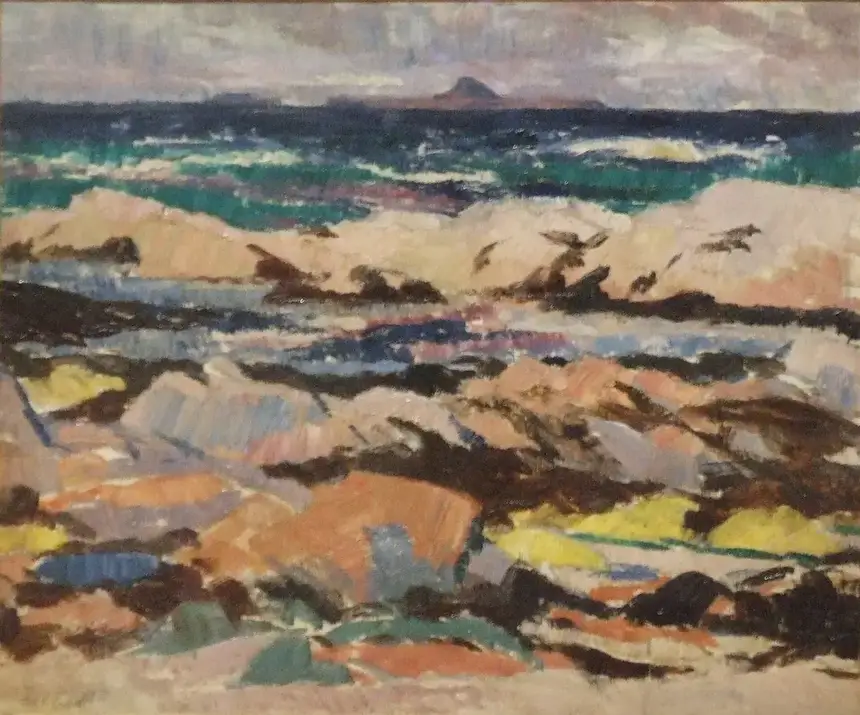
The composition is built on a few large masses. Get those right and the rest follows.
Where the source has light coming through the paint, we glaze rather than paint opaque white.
Every colour in Afternoon has a warm version and a cool version, and the painter chooses between them passage by passage.
The last marks are the ones that are left alone. Overworking is the enemy.
The hardest passage is the quiet one, where a small mistake has nowhere to hide.
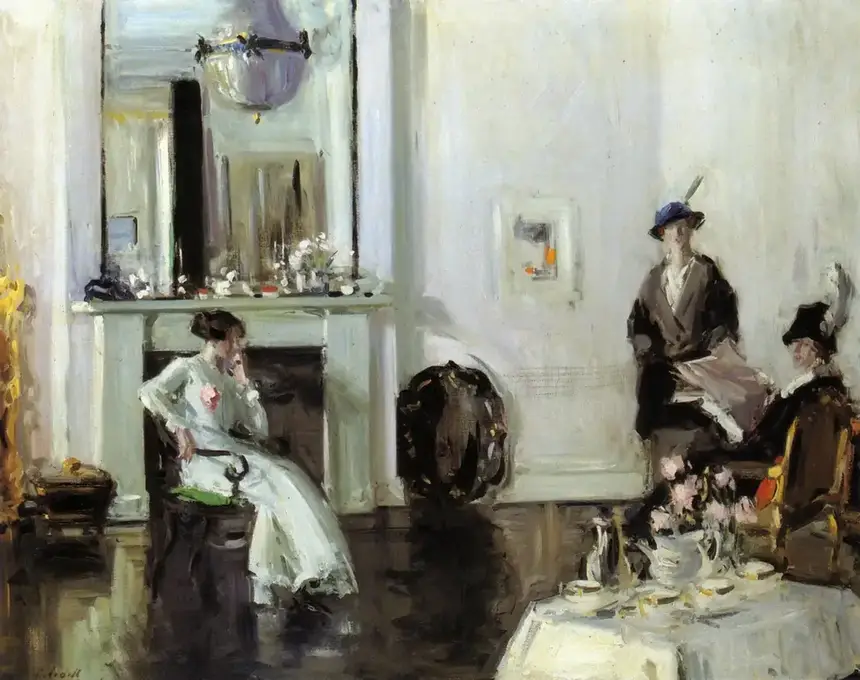
Given the subject, this sits naturally in a living room or a study rather than a hallway.
| Artist | Francis Cadell |
|---|---|
| Title | Afternoon |
| Created (original) | 1913 |
| Medium | Oil on canvas, hand-painted to order |
| Our version | Oil on canvas, painted by hand to order |
| Original status | Public domain (artist deceased) |
Why this one cannot be printed
The difference is not subtle when the two hang side by side. Ink sits on the surface; oil stands off it.
Edges are left soft where the form turns away and sharp where it does not. That single habit is what separates a painting from a copy.
| Aspect | Hand-painted oil | Printed canvas |
|---|---|---|
| Edge quality | Soft where the form turns, sharp where it does not | Uniformly sharp or uniformly blurred |
| Colour | Mixed for each passage, warm and cool versions | One flat value per area |
| Value over time | Can be re-stretched, cleaned and re-framed | Little value beyond the print |
| Depth | Built in layers, catches light from the side | Flat; highlights are printed as pale ink |
| The surface | Built up with brushes and knives | Printed flat in one pass |
The risk with a landscape is overworking, and the way to avoid it is knowing when to stop.
Every canvas is painted to order, so the quote follows your size, frame and destination rather than a fixed list. Tell us what you need on WhatsApp and we reply with an exact figure, usually within the hour. You deal directly with the studio that paints it — no reseller layer.
How the canvas is built
No two canvases are painted the same way, but the sequence is always this:
- Stretching and priming the support — cotton duck or linen goes onto the bars and gets its ground.
- A loose underdrawing — proportions checked by eye against the source image.
- Blocking the masses — thin paint, working the whole surface rather than one corner at a time.
- Setting the key — how dark the darks go determines everything that follows.
- Building the colour — a warm and a cool version of each passage, put down in order.
- Detail and highlights last — put on thickly and then not touched again.
- It dries, then gets varnished — and only then is it photographed for you.
The difficulty is restraint: leaving out most of what a photograph would show.
Living with it
Once the varnish has cured the surface can be cleaned by a conservator, but in a normal house it will not need it for decades.
On framing
A frame is a separate line on the quote, not a bundle. You choose it once the painting exists.
If you are shipping, an unframed canvas rolled in a tube is considerably cheaper to move than a framed one.
What it is made of
The varnish is removable, so a conservator can clean the painting in fifty years without touching the paint. The paint is built in layers, fat over lean, which is what stops it cracking later.
Oil paint dries by oxidation, not evaporation, which is why a finished canvas needs weeks before it travels. The ground is a proper acrylic sizing, so the oil does not rot the fabric over time.
Choosing a size
You are not choosing from a list; you are telling us a measurement. These are the common ones:
| Size (inches) | Size (cm) | Best for |
|---|---|---|
| 32 × 24 in | 81 × 61 cm | Living room, above a sideboard |
| 30 × 24 in | 76 × 61 cm | Dining room, bedroom feature wall |
| 24 × 20 in | 60 × 50 cm | Study, home office, above a desk |
| 20 × 16 in | 50 × 40 cm | Bedroom, hallway, above a console |
If your wall is an odd shape, send the measurement and we will work to it. Proportions from the original are kept unless you ask us to change them. We sell DAP: the price covers the painting and the freight, and any import duties or taxes are the buyer's to settle with customs. We do not collect them and we do not estimate them.
It works best on a wall you pass rather than one you sit and stare at — the paint rewards a moving eye.
Send the wall, the size and whether you want a frame, and we will quote.
💬 Get a Quote for AfternoonHow it reaches you
Allow 9–15 days for the painting itself. Shipping is a separate line on your quote — you see it before payment, not after.
Air freight runs about 7–10 business days, tracked, to your door. We send photographs of the finished painting before it is packed, and again once it is boxed.
Before anything is packed, you get photographs of the actual canvas and a chance to ask for changes. Adjustments are part of the process. Say what you want different and it gets done.
DAP terms: we pay the freight, you settle any duty or tax your country applies. We do not collect taxes on anyone's behalf.
A deposit starts the canvas and books the painter's time; the balance is due before the crate leaves. If a crate arrives damaged, send us photographs within 48 hours and contact us directly — we will sort it out with you.
Questions worth asking
Does it read well in a dim room?
Better than a print does, because the light in the painting is built from underlayers rather than from a bright surface coat.
How do I know what size will look right?
Measure the wall and send a photograph. We will say honestly if the canvas you have in mind is too small for the space, which is the most common mistake.
What if my wall is an unusual shape?
That is normal for us. Send the measurements and we will work out a canvas proportion that suits the space.
What does it cost?
Every canvas is quoted on size, frame and destination rather than a fixed list. Tell us what you need and we reply with an exact figure.
What is the canvas made of?
Cotton or linen, oil colour, and varnish. Stretcher bars are wedged so the canvas can be re-tensioned later.
Do you sell prints?
No. Hand-painted oil on canvas only. No printing, no giclée, no canvas transfer.
What if it arrives damaged?
Report damage within 48 hours with photographs. We deal with the carrier rather than leaving you to argue alone.
How long does it take?
From order to finished canvas is 9–15 days; delivery adds about 7–10 business days by air.
Who pays the import duty?
You do. We sell DAP, so any duty or tax your customs authority charges is settled by you at import. We do not collect it and we do not estimate it.
Is it really painted by hand?
Yes — oil on canvas, brush and knife. There is no printing, no giclée and no canvas transfer at any stage.
Will I see it before it ships?
Yes — photographs of the actual painting go to you first, and nothing is packed until you have seen them.
Do you take a deposit?
A deposit starts the canvas and the balance falls due before it ships. Both figures appear on the quote.