About La Cena de Emaús
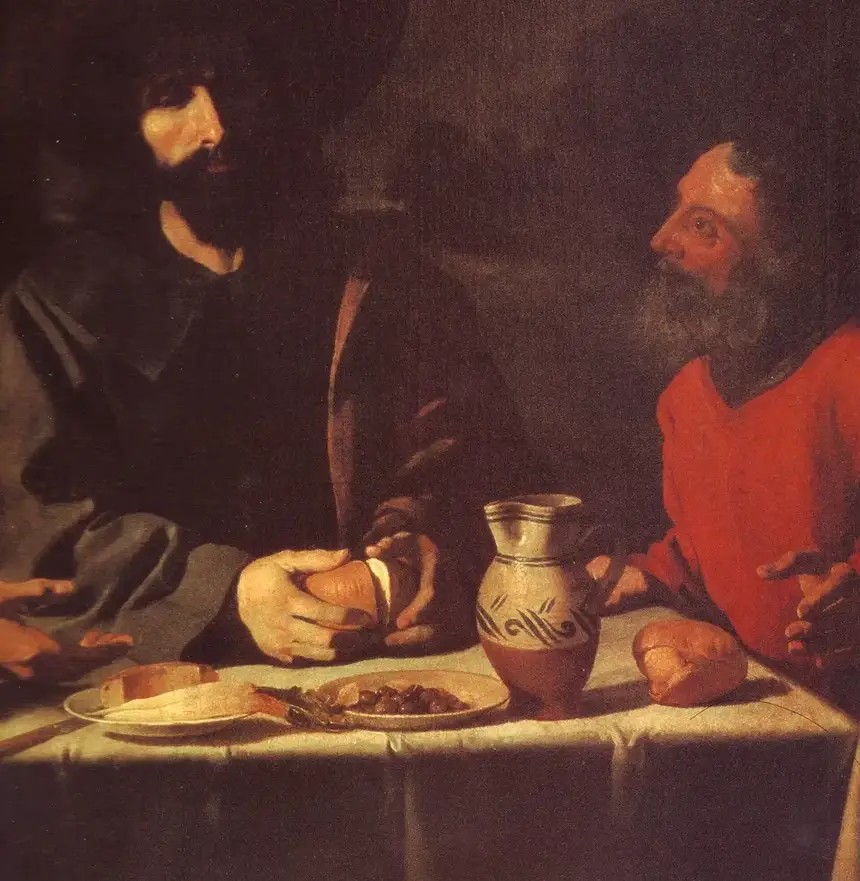
Francisco de Zurbarán died in 1664. That puts the painting well outside copyright, which is why we can paint it and you can own it anywhere in the world.
Ours is a painting made with brushes. There is no giclée, no canvas transfer and no digital underlayer anywhere in the process.
The painting was made in the years before 1664, and what we reproduce is the record of it, not the object.
If you want something printed, we are the wrong workshop. We do not own a printer that touches canvas.
Looking at it properly
There is a reason a landscape is the hardest thing to print and the easiest thing to paint: the paint itself carries the depth.
Our painter blocks the big shapes first and lets the detail come last, so the composition holds at any size.
The light in La Cena de Emaús has a direction, and the painter keeps it consistent across every object in the picture.
Our painter keeps the colour relationships rather than the exact hues, because relationships are what survive.
Our painter loads the brush differently for the near and far passages, and you can read the difference.
The difficulty is restraint: leaving out most of what a photograph would show.
Hang it at eye level — roughly 145 cm from the floor to the centre — and it will hold the wall.
| Artist | Francisco de Zurbarán |
|---|---|
| Title | La Cena de Emaús |
| Medium | Oil on canvas, hand-painted to order |
| Reproduction | Hand-painted oil on canvas, made to order |
| Copyright | Public domain; the original is out of copyright |
Hand-painted, not printed
What you lose in a print is the air. A press lays ink flat; a painter builds depth in layers, and the depth is what you actually see.
Paint goes on in the original's order — thin first, thick last — so the surface behaves the way the painter intended.
| Aspect | Hand-painted oil | Printed canvas |
|---|---|---|
| Available sizes | Whatever you need, painted to order | What the printer can output |
| Handling of colour | Mixed on the palette and finished on the canvas | Fixed by the colour profile |
| The surface | Built up with brushes and knives | Printed flat in one pass |
| Changing something | Tell us and the passage gets repainted | Usually means starting the file again |
| Time to make | Days of one painter's working time | Minutes |
The passage that will take longest is the one that looks simplest.
Every canvas is painted to order, so the quote follows your size, frame and destination rather than a fixed list. Tell us what you need on WhatsApp and we reply with an exact figure, usually within the hour. You are talking to the people who will actually paint it, not a middleman.
How the canvas is built
No two canvases are painted the same way, but the sequence is always this:
- We start with the canvas itself — stretched, sized and left to settle before any colour is mixed.
- The drawing goes down — charcoal or thin paint, done by eye rather than traced from a printout.
- The big shapes are blocked in — thin paint, one colour at a time, the whole canvas at once.
- Getting the values right — the stage that decides whether the finished painting holds together.
- Building the colour — a warm and a cool version of each passage, put down in order.
- Detail and highlights last — put on thickly and then not touched again.
- Drying and varnishing — the final varnish goes on once the paint has set, before we photograph it.
The risk with a landscape is overworking, and the way to avoid it is knowing when to stop.
Looking after it
Dust it with a dry, soft brush. Keep it out of direct sun and away from radiators, and it will outlive you.
Whether to frame it
Frames are priced once you have chosen them, not estimated in advance.
We can supply a simple floater frame, a traditional gilt, or nothing at all. It is your call.
What goes into it
Brushes, knives and rags. That is the equipment list; there is no machine in the process. Linen is worth the extra cost above about a metre across, because it holds tension better in humid rooms.
Oil paint dries by oxidation, not evaporation, which is why a finished canvas needs weeks before it travels. Large canvases get a cross-brace; anything over about a metre and a half needs one.
Getting the size right
The canvas is cut to your wall, not the other way round. For reference, these are the dimensions most often requested:
| Size (inches) | Size (cm) | Best for |
|---|---|---|
| 30 × 24 in | 76 × 61 cm | Dining room, bedroom feature wall |
| 24 × 20 in | 60 × 50 cm | Study, home office, above a desk |
| 20 × 16 in | 50 × 40 cm | Bedroom, hallway, above a console |
| 16 × 12 in | 40 × 30 cm | A shelf, a small wall, a gallery group |
| 64 × 48 in | 163 × 122 cm | Villa scale, lobby, hospitality wall |
| 48 × 36 in | 122 × 91 cm | Large living room, stairwell, loft |
If your wall is an odd shape, send the measurement and we will work to it. Proportions from the original are kept unless you ask us to change them. Terms are DAP. Import duties and taxes, where they apply, are paid by the buyer on arrival — we never collect them in advance and never guess at the amount.
It suits a room with warm, low light. Strong downlighting flattens the surface.
Message us the dimensions you have in mind and we will come back with a figure.
💬 Get a Quote for La Cena de EmaúsTimeline and shipping
From order to finished canvas is 9–15 days. Freight appears as a separate line on the quote and is fixed before you pay.
In transit it is typically 7–10 business days by air, tracked door to door. Rolled in a tube it travels cheaper and safer than framed; most overseas clients take it that way.
Nothing ships before you have seen it. Photographs of the finished painting go to you first. If something is not right, tell us what to adjust and we adjust it.
DAP terms: we pay the freight, you settle any duty or tax your country applies. We do not collect taxes on anyone's behalf.
Work begins on a deposit and ships on the balance. Both figures are on the quote. If a crate arrives damaged, send us photographs within 48 hours and contact us directly — we will sort it out with you.
Questions worth asking
Why not just print it?
A print flattens the surface into a poster: the distance collapses and the highlights turn to grey. Paint keeps the depth and the texture the original was built from.
What happens after I message you?
You tell us the painting, size and whether you want a frame. We quote, a painter starts on your canvas, and you get photographs before it ships.
Can I see progress photos while it is being painted?
We send photographs of the finished painting for approval before it ships. Mid-process images are not part of the standard workflow.
Can I change the size?
Any size you like. We paint to the number you give us rather than to a standard range.
Do you sell prints?
No prints at all — no giclée, no canvas transfer, nothing machine-made.
What is the canvas made of?
Cotton duck as standard, linen on request, artist-grade oil paint, and a final varnish once the paint is fully dry.
Does it come framed?
Frames are priced on their own line. Most clients choose after seeing the photographs.
How long does it take?
Allow 9–15 days for the painting itself, then roughly 7–10 business days in transit.
How do I hang it?
Centre it at about 145 cm from the floor, or two-thirds the width of the furniture below it. We will tell you the exact number for your wall.
Do you take a deposit?
A deposit starts the canvas and the balance falls due before it ships. Both figures appear on the quote.
What if it arrives damaged?
Report damage within 48 hours with photographs. We deal with the carrier rather than leaving you to argue alone.
Will I see it before it ships?
Yes — photographs of the actual painting go to you first, and nothing is packed until you have seen them.