About the original
Francisco Goya died in 1828, so the work has been in the public domain for decades. Reproducing it by hand is legal, and so is owning one.
Ours is a painting made with brushes. There is no giclée, no canvas transfer and no digital underlayer anywhere in the process.
It is an original composition painted before 1828, and our version is painted from the surviving image of it.
If you want something printed, we are the wrong workshop. We do not own a printer that touches canvas.
What to look at
A painted a landscape is an argument about air. Copy the shapes and you still have not copied the argument.
Space in a landscape is made with value, not perspective: things that are further away are painted cooler and weaker.
Our painter leaves the highlights until last and puts them on thickly, so they stand off the surface.
We keep the original's palette rather than brightening it, even where a modern eye would.
Where the source has a loaded passage, ours is loaded too — you will feel it from the side.
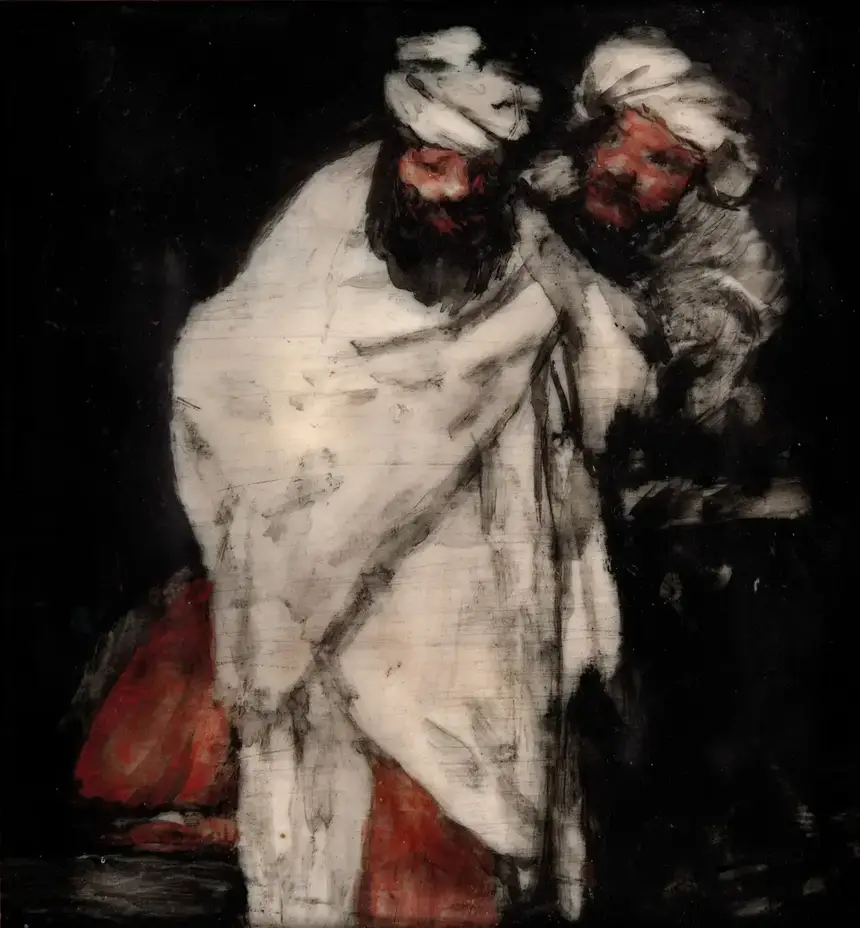
Getting Dos moros, Francisco de Goya right means painting it in the right order, and the order is not obvious.
It suits a room with warm, low light. Strong downlighting flattens the surface.
| Artist | Francisco Goya |
|---|---|
| Title | Dos moros, Francisco de Goya |
| Medium | Oil on canvas, hand-painted to order |
| What you receive | A hand-painted oil painting on canvas |
| Original status | Public domain (artist deceased) |
Why this one cannot be printed
The difference is not subtle when the two hang side by side. Ink sits on the surface; oil stands off it.
Where the original is loaded, ours is loaded. Where it is thin, ours is thin. Matching the weight of the paint matters more than matching the colour.
| Aspect | Hand-painted oil | Printed canvas |
|---|---|---|
| Sense of depth | Real, created by layers of paint | Simulated by darker ink |
| Value over time | Can be re-stretched, cleaned and re-framed | Little value beyond the print |
| How it ages | Warms and settles; cleanable by a conservator | Fades, then cracks at the stretcher |
| Edge quality | Soft where the form turns, sharp where it does not | Uniformly sharp or uniformly blurred |
| Impasto | Real paint standing off the canvas | Flat ink, sometimes embossed to imitate |
Anyone can copy the shapes. The skill is in the transitions, and that is what takes the days.
Every canvas is painted to order, so the quote follows your size, frame and destination rather than a fixed list. Tell us what you need on WhatsApp and we reply with an exact figure, usually within the hour. You are buying from the workshop, not a catalogue.
The sequence on our floor
This is how the painting is built, in the order our painters build it:
- The canvas is stretched and primed — cotton or linen, sized and ready before any paint goes near it.
- Laying in the drawing — done by eye from the reference, not traced or projected.
- Blocking the masses — thin paint, working the whole surface rather than one corner at a time.
- Getting the values right — the stage that decides whether the finished painting holds together.
- Building the colour — a warm and a cool version of each passage, put down in order.
- The detail and highlights go on — last, loaded, and left alone once they are down.
- Drying and varnishing — the final varnish goes on once the paint has set, before we photograph it.
The risk with a landscape is overworking, and the way to avoid it is knowing when to stop.
Looking after it
Once the varnish has cured the surface can be cleaned by a conservator, but in a normal house it will not need it for decades.
Materials
The paint is built in layers, fat over lean, which is what stops it cracking later. Large canvases get a cross-brace; anything over about a metre and a half needs one.
Varnish goes on only once the paint is properly dry, months after the last stroke, not before. We buy pigment in tubes from the same suppliers the village has used for years, not in bulk drums.
Framing
If you are shipping, an unframed canvas rolled in a tube is considerably cheaper to move than a framed one.
We can supply a simple floater frame, a traditional gilt, or nothing at all. It is your call.
Canvas sizes
The canvas is cut to your wall, not the other way round. For reference, these are the dimensions most often requested:
| Size (inches) | Size (cm) | Best for |
|---|---|---|
| 48 × 36 in | 122 × 91 cm | Large living room, stairwell, loft |
| 40 × 30 in | 102 × 76 cm | Living room focal wall, above a sofa |
| 32 × 24 in | 81 × 61 cm | Living room, above a sideboard |
| 30 × 24 in | 76 × 61 cm | Dining room, bedroom feature wall |
Anything outside this table is fine — we paint to the number you give us. Import charges, where they exist, are the buyer's responsibility (DAP). We never add them to the quote and never guess what they will be.
Hang it at eye level — roughly 145 cm from the floor to the centre — and it will hold the wall.
Tell us the size and frame — exact quote back, usually within the hour.
💬 Get a Quote for Dos moros, Francisco de GoyaHow it reaches you
Allow 9–15 days for the painting itself. Shipping is a separate line on your quote — you see it before payment, not after.
In transit it is typically 7–10 business days by air, tracked door to door. We send photographs of the finished painting before it is packed, and again once it is boxed.
Before anything is packed, you get photographs of the actual canvas and a chance to ask for changes. If something is not right, tell us what to adjust and we adjust it.
We sell DAP: the price covers the painting and the freight, and any import duties or taxes are the buyer's to settle with customs. We do not collect them and we do not estimate them.
Work begins on a deposit and ships on the balance. Both figures are on the quote. If a crate arrives damaged, send us photographs within 48 hours and contact us directly — we will sort it out with you.
The practical questions
What size should I order?
You choose the size. Each canvas is cut to your measurements rather than pulled from stock, so tell us the wall dimensions and we will tell you what proportion works.
Is there a rush option?
It depends on the canvas and what else is in the studio. Ask on WhatsApp with your size and we will tell you straight what is possible.
Is owning a reproduction legal?
Yes. Francisco Goya died more than 70 years ago, so the work is in the public domain and owning a hand-painted version is legal anywhere. We never pass ours off as the original.
How long does it take?
Painting takes 9–15 days. Air freight is usually 7–10 business days on top of that, tracked.
Does it come framed?
Framing is quoted separately, so you can decide once you have seen the finished painting in photographs.
Do you ship to my country?
We export to more than 20 countries. Tell us where you are and we will quote the freight as a separate line.
What does it cost?
There is no price list, because the number depends on your size and frame. Message us and we will quote exactly.
What is the canvas made of?
Cotton duck as standard, linen on request, artist-grade oil paint, and a final varnish once the paint is fully dry.
Who pays the import duty?
The buyer does. Terms are DAP: duties and taxes, where they apply, are paid on arrival. We never add a tax line of our own.
Is it really painted by hand?
Yes — oil on canvas, brush and knife. There is no printing, no giclée and no canvas transfer at any stage.
Do you sell prints?
No. Hand-painted oil on canvas only. No printing, no giclée, no canvas transfer.