The original, and why we can paint it
Because Frank Weston Benson died in 1951, this work is in the public domain. We are painting a copy of a painting — we never pass it off as the original, and neither should anyone selling you one.
Ours is a painting made with brushes. There is no giclée, no canvas transfer and no digital underlayer anywhere in the process.
The painting was made in the years before 1951, and what we reproduce is the record of it, not the object.
If you want something printed, we are the wrong workshop. We do not own a printer that touches canvas.
Looking at it properly
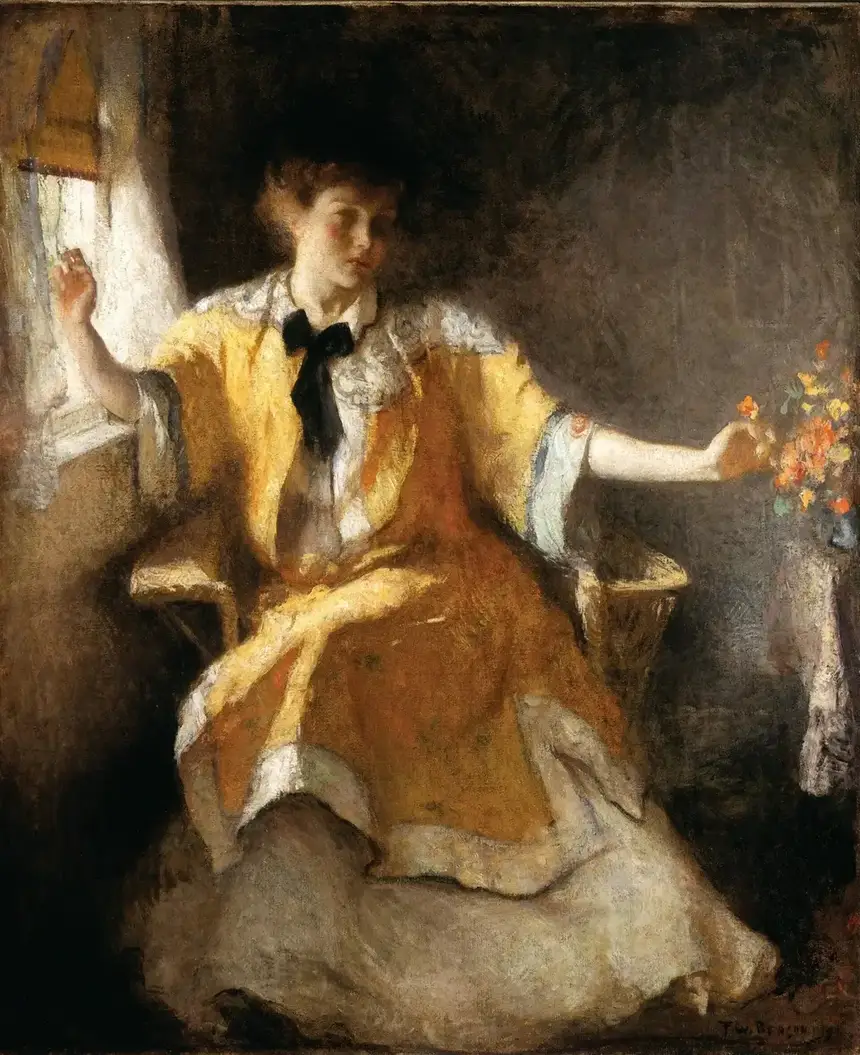
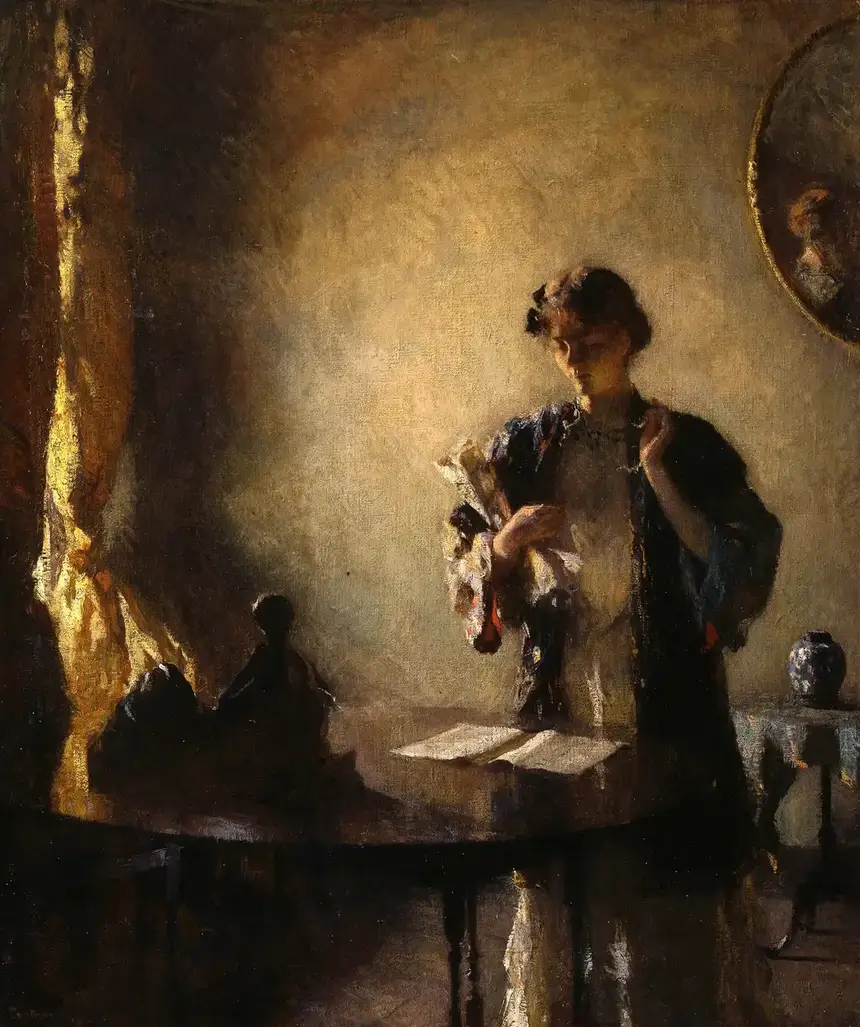
The difficulty in Figure in a Room is keeping the shadows transparent, which is a layering problem, not a colour problem.
Objects are grouped by value, so the eye moves through the room instead of stopping at each one.
Shadows indoors are lit by bounce, and we paint them as lit rather than as dark.
Our painter mixes on the palette but finishes on the canvas, which is where the small variations come from.
Our painter uses a larger brush than you would expect, which is why the passages stay simple.
What takes time here is the number of separate decisions, not the size of the canvas.
A plain wall is better than a busy one; the painting supplies the interest.
| Artist | Frank Weston Benson |
|---|---|
| Title | Figure in a Room |
| Created (original) | 1912 |
| Medium | Oil on canvas, hand-painted to order |
| How it is made | Painted by hand in oil on canvas, to your size |
| Original status | Public domain (artist deceased) |
Why hand-painting matters here
Prints are good at information and bad at paint. This subject is mostly paint.
Where the original is loaded, ours is loaded. Where it is thin, ours is thin. Matching the weight of the paint matters more than matching the colour.
| Aspect | Hand-painted oil | Printed canvas |
|---|---|---|
| Size | Any size, painted to your wall | Limited by the printer |
| Changing something | Tell us and the passage gets repainted | Usually means starting the file again |
| Edges | Chosen by the painter, passage by passage | Whatever the file happens to contain |
| Surface | Hand-painted oil on canvas | Ink on canvas, flat |
| How it ages | Warms and settles; cleanable by a conservator | Fades, then cracks at the stretcher |
This one repaints badly, so our painter gets the values right early and leaves them.
Every canvas is painted to order, so the quote follows your size, frame and destination rather than a fixed list. Tell us what you need on WhatsApp and we reply with an exact figure, usually within the hour. There is no agency in between; the studio that paints your canvas is the one answering your messages.
How the canvas is built
Here is what actually happens between your message and the crate:
- We start with the canvas itself — stretched, sized and left to settle before any colour is mixed.
- Laying in the drawing — done by eye from the reference, not traced or projected.
- Blocking the masses — thin paint, working the whole surface rather than one corner at a time.
- Setting the key — how dark the darks go determines everything that follows.
- Colour is built up — warmer and cooler versions of each passage, laid over the underpainting.
- Finishing passes — the loaded highlights go on at the end and stay there.
- Drying and varnishing — the final varnish goes on once the paint has set, before we photograph it.
The hardest passage is the quiet one, where a small mistake has nowhere to hide.
Care and cleaning
Do not wipe it with anything wet. Dust lightly, hang it somewhere stable, and forget about it.
Frames
We can supply a simple floater frame, a traditional gilt, or nothing at all. It is your call.
Frames are priced once you have chosen them, not estimated in advance.
Canvas, paint and varnish
We buy pigment in tubes from the same suppliers the village has used for years, not in bulk drums. We do not use a printer at any stage. There is no giclée, no canvas transfer, no digital underlayer.
The varnish is removable, so a conservator can clean the painting in fifty years without touching the paint. We use a neutral-sized ground so the whites stay warm rather than going blue over time.
Choosing a size
You are not choosing from a list; you are telling us a measurement. These are the common ones:
| Size (inches) | Size (cm) | Best for |
|---|---|---|
| 40 × 30 in | 102 × 76 cm | Living room focal wall, above a sofa |
| 32 × 24 in | 81 × 61 cm | Living room, above a sideboard |
| 30 × 24 in | 76 × 61 cm | Dining room, bedroom feature wall |
| 24 × 20 in | 60 × 50 cm | Study, home office, above a desk |
If your wall is an odd shape, send the measurement and we will work to it. Proportions from the original are kept unless you ask us to change them. We sell DAP: the price covers the painting and the freight, and any import duties or taxes are the buyer's to settle with customs. We do not collect them and we do not estimate them.
Given the subject, this sits naturally in a living room or a study rather than a hallway.
Tell us where it will hang and how big it needs to be — we will price it properly.
💬 Get a Quote for Figure in a RoomHow it reaches you
From order to finished canvas is 9–15 days. Freight appears as a separate line on the quote and is fixed before you pay.
Air freight runs about 7–10 business days, tracked, to your door. Every shipment goes out with tracking. We do not send anything untracked.
Nothing ships before you have seen it. Photographs of the finished painting go to you first. Changes are handled by telling us what to change; we change it and send new photographs.
Shipments go out DAP. If your customs office charges duty or tax on arrival, that is between you and them — we do not collect it and we do not put a number on it.
Work begins on a deposit and ships on the balance. Both figures are on the quote. Report any transit damage within 48 hours with photographs and we will deal with the carrier. We will not promise a payout, but we will not leave you to argue alone either.
The practical questions
Is there a rush option?
It depends on the canvas and what else is in the studio. Ask on WhatsApp with your size and we will tell you straight what is possible.
Can I change something in the composition?
Often yes — background, cropping, or adapting the proportions to your wall. Tell us what you have in mind and we will say honestly whether it will work.
Does changing the size change the composition?
No — we keep the original's proportions and scale from there, rather than cropping the image to fit a standard frame.
Do you sell prints?
No prints at all — no giclée, no canvas transfer, nothing machine-made.
What is the canvas made of?
Cotton duck as standard, linen on request, artist-grade oil paint, and a final varnish once the paint is fully dry.
How do I hang it?
Roughly 145 cm from floor to centre works for most rooms. Tell us your wall and we will give you the measurement.
How long does it take?
Painting takes 9–15 days. Air freight is usually 7–10 business days on top of that, tracked.
Can you paint it from a different photograph of the same work?
Send your own reference image and we will paint from that instead.
What if it arrives damaged?
send us photographs within 48 hours and contact us directly — we will sort it out with you.
Does it come framed?
Framing is quoted separately, so you can decide once you have seen the finished painting in photographs.
Who pays the import duty?
The buyer does. Terms are DAP: duties and taxes, where they apply, are paid on arrival. We never add a tax line of our own.
Is owning a reproduction legal?
Yes. The painting is out of copyright because Frank Weston Benson died more than 70 years ago. We paint copies honestly and never claim they are originals.