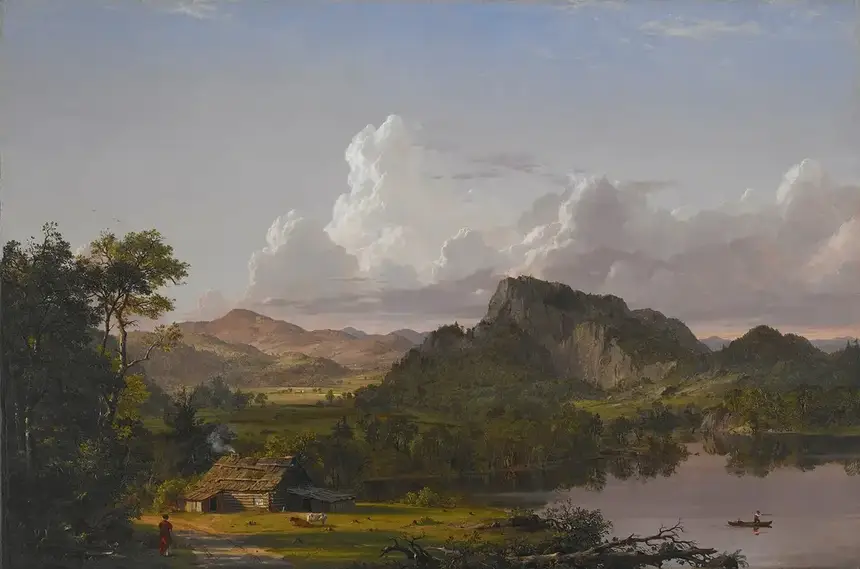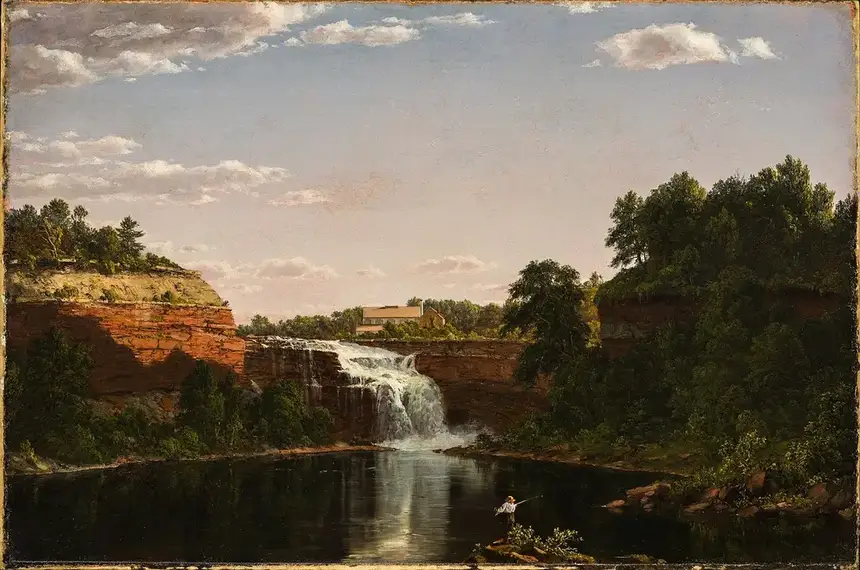
About the original
Because Frederic Edwin Church died in 1900, this work is in the public domain. We are painting a copy of a painting — we never pass it off as the original, and neither should anyone selling you one.
Ours is a painting made with brushes. There is no giclée, no canvas transfer and no digital underlayer anywhere in the process.
The painting was made in the years before 1900, and what we reproduce is the record of it, not the object.
You are buying a painting, not a file. That distinction is the whole business we are in.
Looking at it properly
What carries Frederick Edwin Church, is not the subject. It is the handling — how the paint was loaded, and where it was left alone.
Where the source leaves an edge lost, we leave it lost. Sharpening it would be painting a different picture.
The fall-off from light to shadow is gradual, and gradual transitions are what printing compresses first.
The darks are mixed, not blackened — black straight from the tube would kill the passage.
Paint is laid on, not pushed around. That is what keeps it fresh.
The difficulty is restraint: leaving out most of what a photograph would show.
Given the subject, this sits naturally in a living room or a study rather than a hallway.
| Artist | Frederic Edwin Church |
|---|---|
| Title | Frederick Edwin Church, |
| Created (original) | 1849 |
| Medium | Oil on canvas, hand-painted to order |
| Our version | Oil on canvas, painted by hand to order |
| Copyright | Public domain; the original is out of copyright |
What a print loses
Prints are good at information and bad at paint. This subject is mostly paint.
Our painter follows the same logic rather than copying a photograph of it: the far distances go down cool and weak, the near ground stays loaded, and nothing is blended flat.
| Aspect | Hand-painted oil | Printed canvas |
|---|---|---|
| Depth | Built in layers, catches light from the side | Flat; highlights are printed as pale ink |
| Handling of colour | Mixed on the palette and finished on the canvas | Fixed by the colour profile |
| What it takes | One painter, several days, start to finish | A machine, a few minutes |
| Available sizes | Whatever you need, painted to order | What the printer can output |
| Value over time | Can be re-stretched, cleaned and re-framed | Little value beyond the print |
Getting Frederick Edwin Church, right means painting it in the right order, and the order is not obvious.
Every canvas is painted to order, so the quote follows your size, frame and destination rather than a fixed list. Tell us what you need on WhatsApp and we reply with an exact figure, usually within the hour. No resellers, no drop-shipper. The painter's studio handles your commission from first message to final crate.
How it gets painted
Here is what actually happens between your message and the crate:
- We start with the canvas itself — stretched, sized and left to settle before any colour is mixed.
- The drawing goes down — charcoal or thin paint, done by eye rather than traced from a printout.
- The first colour pass — thin and simple, establishing the main shapes only.
- The values are established — this is the stage that decides whether the painting works.
- Colour is built up — warmer and cooler versions of each passage, laid over the underpainting.
- The detail and highlights go on — last, loaded, and left alone once they are down.
- Drying and varnishing — the final varnish goes on once the paint has set, before we photograph it.
This one repaints badly, so our painter gets the values right early and leaves them.
Living with it
Once the varnish has cured the surface can be cleaned by a conservator, but in a normal house it will not need it for decades.
Materials
We buy pigment in tubes from the same suppliers the village has used for years, not in bulk drums. Pigment is artist-grade oil colour, not acrylic and not house paint. It behaves differently and it lasts.
Large canvases get a cross-brace; anything over about a metre and a half needs one. Nothing is sprayed, sealed or laminated. The surface you see is paint and varnish, and that is all.
Whether to frame it
Frames are priced once you have chosen them, not estimated in advance.
Framing is quoted separately, so you can decide after you have seen the finished canvas in photographs.
What size works
Because each piece is painted from scratch, you are not limited to stock dimensions. These are the sizes clients ask for most:
| Size (inches) | Size (cm) | Best for |
|---|---|---|
| 32 × 24 in | 81 × 61 cm | Living room, above a sideboard |
| 30 × 24 in | 76 × 61 cm | Dining room, bedroom feature wall |
| 24 × 20 in | 60 × 50 cm | Study, home office, above a desk |
| 20 × 16 in | 50 × 40 cm | Bedroom, hallway, above a console |
| 16 × 12 in | 40 × 30 cm | A shelf, a small wall, a gallery group |
| 64 × 48 in | 163 × 122 cm | Villa scale, lobby, hospitality wall |
Anything outside this table is fine — we paint to the number you give us. We quote DAP, so any duty or tax your country charges is settled by you at import. We do not add a tax line of our own.
It wants a wall where the light rakes across it, because the surface is part of the picture.
Give us your size and framing preference and you will have a quote shortly.
💬 Get a Quote for Frederick Edwin Church, Lower Falls, RochesterOrder, painting, shipping
From order to finished canvas is 9–15 days. Freight appears as a separate line on the quote and is fixed before you pay.
Expect 7–10 business days in transit, with tracking from our door to yours. Unframed canvases are rolled face-out on a tube; framed ones are corner-protected and crated.
Before anything is packed, you get photographs of the actual canvas and a chance to ask for changes. Adjustments are part of the process. Say what you want different and it gets done.
Duties and import taxes are the buyer's account (DAP). Your customs authority sets them; we do not.
A deposit starts the canvas and books the painter's time; the balance is due before the crate leaves. If a crate arrives damaged, send us photographs within 48 hours and contact us directly — we will sort it out with you.
Questions worth asking
How do I know what size will look right?
Measure the wall and send a photograph. We will say honestly if the canvas you have in mind is too small for the space, which is the most common mistake.
When will it actually arrive?
Studio time is 9–15 days, then a few more days for the oil to set before we can photograph and pack it. We tell you where your canvas is at each stage.
How close will it be to the original?
The composition, colour and drawing follow the original closely; the brushwork carries the painter's own hand. The painter works freehand on a blank canvas, following the same logic as the original rather than copying a photograph.
Do you take a deposit?
Work begins on a deposit and ships once the balance is paid. Nothing is charged that is not on the quote.
Does it come framed?
Framing is quoted separately, so you can decide once you have seen the finished painting in photographs.
Will I see it before it ships?
Yes — photographs of the actual painting go to you first, and nothing is packed until you have seen them.
Who pays the import duty?
The buyer does. Terms are DAP: duties and taxes, where they apply, are paid on arrival. We never add a tax line of our own.
Can I change the size?
Any size you like. We paint to the number you give us rather than to a standard range.
Do you ship to my country?
We export to more than 20 countries. Tell us where you are and we will quote the freight as a separate line.
Can you paint a different work by Frederic Edwin Church?
Yes. Send the image and we will quote it, or browse the other paintings we have listed.
Can you change the colours to suit my room?
We can shift the palette, but we will tell you honestly when a change would spoil the painting.
Is it really painted by hand?
Yes. One painter, oil paint, brushes. We do not own a printer that touches canvas.