About Whispers
Frederic Leighton died in 1896, so the work has been in the public domain for decades. Reproducing it by hand is legal, and so is owning one.
Ours is a painting made with brushes. There is no giclée, no canvas transfer and no digital underlayer anywhere in the process.
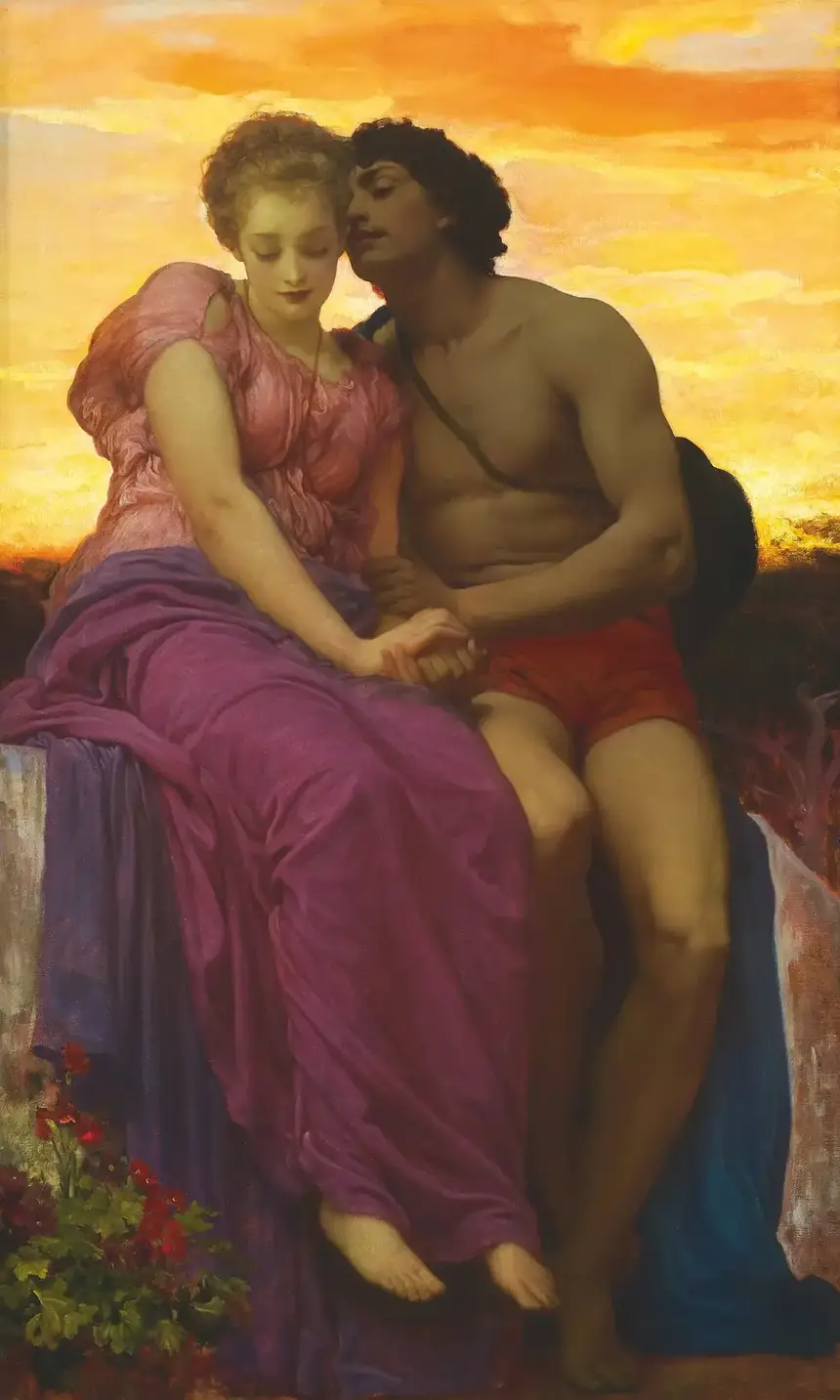
The painting was made in the years before 1896, and what we reproduce is the record of it, not the object.
What arrives is a canvas with paint on it, made by a person. That is the only thing we sell.
Where the painting lives
Ours is painted from the source image, stroke by stroke, so Whispers keeps the order it was originally built in.
Our painter blocks the big shapes first and lets the detail come last, so the composition holds at any size.
Dusk and overcast passages are the hardest and the most rewarding — they are all half-tones.
Temperature does the work of contrast in the quiet areas, where value differences are small.
The last marks are the ones that are left alone. Overworking is the enemy.
The risk with a landscape is overworking, and the way to avoid it is knowing when to stop.
This reads well above a sofa or a sideboard, where it will be seen from two to three metres.
| Artist | Frederic Leighton |
|---|---|
| Title | Whispers |
| Medium | Oil on canvas, hand-painted to order |
| Our version | Oil on canvas, painted by hand to order |
| Copyright | Public domain; the original is out of copyright |
Why this one cannot be printed
The difference is not subtle when the two hang side by side. Ink sits on the surface; oil stands off it.
Our painter follows the same logic rather than copying a photograph of it: the far distances go down cool and weak, the near ground stays loaded, and nothing is blended flat.
| Aspect | Hand-painted oil | Printed canvas |
|---|---|---|
| What it takes | One painter, several days, start to finish | A machine, a few minutes |
| Changing something | Tell us and the passage gets repainted | Usually means starting the file again |
| Sense of depth | Real, created by layers of paint | Simulated by darker ink |
| Edges | Chosen by the painter, passage by passage | Whatever the file happens to contain |
| Impasto | Real paint standing off the canvas | Flat ink, sometimes embossed to imitate |
The difficulty is restraint: leaving out most of what a photograph would show.
Every canvas is painted to order, so the quote follows your size, frame and destination rather than a fixed list. Tell us what you need on WhatsApp and we reply with an exact figure, usually within the hour. There is no agency in between; the studio that paints your canvas is the one answering your messages.
The sequence on our floor
This is how the painting is built, in the order our painters build it:
- The canvas is stretched and primed — cotton or linen, sized and ready before any paint goes near it.
- Laying in the drawing — done by eye from the reference, not traced or projected.
- Blocking the masses — thin paint, working the whole surface rather than one corner at a time.
- The values are established — this is the stage that decides whether the painting works.
- The colour passes — each area gets its own mixture rather than one colour used throughout.
- Finishing passes — the loaded highlights go on at the end and stay there.
- Drying and varnishing — the final varnish goes on once the paint has set, before we photograph it.
Matching the original's degree of finish is harder than matching its colours.
Living with it
Do not wipe it with anything wet. Dust lightly, hang it somewhere stable, and forget about it.
What goes into it
The varnish is removable, so a conservator can clean the painting in fifty years without touching the paint. Each painter works on one canvas at a time — the painting you ordered is not shared with another order.
The ground is a proper acrylic sizing, so the oil does not rot the fabric over time. We use cotton duck for most sizes and linen where the canvas is large or the client asks for it.
Framing
We can supply a simple floater frame, a traditional gilt, or nothing at all. It is your call.
Frames are priced once you have chosen them, not estimated in advance.
What size works
The canvas is cut to your wall, not the other way round. For reference, these are the dimensions most often requested:
| Size (inches) | Size (cm) | Best for |
|---|---|---|
| 16 × 12 in | 40 × 30 cm | A shelf, a small wall, a gallery group |
| 64 × 48 in | 163 × 122 cm | Villa scale, lobby, hospitality wall |
| 48 × 36 in | 122 × 91 cm | Large living room, stairwell, loft |
| 40 × 30 in | 102 × 76 cm | Living room focal wall, above a sofa |
| 32 × 24 in | 81 × 61 cm | Living room, above a sideboard |
| 30 × 24 in | 76 × 61 cm | Dining room, bedroom feature wall |
Tell us the wall width and we will tell you what looks right rather than what is standard. Shipments go out DAP. If your customs office charges duty or tax on arrival, that is between you and them — we do not collect it and we do not put a number on it.
Hang it at eye level — roughly 145 cm from the floor to the centre — and it will hold the wall.
Tell us where it will hang and how big it needs to be — we will price it properly.
💬 Get a Quote for WhispersFrom order to your wall
From order to finished canvas is 9–15 days. Freight appears as a separate line on the quote and is fixed before you pay.
Air freight runs about 7–10 business days, tracked, to your door. We send photographs of the finished painting before it is packed, and again once it is boxed.
You see photographs of the finished painting before it ships, and you tell us what to adjust. Changes are handled by telling us what to change; we change it and send new photographs.
Duties and import taxes are the buyer's account (DAP). Your customs authority sets them; we do not.
A deposit starts the canvas and books the painter's time; the balance is due before the crate leaves. If a crate arrives damaged, send us photographs within 48 hours and contact us directly — we will sort it out with you.
The practical questions
How close will it be to the original?
The composition, colour and drawing follow the original closely; the brushwork carries the painter's own hand. The painter works freehand on a blank canvas, following the same logic as the original rather than copying a photograph.
When will it actually arrive?
Studio time is 9–15 days, then a few more days for the oil to set before we can photograph and pack it. We tell you where your canvas is at each stage.
Do you work from my own photograph?
Yes, though that is a separate service. This page is for a hand-painted version of {title}; for a photo-to-painting commission, send the image on WhatsApp.
Do you sell prints?
No prints at all — no giclée, no canvas transfer, nothing machine-made.
Is owning a reproduction legal?
Yes. The painting is out of copyright because Frederic Leighton died more than 70 years ago. We paint copies honestly and never claim they are originals.
Does it come framed?
Framing is quoted separately, so you can decide once you have seen the finished painting in photographs.
How long does it take?
Allow 9–15 days for the painting itself, then roughly 7–10 business days in transit.
Can I change the size?
Yes. The canvas is painted to your measurement, not taken from a stock list.
What is the canvas made of?
Cotton or linen, oil colour, and varnish. Stretcher bars are wedged so the canvas can be re-tensioned later.
How do I hang it?
Centre it at about 145 cm from the floor, or two-thirds the width of the furniture below it. We will tell you the exact number for your wall.
Can you paint it from a different photograph of the same work?
Yes. If you have a better reference, send it on WhatsApp and we will work from yours.
Will I see it before it ships?
Yes. We send photographs of the finished canvas and wait for your reply before packing.