The original, and why we can paint it
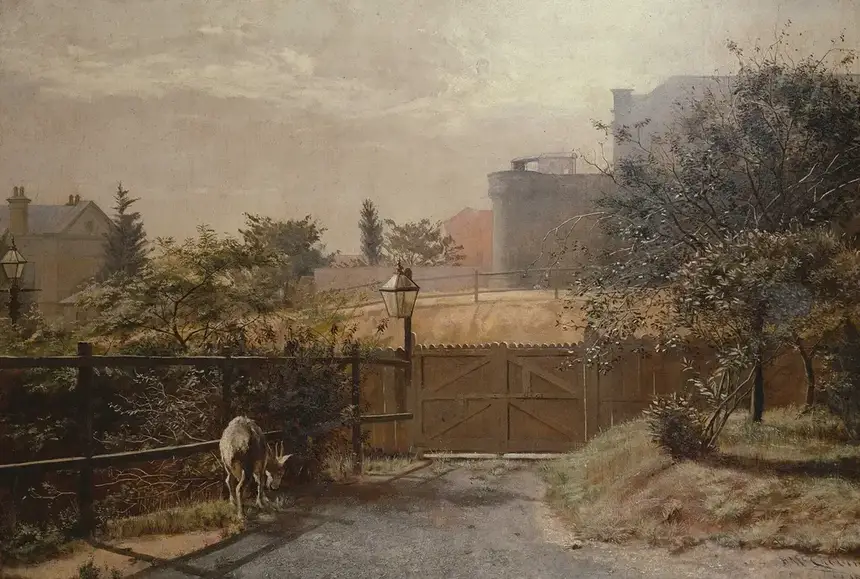
Frederick McCubbin died in 1917. That puts the painting well outside copyright, which is why we can paint it and you can own it anywhere in the world.
Every version we make is oil on canvas, painted by one painter from start to finish. No printing is involved at any stage.
It is an original composition painted before 1917, and our version is painted from the surviving image of it.
If you want something printed, we are the wrong workshop. We do not own a printer that touches canvas.
What the painting is doing
The difficulty in Melbourne gaol in sunlight is keeping the shadows transparent, which is a layering problem, not a colour problem.
The room is organised around the window, and everything else is measured against that light.
Where a lamp or candle appears in the source, its light is local and does not reach the whole room.
Our painter keeps the colour relationships rather than the exact hues, because relationships are what survive.
Nothing here is blended flat. Blending is what makes a painting look printed.
Matching the original's degree of finish is harder than matching its colours.
For a stairwell or a double-height space, go larger than you think — the composition was built for distance.
| Artist | Frederick McCubbin |
|---|---|
| Title | Melbourne gaol in sunlight |
| Created (original) | 1884 |
| Medium | Oil on canvas, hand-painted to order |
| How it is made | Painted by hand in oil on canvas, to your size |
| Public domain | Yes — the artist died over 70 years ago |
Hand-painted, not printed
A print reproduces the shapes and drops the substance. It is the substance you are buying.
Where the original is loaded, ours is loaded. Where it is thin, ours is thin. Matching the weight of the paint matters more than matching the colour.
| Aspect | Hand-painted oil | Printed canvas |
|---|---|---|
| Edges | Chosen by the painter, passage by passage | Whatever the file happens to contain |
| Lifespan | Slow to change; varnish can be refreshed decades later | Fades and cracks sooner |
| Changing something | Tell us and the passage gets repainted | Usually means starting the file again |
| Handling of colour | Mixed on the palette and finished on the canvas | Fixed by the colour profile |
| Surface | Hand-painted oil on canvas | Ink on canvas, flat |
The risk with an interior is overworking, and the way to avoid it is knowing when to stop.
Every canvas is painted to order, so the quote follows your size, frame and destination rather than a fixed list. Tell us what you need on WhatsApp and we reply with an exact figure, usually within the hour. You are buying from the workshop, not a catalogue.
How it gets painted
Every canvas is painted to order, so nothing is pulled off a shelf. This is the sequence:
- The canvas is stretched and primed — cotton or linen, sized and ready before any paint goes near it.
- Laying in the drawing — done by eye from the reference, not traced or projected.
- The big shapes are blocked in — thin paint, one colour at a time, the whole canvas at once.
- Getting the values right — the stage that decides whether the finished painting holds together.
- The colour passes — each area gets its own mixture rather than one colour used throughout.
- The detail and highlights go on — last, loaded, and left alone once they are down.
- Drying and varnishing — the final varnish goes on once the paint has set, before we photograph it.
Anyone can copy the shapes. The skill is in the transitions, and that is what takes the days.
Framing
Framing is quoted separately, so you can decide after you have seen the finished canvas in photographs.
Framing is quoted separately, so you can decide after you have seen the finished canvas in photographs.
Canvas, paint and varnish
We buy pigment in tubes from the same suppliers the village has used for years, not in bulk drums. Nothing is sprayed, sealed or laminated. The surface you see is paint and varnish, and that is all.
Pigment is artist-grade oil colour, not acrylic and not house paint. It behaves differently and it lasts. We use cotton duck for most sizes and linen where the canvas is large or the client asks for it.
Care and cleaning
Dust it with a dry, soft brush. Keep it out of direct sun and away from radiators, and it will outlive you.
What size works
The canvas is cut to your wall, not the other way round. For reference, these are the dimensions most often requested:
| Size (inches) | Size (cm) | Best for |
|---|---|---|
| 40 × 30 in | 102 × 76 cm | Living room focal wall, above a sofa |
| 32 × 24 in | 81 × 61 cm | Living room, above a sideboard |
| 30 × 24 in | 76 × 61 cm | Dining room, bedroom feature wall |
| 24 × 20 in | 60 × 50 cm | Study, home office, above a desk |
| 20 × 16 in | 50 × 40 cm | Bedroom, hallway, above a console |
Anything outside this table is fine — we paint to the number you give us. DAP terms: we pay the freight, you settle any duty or tax your country applies. We do not collect taxes on anyone's behalf.
In a bedroom it works above a headboard, sized to about two-thirds of the furniture width.
Tell us the size and frame — exact quote back, usually within the hour.
💬 Get a Quote for Melbourne gaol in sunlight from the Public Library groundsOrder, painting, shipping
From order to finished canvas is 9–15 days. Freight appears as a separate line on the quote and is fixed before you pay.
In transit it is typically 7–10 business days by air, tracked door to door. Every shipment goes out with tracking. We do not send anything untracked.
Nothing ships before you have seen it. Photographs of the finished painting go to you first. If something is not right, tell us what to adjust and we adjust it.
We sell DAP: the price covers the painting and the freight, and any import duties or taxes are the buyer's to settle with customs. We do not collect them and we do not estimate them.
A deposit starts the canvas and books the painter's time; the balance is due before the crate leaves. If a crate arrives damaged, send us photographs within 48 hours and contact us directly — we will sort it out with you.
The practical questions
Does changing the size change the composition?
No — we keep the original's proportions and scale from there, rather than cropping the image to fit a standard frame.
Will it look exactly like the image?
Not exactly, and that is the point — it is a painting, not a scan. Composition, colour and drawing follow the original closely; the surface is where a painter's own decisions show.
Can I resell the reproduction?
Yes. Because the underlying work is in the public domain, the hand-painted canvas is yours to sell, gift or install commercially.
Do you sell prints?
No prints at all — no giclée, no canvas transfer, nothing machine-made.
Is it really painted by hand?
Yes. One painter, oil paint, brushes. We do not own a printer that touches canvas.
Will I see it before it ships?
Yes — photographs of the actual painting go to you first, and nothing is packed until you have seen them.
Do you ship to my country?
We export to more than 20 countries. Tell us where you are and we will quote the freight as a separate line.
What is the canvas made of?
Cotton duck as standard, linen on request, artist-grade oil paint, and a final varnish once the paint is fully dry.
Is owning a reproduction legal?
Yes. The painting is out of copyright because Frederick McCubbin died more than 70 years ago. We paint copies honestly and never claim they are originals.
Do you take a deposit?
Work begins on a deposit and ships once the balance is paid. Nothing is charged that is not on the quote.
What if it arrives damaged?
Report damage within 48 hours with photographs. We deal with the carrier rather than leaving you to argue alone.
What does it cost?
Every canvas is quoted on size, frame and destination rather than a fixed list. Tell us what you need and we reply with an exact figure.