About The Triumph at Calvary
George Inness died in 1894, so the work has been in the public domain for decades. Reproducing it by hand is legal, and so is owning one.
Every version we make is oil on canvas, painted by one painter from start to finish. No printing is involved at any stage.
The painting was made in the years before 1894, and what we reproduce is the record of it, not the object.
You are buying a painting, not a file. That distinction is the whole business we are in.
What to look at
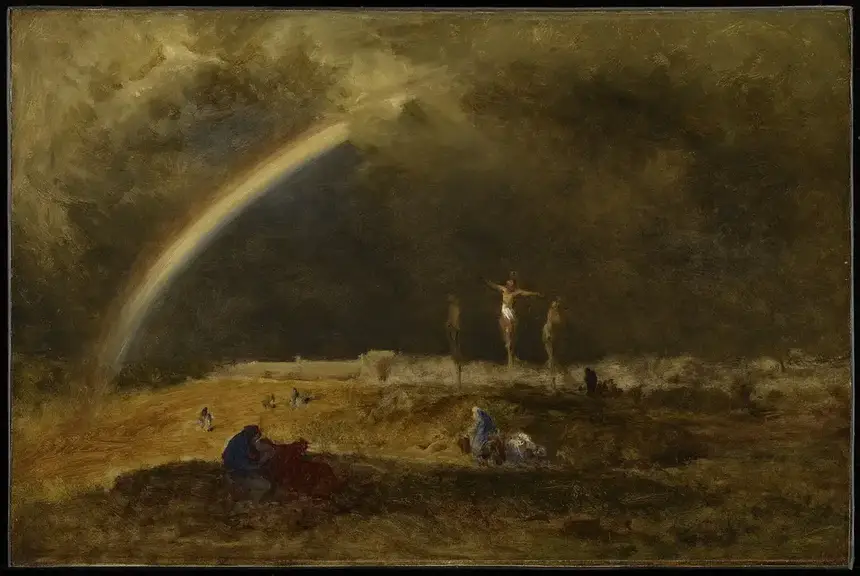
Ours is painted from the source image, stroke by stroke, so The Triumph at Calvary keeps the order it was originally built in.
The near ground is painted loaded and the far ground thin. That single decision creates the whole space.
The light in The Triumph at Calvary has a direction, and the painter keeps it consistent across every object in the picture.
The saturation is deliberately uneven: strongest at the focal point, weaker everywhere else.
Nothing here is blended flat. Blending is what makes a painting look printed.
Anyone can copy the shapes. The skill is in the transitions, and that is what takes the days.
It works best on a wall you pass rather than one you sit and stare at — the paint rewards a moving eye.
| Artist | George Inness |
|---|---|
| Title | The Triumph at Calvary |
| Medium | Oil on canvas, hand-painted to order |
| Reproduction | Hand-painted oil on canvas, made to order |
| Public domain | Yes — the artist died over 70 years ago |
Hand-painted, not printed
A print reproduces the shapes and drops the substance. It is the substance you are buying.
Where the original is loaded, ours is loaded. Where it is thin, ours is thin. Matching the weight of the paint matters more than matching the colour.
| Aspect | Hand-painted oil | Printed canvas |
|---|---|---|
| Impasto | Real paint standing off the canvas | Flat ink, sometimes embossed to imitate |
| Sense of depth | Real, created by layers of paint | Simulated by darker ink |
| Value over time | Can be re-stretched, cleaned and re-framed | Little value beyond the print |
| What it takes | One painter, several days, start to finish | A machine, a few minutes |
| The surface | Built up with brushes and knives | Printed flat in one pass |
The hardest passage is the quiet one, where a small mistake has nowhere to hide.
Every canvas is painted to order, so the quote follows your size, frame and destination rather than a fixed list. Tell us what you need on WhatsApp and we reply with an exact figure, usually within the hour. There is no agency in between; the studio that paints your canvas is the one answering your messages.
How it gets painted
This is how the painting is built, in the order our painters build it:
- Stretching and priming the support — cotton duck or linen goes onto the bars and gets its ground.
- The drawing goes down — charcoal or thin paint, done by eye rather than traced from a printout.
- The first colour pass — thin and simple, establishing the main shapes only.
- Setting the key — how dark the darks go determines everything that follows.
- Building the colour — a warm and a cool version of each passage, put down in order.
- Finishing passes — the loaded highlights go on at the end and stay there.
- Left to dry before varnish — nothing is photographed or packed until the surface is ready.
The passage that will take longest is the one that looks simplest.
Looking after it
Oil paint needs very little: no water, no cleaners, no sprays. A dry brush and a stable room.
Materials
The varnish is removable, so a conservator can clean the painting in fifty years without touching the paint. Stretcher bars are kiln-dried and wedged, so the canvas can be re-tensioned years later.
The paint is built in layers, fat over lean, which is what stops it cracking later. Brushes, knives and rags. That is the equipment list; there is no machine in the process.
On framing
We can supply a simple floater frame, a traditional gilt, or nothing at all. It is your call.
Most clients wait for the photographs before choosing a frame, which is the sensible order.
What size works
Any size is possible. These are simply the ones that come up most often in quotes:
| Size (inches) | Size (cm) | Best for |
|---|---|---|
| 30 × 24 in | 76 × 61 cm | Dining room, bedroom feature wall |
| 24 × 20 in | 60 × 50 cm | Study, home office, above a desk |
| 20 × 16 in | 50 × 40 cm | Bedroom, hallway, above a console |
| 16 × 12 in | 40 × 30 cm | A shelf, a small wall, a gallery group |
| 64 × 48 in | 163 × 122 cm | Villa scale, lobby, hospitality wall |
Anything outside this table is fine — we paint to the number you give us. Shipments go out DAP. If your customs office charges duty or tax on arrival, that is between you and them — we do not collect it and we do not put a number on it.
For a stairwell or a double-height space, go larger than you think — the composition was built for distance.
Tell us where it will hang and how big it needs to be — we will price it properly.
💬 Get a Quote for The Triumph at CalvaryTimeline and shipping
Painting takes 9–15 days. Freight is quoted as its own line on the quote, agreed before you pay anything, and never added afterwards.
Expect 7–10 business days in transit, with tracking from our door to yours. Every shipment goes out with tracking. We do not send anything untracked.
You approve the painting from photographs before it is packed — that is the checkpoint. If something is not right, tell us what to adjust and we adjust it.
Our terms are DAP, meaning the freight is paid by us and any import charges are yours to settle. We will not estimate them, because the figure is your customs authority's to set.
Work begins on a deposit and ships on the balance. Both figures are on the quote. If a crate arrives damaged, send us photographs within 48 hours and contact us directly — we will sort it out with you.
Before you order
Can I get this in a size that is not listed?
Yes — the listed sizes are the common requests, not a limit. Very wide or unusually tall proportions are routine for us.
Can I see progress photos while it is being painted?
We send photographs of the finished painting for approval before it ships. Mid-process images are not part of the standard workflow.
Can you paint a different work by George Inness?
Yes. Send the image and we will quote it, or browse the other paintings we have listed.
How long does it take?
Painting takes 9–15 days. Air freight is usually 7–10 business days on top of that, tracked.
Can I change the size?
Any size you like. We paint to the number you give us rather than to a standard range.
How do I hang it?
Roughly 145 cm from floor to centre works for most rooms. Tell us your wall and we will give you the measurement.
Do you ship to my country?
We ship to over 20 countries. Give us your city and the freight appears as its own line on the quote.
Who pays the import duty?
You do. We sell DAP, so any duty or tax your customs authority charges is settled by you at import. We do not collect it and we do not estimate it.
What is the canvas made of?
Cotton duck as standard, linen on request, artist-grade oil paint, and a final varnish once the paint is fully dry.
Will I see it before it ships?
Yes. We send photographs of the finished canvas and wait for your reply before packing.
Is owning a reproduction legal?
Yes. The painting is out of copyright because George Inness died more than 70 years ago. We paint copies honestly and never claim they are originals.