What you are buying into
Georges Seurat died in 1891, so the work has been in the public domain for decades. Reproducing it by hand is legal, and so is owning one.
We paint it in oil on canvas, one at a time, in Dafen Village. Nothing is printed, scanned or transferred.
The painting was made in the years before 1891, and what we reproduce is the record of it, not the object.
If you want something printed, we are the wrong workshop. We do not own a printer that touches canvas.
What to look at
There is a reason a night subject is the hardest thing to print and the easiest thing to paint: the paint itself carries the depth.
The near ground is painted loaded and the far ground thin. That single decision creates the whole space.
Where the source has light coming through the paint, we glaze rather than paint opaque white.
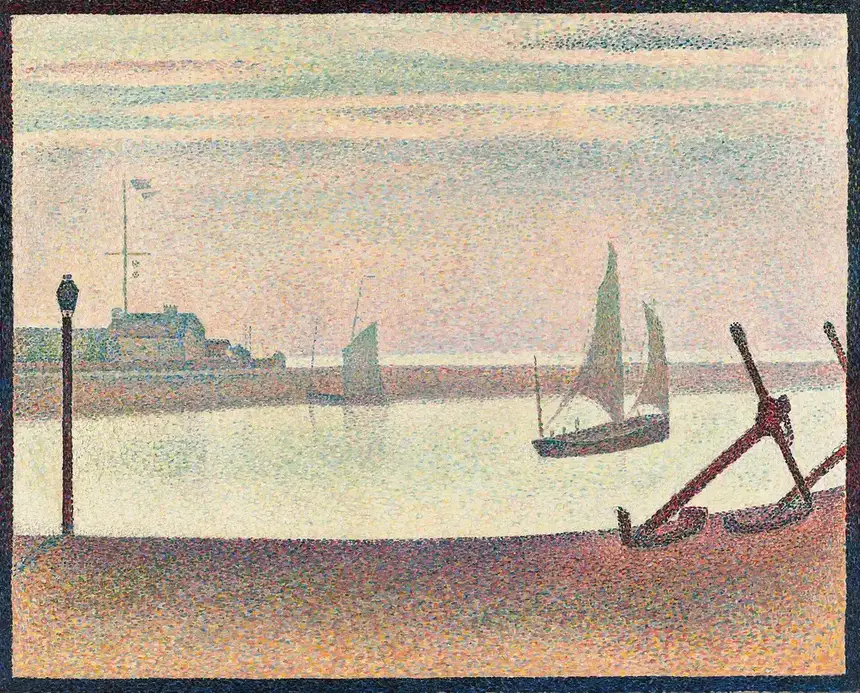
Every colour in The Channel at Gravelines, Evening has a warm version and a cool version, and the painter chooses between them passage by passage.
Paint is laid on, not pushed around. That is what keeps it fresh.
Getting The Channel at Gravelines, Evening right means painting it in the right order, and the order is not obvious.
In a bedroom it works above a headboard, sized to about two-thirds of the furniture width.
| Artist | Georges Seurat |
|---|---|
| Title | The Channel at Gravelines, Evening |
| Created (original) | 1890 |
| Medium | Oil on canvas, hand-painted to order |
| Reproduction | Hand-painted oil on canvas, made to order |
| Original status | Public domain (artist deceased) |
Hand-painted, not printed
A print reproduces the shapes and drops the substance. It is the substance you are buying.
Where the original is loaded, ours is loaded. Where it is thin, ours is thin. Matching the weight of the paint matters more than matching the colour.
| Aspect | Hand-painted oil | Printed canvas |
|---|---|---|
| Time to make | Days of one painter's working time | Minutes |
| Edges | Chosen by the painter, passage by passage | Whatever the file happens to contain |
| Texture | Ridges and drag you can see from across a room | None, or a printed imitation of it |
| Value over time | Can be re-stretched, cleaned and re-framed | Little value beyond the print |
| Corrections | We adjust it and repaint the passage | The file is reprinted or it is not |
The difficult part is not the detail. It is keeping the whole canvas at the same stage of finish.
Every canvas is painted to order, so the quote follows your size, frame and destination rather than a fixed list. Tell us what you need on WhatsApp and we reply with an exact figure, usually within the hour. There is no agency in between; the studio that paints your canvas is the one answering your messages.
How the canvas is built
Here is what actually happens between your message and the crate:
- The canvas is stretched and primed — cotton or linen, sized and ready before any paint goes near it.
- A loose underdrawing — proportions checked by eye against the source image.
- The big shapes are blocked in — thin paint, one colour at a time, the whole canvas at once.
- The values are established — this is the stage that decides whether the painting works.
- Building the colour — a warm and a cool version of each passage, put down in order.
- Finishing passes — the loaded highlights go on at the end and stay there.
- Drying and varnishing — the final varnish goes on once the paint has set, before we photograph it.
This one repaints badly, so our painter gets the values right early and leaves them.
What goes into it
Brushes, knives and rags. That is the equipment list; there is no machine in the process. The varnish is removable, so a conservator can clean the painting in fifty years without touching the paint.
Pigment is artist-grade oil colour, not acrylic and not house paint. It behaves differently and it lasts. The ground is a proper acrylic sizing, so the oil does not rot the fabric over time.
Whether to frame it
Framing is quoted separately, so you can decide after you have seen the finished canvas in photographs.
Framing is quoted separately, so you can decide after you have seen the finished canvas in photographs.
Keeping it
Once the varnish has cured the surface can be cleaned by a conservator, but in a normal house it will not need it for decades.
What size works
Because each piece is painted from scratch, you are not limited to stock dimensions. These are the sizes clients ask for most:
| Size (inches) | Size (cm) | Best for |
|---|---|---|
| 30 × 24 in | 76 × 61 cm | Dining room, bedroom feature wall |
| 24 × 20 in | 60 × 50 cm | Study, home office, above a desk |
| 20 × 16 in | 50 × 40 cm | Bedroom, hallway, above a console |
| 16 × 12 in | 40 × 30 cm | A shelf, a small wall, a gallery group |
If your wall is an odd shape, send the measurement and we will work to it. Proportions from the original are kept unless you ask us to change them. We quote DAP, so any duty or tax your country charges is settled by you at import. We do not add a tax line of our own.
Hang it at eye level — roughly 145 cm from the floor to the centre — and it will hold the wall.
Tell us where it will hang and how big it needs to be — we will price it properly.
💬 Get a Quote for The Channel at Gravelines, EveningFrom order to your wall
Allow 9–15 days for the painting itself. Shipping is a separate line on your quote — you see it before payment, not after.
Transit is usually 7–10 business days, tracked all the way. We send photographs of the finished painting before it is packed, and again once it is boxed.
You approve the painting from photographs before it is packed — that is the checkpoint. Changes are handled by telling us what to change; we change it and send new photographs.
Duties and import taxes are the buyer's account (DAP). Your customs authority sets them; we do not.
Work begins on a deposit and ships on the balance. Both figures are on the quote. Damage in transit should be reported to us within 48 hours, with photographs. We pursue it with the carrier rather than promising a refund.
The practical questions
Will the dark passages look muddy?
That is the main risk in a night painting and the reason it cannot be printed. The painter mixes darks from colour rather than reaching for black, which keeps them transparent instead of dead.
Why not just print it?
A print flattens the surface into a poster: the distance collapses and the highlights turn to grey. Paint keeps the depth and the texture the original was built from.
Does it come with a certificate of authenticity?
No, and we would be wary of anyone who issues one for a public-domain reproduction. What you receive is a hand-painted canvas and photographs of it before it ships.
Do you ship to my country?
We export to more than 20 countries. Tell us where you are and we will quote the freight as a separate line.
Is it really painted by hand?
Yes — oil on canvas, brush and knife. There is no printing, no giclée and no canvas transfer at any stage.
Can you paint it from a different photograph of the same work?
Yes. If you have a better reference, send it on WhatsApp and we will work from yours.
Can you paint a different work by Georges Seurat?
Yes. Send the image and we will quote it, or browse the other paintings we have listed.
Do you take a deposit?
Work begins on a deposit and ships once the balance is paid. Nothing is charged that is not on the quote.
Who pays the import duty?
The buyer does. Terms are DAP: duties and taxes, where they apply, are paid on arrival. We never add a tax line of our own.
What if it arrives damaged?
send us photographs within 48 hours and contact us directly — we will sort it out with you.
What does it cost?
There is no price list, because the number depends on your size and frame. Message us and we will quote exactly.
How do I hang it?
Roughly 145 cm from floor to centre works for most rooms. Tell us your wall and we will give you the measurement.