What you are buying into
Giovanni Boldini died in 1931. That puts the painting well outside copyright, which is why we can paint it and you can own it anywhere in the world.
Every version we make is oil on canvas, painted by one painter from start to finish. No printing is involved at any stage.
It is an original composition painted before 1931, and our version is painted from the surviving image of it.
What arrives is a canvas with paint on it, made by a person. That is the only thing we sell.
How to read it
Portraits fail in print because skin is made of ten colours laid next to each other, not one colour printed flat.
Scale matters in a portrait: we size it so the head reads at life size or larger, which is when it starts to work.
Our painter keeps the halftone — the narrow band between light and shadow — which is where a face lives.
Colour here is mixed for the passage, not for the object, which is why nothing looks like it was filled in.
The last marks are the ones that are left alone. Overworking is the enemy.
Matching the original's degree of finish is harder than matching its colours.
It is a picture for a room you use, not a corridor you walk through.
| Artist | Giovanni Boldini |
|---|---|
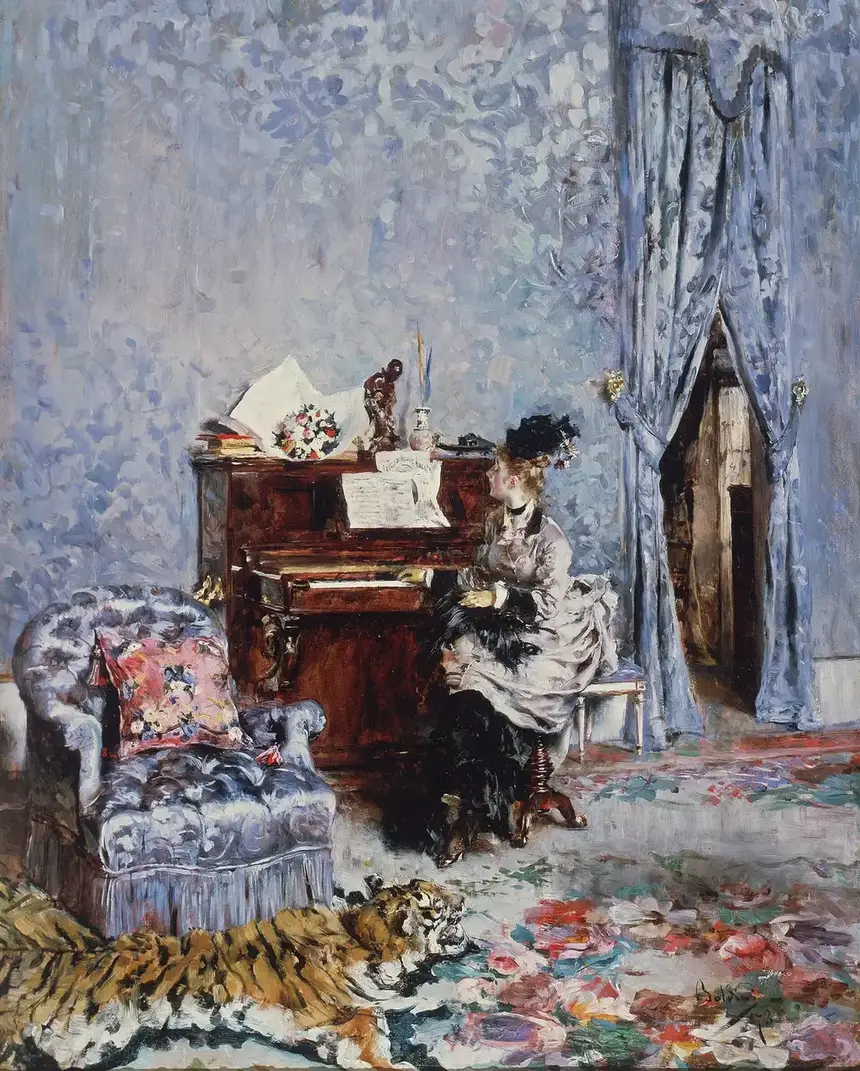
| Title | Interior with woman at the piano |
| Created (original) | 1873 |
| Medium | Oil on canvas, hand-painted to order |
| How it is made | Painted by hand in oil on canvas, to your size |
| Public domain | Yes — the artist died over 70 years ago |
Why hand-painting matters here
A print reproduces the shapes and drops the substance. It is the substance you are buying.
Edges are left soft where the form turns away and sharp where it does not. That single habit is what separates a painting from a copy.
| Aspect | Hand-painted oil | Printed canvas |
|---|---|---|
| Changing something | Tell us and the passage gets repainted | Usually means starting the file again |
| Edges | Chosen by the painter, passage by passage | Whatever the file happens to contain |
| Impasto | Real paint standing off the canvas | Flat ink, sometimes embossed to imitate |
| Depth | Built in layers, catches light from the side | Flat; highlights are printed as pale ink |
| Size | Any size, painted to your wall | Limited by the printer |
This one repaints badly, so our painter gets the values right early and leaves them.
Every canvas is painted to order, so the quote follows your size, frame and destination rather than a fixed list. Tell us what you need on WhatsApp and we reply with an exact figure, usually within the hour. You are buying from the workshop, not a catalogue.
How it gets painted
This is how the painting is built, in the order our painters build it:
- We start with the canvas itself — stretched, sized and left to settle before any colour is mixed.
- The drawing goes down — charcoal or thin paint, done by eye rather than traced from a printout.
- Blocking the masses — thin paint, working the whole surface rather than one corner at a time.
- The values are established — this is the stage that decides whether the painting works.
- The colour passes — each area gets its own mixture rather than one colour used throughout.
- Finishing passes — the loaded highlights go on at the end and stay there.
- Drying and varnishing — the final varnish goes on once the paint has set, before we photograph it.
The hardest passage is the quiet one, where a small mistake has nowhere to hide.
Frames
Most clients wait for the photographs before choosing a frame, which is the sensible order.
A frame is a separate line on the quote, not a bundle. You choose it once the painting exists.
Looking after it
Once the varnish has cured the surface can be cleaned by a conservator, but in a normal house it will not need it for decades.
Canvas, paint and varnish
Each painter works on one canvas at a time — the painting you ordered is not shared with another order. The ground is a proper acrylic sizing, so the oil does not rot the fabric over time.
The paint is built in layers, fat over lean, which is what stops it cracking later. Stretcher bars are kiln-dried and wedged, so the canvas can be re-tensioned years later.
Sizing it
Any size is possible. These are simply the ones that come up most often in quotes:
| Size (inches) | Size (cm) | Best for |
|---|---|---|
| 20 × 16 in | 50 × 40 cm | Bedroom, hallway, above a console |
| 16 × 12 in | 40 × 30 cm | A shelf, a small wall, a gallery group |
| 64 × 48 in | 163 × 122 cm | Villa scale, lobby, hospitality wall |
| 48 × 36 in | 122 × 91 cm | Large living room, stairwell, loft |
| 40 × 30 in | 102 × 76 cm | Living room focal wall, above a sofa |
Anything outside this table is fine — we paint to the number you give us. Duties and import taxes are the buyer's account (DAP). Your customs authority sets them; we do not.
For a stairwell or a double-height space, go larger than you think — the composition was built for distance.
Tell us the size and frame — exact quote back, usually within the hour.
💬 Get a Quote for Interior with woman at the pianoFrom order to your wall
The painting takes 9–15 days, and delivery is priced separately on the quote so there is no surprise later.
Air freight runs about 7–10 business days, tracked, to your door. We send photographs of the finished painting before it is packed, and again once it is boxed.
You see photographs of the finished painting before it ships, and you tell us what to adjust. If something is not right, tell us what to adjust and we adjust it.
Shipments go out DAP. If your customs office charges duty or tax on arrival, that is between you and them — we do not collect it and we do not put a number on it.
Work begins on a deposit and ships on the balance. Both figures are on the quote. If a crate arrives damaged, send us photographs within 48 hours and contact us directly — we will sort it out with you.
The practical questions
Does changing the size change the composition?
No — we keep the original's proportions and scale from there, rather than cropping the image to fit a standard frame.
Will I see it before it ships?
Yes — photographs of the actual painting go to you first, and nothing is packed until you have seen them.
Who pays the import duty?
The buyer does. Terms are DAP: duties and taxes, where they apply, are paid on arrival. We never add a tax line of our own.
How long does it take?
Allow 9–15 days for the painting itself, then roughly 7–10 business days in transit.
Can you paint it from a different photograph of the same work?
Yes. If you have a better reference, send it on WhatsApp and we will work from yours.
What does it cost?
There is no price list, because the number depends on your size and frame. Message us and we will quote exactly.
What if it arrives damaged?
send us photographs within 48 hours and contact us directly — we will sort it out with you.
What is the canvas made of?
Cotton or linen, oil colour, and varnish. Stretcher bars are wedged so the canvas can be re-tensioned later.
Can you paint a different work by Giovanni Boldini?
Yes — send us the image, or look through the other Giovanni Boldini works on the site.
Is it really painted by hand?
Yes — oil on canvas, brush and knife. There is no printing, no giclée and no canvas transfer at any stage.