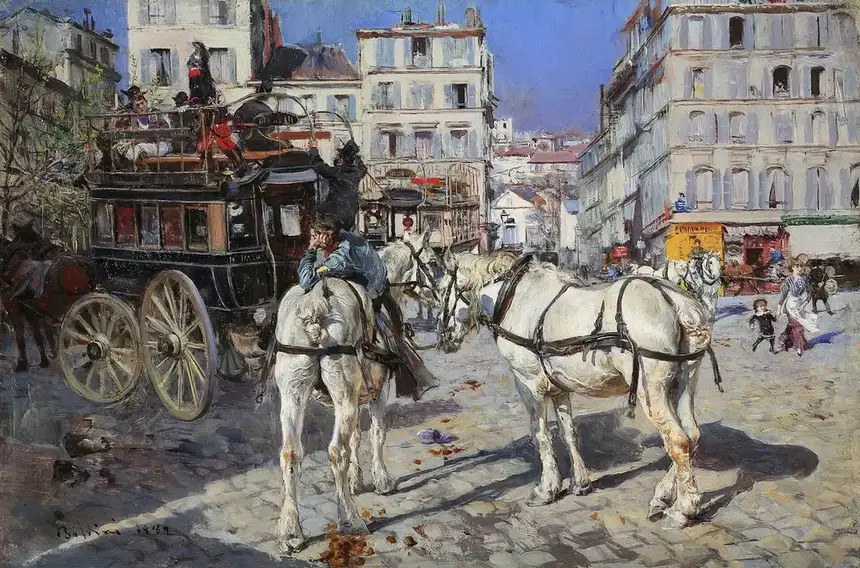
About Place Pigalle and the Place
Giovanni Boldini died in 1931. That puts the painting well outside copyright, which is why we can paint it and you can own it anywhere in the world.
Every version we make is oil on canvas, painted by one painter from start to finish. No printing is involved at any stage.
The painting was made in the years before 1931, and what we reproduce is the record of it, not the object.
What arrives is a canvas with paint on it, made by a person. That is the only thing we sell.
What to look at
The reason Place Pigalle and the Place still works as a painting is that it was built as paint, not as a picture of a place.
We keep the original proportions rather than cropping to a standard frame, so an unusually wide composition stays honest.
The light in Place Pigalle and the Place has a direction, and the painter keeps it consistent across every object in the picture.
Our painter keeps the colour relationships rather than the exact hues, because relationships are what survive.
Paint is laid on, not pushed around. That is what keeps it fresh.
The passage that will take longest is the one that looks simplest.
For a stairwell or a double-height space, go larger than you think — the composition was built for distance.
| Artist | Giovanni Boldini |
|---|---|
| Title | Place Pigalle and the Place |
| Created (original) | 1882 |
| Medium | Oil on canvas, hand-painted to order |
| Reproduction | Hand-painted oil on canvas, made to order |
| Public domain | Yes — the artist died over 70 years ago |
Why hand-painting matters here
A print reproduces the shapes and drops the substance. It is the substance you are buying.
Edges are left soft where the form turns away and sharp where it does not. That single habit is what separates a painting from a copy.
| Aspect | Hand-painted oil | Printed canvas |
|---|---|---|
| Time to make | Days of one painter's working time | Minutes |
| Changing something | Tell us and the passage gets repainted | Usually means starting the file again |
| The surface | Built up with brushes and knives | Printed flat in one pass |
| Available sizes | Whatever you need, painted to order | What the printer can output |
| Texture | Ridges and drag you can see from across a room | None, or a printed imitation of it |
Anyone can copy the shapes. The skill is in the transitions, and that is what takes the days.
Every canvas is painted to order, so the quote follows your size, frame and destination rather than a fixed list. Tell us what you need on WhatsApp and we reply with an exact figure, usually within the hour. You are talking to the people who will actually paint it, not a middleman.
The sequence on our floor
Here is what actually happens between your message and the crate:
- We start with the canvas itself — stretched, sized and left to settle before any colour is mixed.
- A loose underdrawing — proportions checked by eye against the source image.
- Blocking the masses — thin paint, working the whole surface rather than one corner at a time.
- The values are established — this is the stage that decides whether the painting works.
- Colour is built up — warmer and cooler versions of each passage, laid over the underpainting.
- Finishing passes — the loaded highlights go on at the end and stay there.
- Drying and varnishing — the final varnish goes on once the paint has set, before we photograph it.
The hardest passage is the quiet one, where a small mistake has nowhere to hide.
Materials
Nothing is sprayed, sealed or laminated. The surface you see is paint and varnish, and that is all. The paint is built in layers, fat over lean, which is what stops it cracking later.
The varnish is removable, so a conservator can clean the painting in fifty years without touching the paint. Large canvases get a cross-brace; anything over about a metre and a half needs one.
Whether to frame it
If you are shipping, an unframed canvas rolled in a tube is considerably cheaper to move than a framed one.
Framing is quoted separately, so you can decide after you have seen the finished canvas in photographs.
Keeping it
Dust it with a dry, soft brush. Keep it out of direct sun and away from radiators, and it will outlive you.
Canvas sizes
You are not choosing from a list; you are telling us a measurement. These are the common ones:
| Size (inches) | Size (cm) | Best for |
|---|---|---|
| 64 × 48 in | 163 × 122 cm | Villa scale, lobby, hospitality wall |
| 48 × 36 in | 122 × 91 cm | Large living room, stairwell, loft |
| 40 × 30 in | 102 × 76 cm | Living room focal wall, above a sofa |
| 32 × 24 in | 81 × 61 cm | Living room, above a sideboard |
| 30 × 24 in | 76 × 61 cm | Dining room, bedroom feature wall |
We will size the canvas to the room, not to a stock list. Send us the measurement. Duties and import taxes are the buyer's account (DAP). Your customs authority sets them; we do not.
In a bedroom it works above a headboard, sized to about two-thirds of the furniture width.
Message us the dimensions you have in mind and we will come back with a figure.
💬 Get a Quote for Place Pigalle and the Place de l’Etoile La Villette omnibusGetting it to you
Allow 9–15 days for the painting itself. Shipping is a separate line on your quote — you see it before payment, not after.
Transit is usually 7–10 business days, tracked all the way. Rolled in a tube it travels cheaper and safer than framed; most overseas clients take it that way.
You see photographs of the finished painting before it ships, and you tell us what to adjust. Adjustments are part of the process. Say what you want different and it gets done.
Import charges, where they exist, are the buyer's responsibility (DAP). We never add them to the quote and never guess what they will be.
A deposit starts the canvas and books the painter's time; the balance is due before the crate leaves. Damage in transit should be reported to us within 48 hours, with photographs. We pursue it with the carrier rather than promising a refund.
The practical questions
Can I get this in a size that is not listed?
Yes — the listed sizes are the common requests, not a limit. Very wide or unusually tall proportions are routine for us.
What happens after I message you?
You tell us the painting, size and whether you want a frame. We quote, a painter starts on your canvas, and you get photographs before it ships.
Can I change the size?
Yes. The canvas is painted to your measurement, not taken from a stock list.
How long does it take?
Allow 9–15 days for the painting itself, then roughly 7–10 business days in transit.
Do you sell prints?
No. Hand-painted oil on canvas only. No printing, no giclée, no canvas transfer.
Can you paint a different work by Giovanni Boldini?
Yes — send us the image, or look through the other Giovanni Boldini works on the site.
Is owning a reproduction legal?
Yes. The painting is out of copyright because Giovanni Boldini died more than 70 years ago. We paint copies honestly and never claim they are originals.
What does it cost?
There is no price list, because the number depends on your size and frame. Message us and we will quote exactly.
What is the canvas made of?
Cotton or linen, oil colour, and varnish. Stretcher bars are wedged so the canvas can be re-tensioned later.
Can you paint it from a different photograph of the same work?
Send your own reference image and we will paint from that instead.
Can you change the colours to suit my room?
Sometimes. We will adjust the palette if it can be done without ruining the picture, and say so if it cannot.