Where this painting comes from
Grant Wood died in 1942, so the work has been in the public domain for decades. Reproducing it by hand is legal, and so is owning one.
Ours is a painting made with brushes. There is no giclée, no canvas transfer and no digital underlayer anywhere in the process.
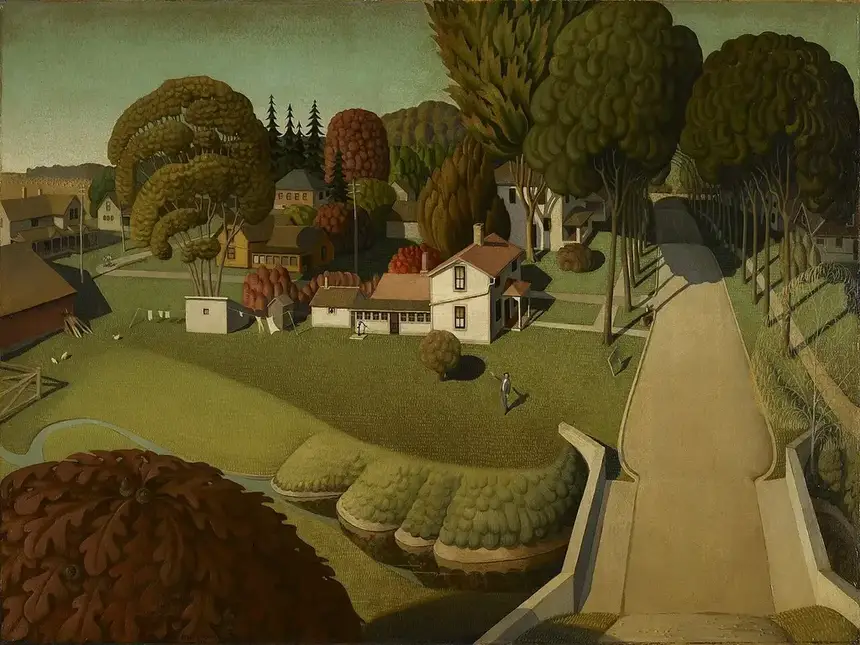
It is an original composition painted before 1942, and our version is painted from the surviving image of it.
You are buying a painting, not a file. That distinction is the whole business we are in.
What the painting is doing
The subject is ordinary. What is not ordinary is how the paint is loaded — that is the part a press cannot reproduce.
Our painter blocks the big shapes first and lets the detail come last, so the composition holds at any size.
Sunlight and shadow are two different temperatures here, not one colour at two strengths.
Saturated colour is kept for a small area; the rest is deliberately knocked back.
Where the source has a loaded passage, ours is loaded too — you will feel it from the side.
The risk with a wooded subject is overworking, and the way to avoid it is knowing when to stop.
It suits a room with warm, low light. Strong downlighting flattens the surface.
| Artist | Grant Wood |
|---|---|
| Title | The Birthplace of Herbert |
| Created (original) | 1931 |
| Medium | Oil on canvas, hand-painted to order |
| What you receive | A hand-painted oil painting on canvas |
| Public domain | Yes — the artist died over 70 years ago |
Why hand-painting matters here
A print reproduces the shapes and drops the substance. It is the substance you are buying.
Our painter follows the same logic rather than copying a photograph of it: the far distances go down cool and weak, the near ground stays loaded, and nothing is blended flat.
| Aspect | Hand-painted oil | Printed canvas |
|---|---|---|
| Sense of depth | Real, created by layers of paint | Simulated by darker ink |
| Later on | Can be restored, re-framed, handed on | Replaceable, and usually replaced |
| Handling of colour | Mixed on the palette and finished on the canvas | Fixed by the colour profile |
| Corrections | We adjust it and repaint the passage | The file is reprinted or it is not |
| How it ages | Warms and settles; cleanable by a conservator | Fades, then cracks at the stretcher |
Matching the original's degree of finish is harder than matching its colours.
Every canvas is painted to order, so the quote follows your size, frame and destination rather than a fixed list. Tell us what you need on WhatsApp and we reply with an exact figure, usually within the hour. You are buying from the workshop, not a catalogue.
How your painting is made
No two canvases are painted the same way, but the sequence is always this:
- We start with the canvas itself — stretched, sized and left to settle before any colour is mixed.
- The drawing goes down — charcoal or thin paint, done by eye rather than traced from a printout.
- The big shapes are blocked in — thin paint, one colour at a time, the whole canvas at once.
- The values are established — this is the stage that decides whether the painting works.
- The colour passes — each area gets its own mixture rather than one colour used throughout.
- The detail and highlights go on — last, loaded, and left alone once they are down.
- Left to dry before varnish — nothing is photographed or packed until the surface is ready.
The difficult part is not the detail. It is keeping the whole canvas at the same stage of finish.
Frames
Most clients wait for the photographs before choosing a frame, which is the sensible order.
Most clients wait for the photographs before choosing a frame, which is the sensible order.
Looking after it
Dust it with a dry, soft brush. Keep it out of direct sun and away from radiators, and it will outlive you.
What it is made of
Large canvases get a cross-brace; anything over about a metre and a half needs one. Nothing is sprayed, sealed or laminated. The surface you see is paint and varnish, and that is all.
The varnish is removable, so a conservator can clean the painting in fifty years without touching the paint. We use a neutral-sized ground so the whites stay warm rather than going blue over time.
Getting the size right
Any size is possible. These are simply the ones that come up most often in quotes:
| Size (inches) | Size (cm) | Best for |
|---|---|---|
| 24 × 20 in | 60 × 50 cm | Study, home office, above a desk |
| 20 × 16 in | 50 × 40 cm | Bedroom, hallway, above a console |
| 16 × 12 in | 40 × 30 cm | A shelf, a small wall, a gallery group |
| 64 × 48 in | 163 × 122 cm | Villa scale, lobby, hospitality wall |
| 48 × 36 in | 122 × 91 cm | Large living room, stairwell, loft |
Tell us the wall width and we will tell you what looks right rather than what is standard. Import charges, where they exist, are the buyer's responsibility (DAP). We never add them to the quote and never guess what they will be.
It works best on a wall you pass rather than one you sit and stare at — the paint rewards a moving eye.
Tell us the size and frame — exact quote back, usually within the hour.
💬 Get a Quote for The Birthplace of Herbert Hoover, West Branch, IowaGetting it to you
From order to finished canvas is 9–15 days. Freight appears as a separate line on the quote and is fixed before you pay.
Air freight runs about 7–10 business days, tracked, to your door. Rolled in a tube it travels cheaper and safer than framed; most overseas clients take it that way.
Nothing ships before you have seen it. Photographs of the finished painting go to you first. If something is not right, tell us what to adjust and we adjust it.
Duties and import taxes are the buyer's account (DAP). Your customs authority sets them; we do not.
Work begins on a deposit and ships on the balance. Both figures are on the quote. Report any transit damage within 48 hours with photographs and we will deal with the carrier. We will not promise a payout, but we will not leave you to argue alone either.
The practical questions
Do you frame it?
Framing is quoted separately, so you can decide once you have seen the finished canvas in photographs.
What size should I order?
You choose the size. Each canvas is cut to your measurements rather than pulled from stock, so tell us the wall dimensions and we will tell you what proportion works.
Can you paint a different work by Grant Wood?
Yes. Send the image and we will quote it, or browse the other paintings we have listed.
Do you take a deposit?
A deposit starts the canvas and the balance falls due before it ships. Both figures appear on the quote.
Can you paint it from a different photograph of the same work?
Yes. If you have a better reference, send it on WhatsApp and we will work from yours.
Do you sell prints?
No. Hand-painted oil on canvas only. No printing, no giclée, no canvas transfer.
What is the canvas made of?
Cotton or linen, oil colour, and varnish. Stretcher bars are wedged so the canvas can be re-tensioned later.
What does it cost?
Every canvas is quoted on size, frame and destination rather than a fixed list. Tell us what you need and we reply with an exact figure.
How long does it take?
Allow 9–15 days for the painting itself, then roughly 7–10 business days in transit.
Do you ship to my country?
We export to more than 20 countries. Tell us where you are and we will quote the freight as a separate line.
Is owning a reproduction legal?
Yes. The painting is out of copyright because Grant Wood died more than 70 years ago. We paint copies honestly and never claim they are originals.