About The Orange Trees
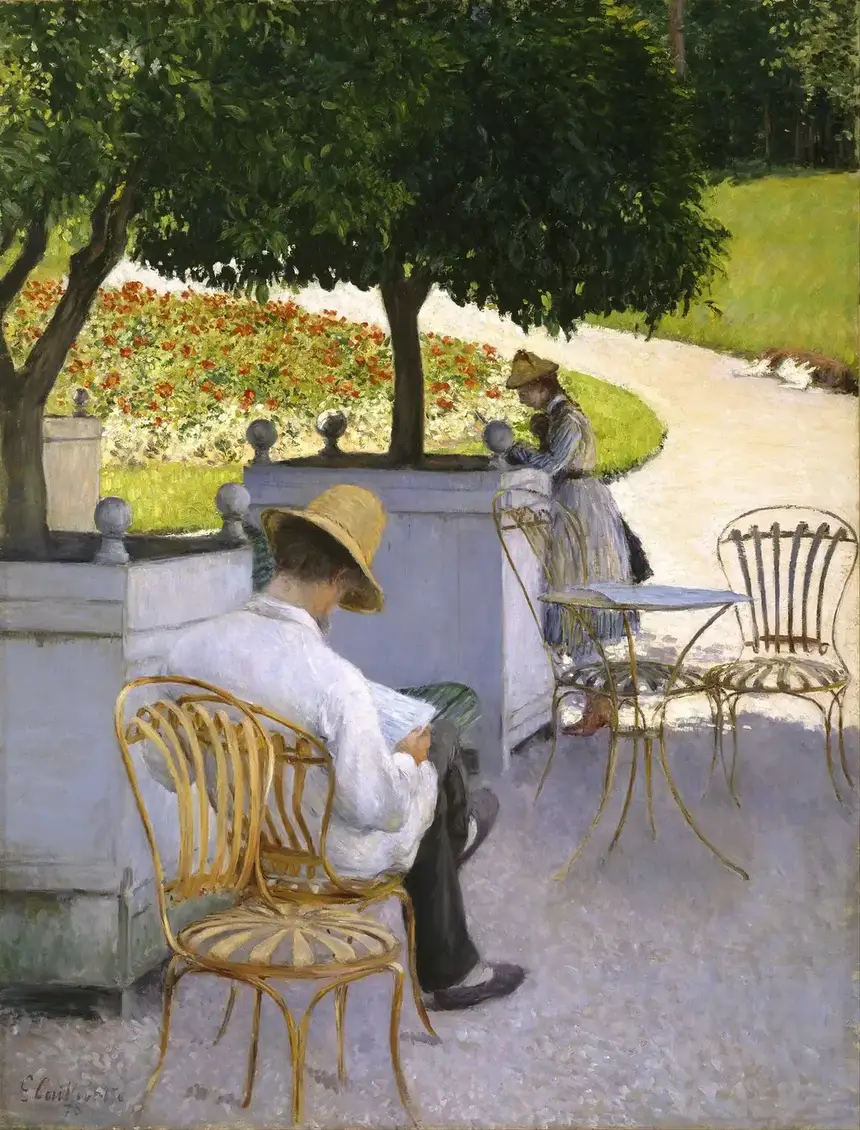
Because Gustave Caillebotte died in 1894, this work is in the public domain. We are painting a copy of a painting — we never pass it off as the original, and neither should anyone selling you one.
Ours is a painting made with brushes. There is no giclée, no canvas transfer and no digital underlayer anywhere in the process.
It is an original composition painted before 1894, and our version is painted from the surviving image of it.
What arrives is a canvas with paint on it, made by a person. That is the only thing we sell.
Looking at it properly
The Orange Trees is about edges: where one thing stops and the next begins, and how sharply.
We paint the shadow first and the object into it, so things sit on a surface instead of floating.
We do not add a light source that is not in the original.
Saturated colour is kept for a small area; the rest is deliberately knocked back.
Where the source has a loaded passage, ours is loaded too — you will feel it from the side.
Matching the original's degree of finish is harder than matching its colours.
In a bedroom it works above a headboard, sized to about two-thirds of the furniture width.
| Artist | Gustave Caillebotte |
|---|---|
| Title | The Orange Trees |
| Created (original) | 1878 |
| Medium | Oil on canvas, hand-painted to order |
| Reproduction | Hand-painted oil on canvas, made to order |
| Copyright | Public domain; the original is out of copyright |
The case for painting it by hand
Prints are good at information and bad at paint. This subject is mostly paint.
Our painter follows the same logic rather than copying a photograph of it: the far distances go down cool and weak, the near ground stays loaded, and nothing is blended flat.
| Aspect | Hand-painted oil | Printed canvas |
|---|---|---|
| Handling of colour | Mixed on the palette and finished on the canvas | Fixed by the colour profile |
| Edge quality | Soft where the form turns, sharp where it does not | Uniformly sharp or uniformly blurred |
| Available sizes | Whatever you need, painted to order | What the printer can output |
| Impasto | Real paint standing off the canvas | Flat ink, sometimes embossed to imitate |
| Value over time | Can be re-stretched, cleaned and re-framed | Little value beyond the print |
The hardest passage is the quiet one, where a small mistake has nowhere to hide.
Every canvas is painted to order, so the quote follows your size, frame and destination rather than a fixed list. Tell us what you need on WhatsApp and we reply with an exact figure, usually within the hour. You are buying from the workshop, not a catalogue.
From blank canvas to finished painting
Here is what actually happens between your message and the crate:
- The canvas is stretched and primed — cotton or linen, sized and ready before any paint goes near it.
- Laying in the drawing — done by eye from the reference, not traced or projected.
- Blocking the masses — thin paint, working the whole surface rather than one corner at a time.
- Setting the key — how dark the darks go determines everything that follows.
- Building the colour — a warm and a cool version of each passage, put down in order.
- Finishing passes — the loaded highlights go on at the end and stay there.
- It dries, then gets varnished — and only then is it photographed for you.
The risk with a still life is overworking, and the way to avoid it is knowing when to stop.
What goes into it
Nothing is sprayed, sealed or laminated. The surface you see is paint and varnish, and that is all. The ground is a proper acrylic sizing, so the oil does not rot the fabric over time.
We use a neutral-sized ground so the whites stay warm rather than going blue over time. The paint is built in layers, fat over lean, which is what stops it cracking later.
On framing
We can supply a simple floater frame, a traditional gilt, or nothing at all. It is your call.
We can supply a simple floater frame, a traditional gilt, or nothing at all. It is your call.
Keeping it
Dust it with a dry, soft brush. Keep it out of direct sun and away from radiators, and it will outlive you.
Getting the size right
You are not choosing from a list; you are telling us a measurement. These are the common ones:
| Size (inches) | Size (cm) | Best for |
|---|---|---|
| 30 × 24 in | 76 × 61 cm | Dining room, bedroom feature wall |
| 24 × 20 in | 60 × 50 cm | Study, home office, above a desk |
| 20 × 16 in | 50 × 40 cm | Bedroom, hallway, above a console |
| 16 × 12 in | 40 × 30 cm | A shelf, a small wall, a gallery group |
| 64 × 48 in | 163 × 122 cm | Villa scale, lobby, hospitality wall |
| 48 × 36 in | 122 × 91 cm | Large living room, stairwell, loft |
We will size the canvas to the room, not to a stock list. Send us the measurement. Terms are DAP. Import duties and taxes, where they apply, are paid by the buyer on arrival — we never collect them in advance and never guess at the amount.
Hang it at eye level — roughly 145 cm from the floor to the centre — and it will hold the wall.
Tell us the size and frame — exact quote back, usually within the hour.
💬 Get a Quote for The Orange TreesTimeline and shipping
Painting takes 9–15 days. Freight is quoted as its own line on the quote, agreed before you pay anything, and never added afterwards.
Transit is usually 7–10 business days, tracked all the way. Unframed canvases are rolled face-out on a tube; framed ones are corner-protected and crated.
You see photographs of the finished painting before it ships, and you tell us what to adjust. If something is not right, tell us what to adjust and we adjust it.
Duties and import taxes are the buyer's account (DAP). Your customs authority sets them; we do not.
You pay a deposit to start and the remainder before shipping. Nothing is hidden in between. Report any transit damage within 48 hours with photographs and we will deal with the carrier. We will not promise a payout, but we will not leave you to argue alone either.
What people ask us
Why not just print it?
A print flattens the surface into a poster: the distance collapses and the highlights turn to grey. Paint keeps the depth and the texture the original was built from.
Can I see progress photos while it is being painted?
We send photographs of the finished painting for approval before it ships. Mid-process images are not part of the standard workflow.
When will it actually arrive?
Studio time is 9–15 days, then a few more days for the oil to set before we can photograph and pack it. We tell you where your canvas is at each stage.
What if it arrives damaged?
send us photographs within 48 hours and contact us directly — we will sort it out with you.
Can you paint it from a different photograph of the same work?
Yes. If you have a better reference, send it on WhatsApp and we will work from yours.
Do you take a deposit?
Work begins on a deposit and ships once the balance is paid. Nothing is charged that is not on the quote.
Can I change the size?
Yes. The canvas is painted to your measurement, not taken from a stock list.
Can you paint a different work by Gustave Caillebotte?
Yes — send us the image, or look through the other Gustave Caillebotte works on the site.
Do you ship to my country?
We ship to over 20 countries. Give us your city and the freight appears as its own line on the quote.
What does it cost?
There is no price list, because the number depends on your size and frame. Message us and we will quote exactly.
What is the canvas made of?
Cotton duck as standard, linen on request, artist-grade oil paint, and a final varnish once the paint is fully dry.
Is owning a reproduction legal?
Yes. Gustave Caillebotte died more than 70 years ago, so the work is in the public domain and owning a hand-painted version is legal anywhere. We never pass ours off as the original.