About the original
Gustave Caillebotte died in 1894. That puts the painting well outside copyright, which is why we can paint it and you can own it anywhere in the world.
Ours is a painting made with brushes. There is no giclée, no canvas transfer and no digital underlayer anywhere in the process.
It is an original composition painted before 1894, and our version is painted from the surviving image of it.
What arrives is a canvas with paint on it, made by a person. That is the only thing we sell.
What the painting is doing
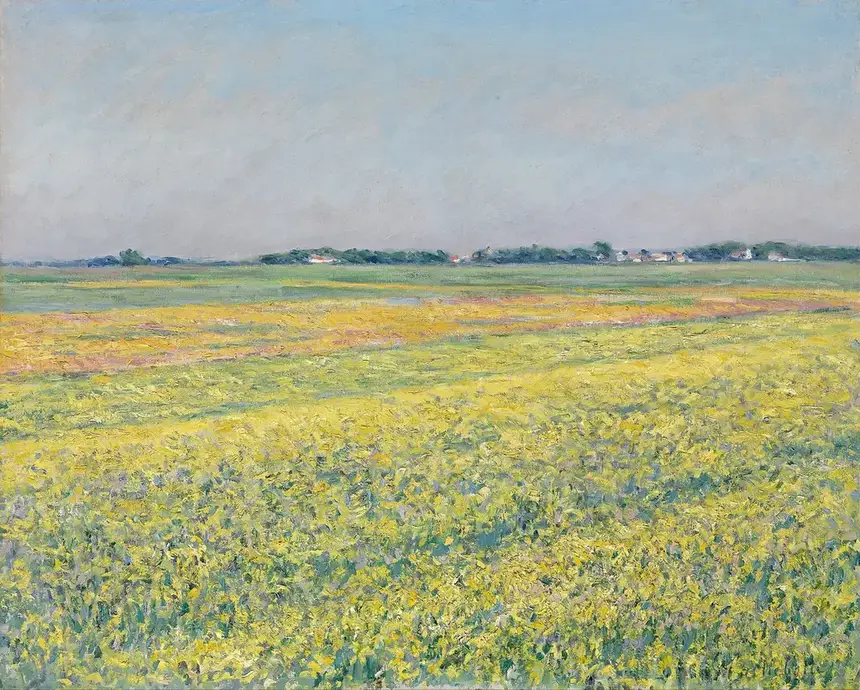
The plain of Gennevilliers, yellow fields is not a postcard. There is a decision in every zone of the canvas, and the decision is visible.
Our painter works freehand on a blank canvas, so the scale of the original survives the enlargement.
We do not brighten the picture for reproduction. The original's key is kept as it is.
Our painter mixes on the palette but finishes on the canvas, which is where the small variations come from.
The thick paint is kept for the light and the thin paint for the dark, which is the traditional way round.
The risk with a field subject is overworking, and the way to avoid it is knowing when to stop.
For a stairwell or a double-height space, go larger than you think — the composition was built for distance.
| Artist | Gustave Caillebotte |
|---|---|
| Title | The plain of Gennevilliers, yellow fields |
| Created (original) | 1884 |
| Medium | Oil on canvas, hand-painted to order |
| What you receive | A hand-painted oil painting on canvas |
| Copyright | Public domain; the original is out of copyright |
Why this one cannot be printed
The difference is not subtle when the two hang side by side. Ink sits on the surface; oil stands off it.
Where the original is loaded, ours is loaded. Where it is thin, ours is thin. Matching the weight of the paint matters more than matching the colour.
| Aspect | Hand-painted oil | Printed canvas |
|---|---|---|
| Depth | Built in layers, catches light from the side | Flat; highlights are printed as pale ink |
| Size | Any size, painted to your wall | Limited by the printer |
| Changing something | Tell us and the passage gets repainted | Usually means starting the file again |
| What it takes | One painter, several days, start to finish | A machine, a few minutes |
| Edge quality | Soft where the form turns, sharp where it does not | Uniformly sharp or uniformly blurred |
The passage that will take longest is the one that looks simplest.
Every canvas is painted to order, so the quote follows your size, frame and destination rather than a fixed list. Tell us what you need on WhatsApp and we reply with an exact figure, usually within the hour. You are talking to the people who will actually paint it, not a middleman.
How your painting is made
Every canvas is painted to order, so nothing is pulled off a shelf. This is the sequence:
- The canvas is stretched and primed — cotton or linen, sized and ready before any paint goes near it.
- The drawing goes down — charcoal or thin paint, done by eye rather than traced from a printout.
- The first colour pass — thin and simple, establishing the main shapes only.
- Setting the key — how dark the darks go determines everything that follows.
- Colour is built up — warmer and cooler versions of each passage, laid over the underpainting.
- Detail and highlights last — put on thickly and then not touched again.
- It dries, then gets varnished — and only then is it photographed for you.
What takes time here is the number of separate decisions, not the size of the canvas.
Whether to frame it
If you are shipping, an unframed canvas rolled in a tube is considerably cheaper to move than a framed one.
Most clients wait for the photographs before choosing a frame, which is the sensible order.
What goes into it
Nothing is sprayed, sealed or laminated. The surface you see is paint and varnish, and that is all. The paint is built in layers, fat over lean, which is what stops it cracking later.
Linen is worth the extra cost above about a metre across, because it holds tension better in humid rooms. Varnish goes on only once the paint is properly dry, months after the last stroke, not before.
Living with it
Do not wipe it with anything wet. Dust lightly, hang it somewhere stable, and forget about it.
Choosing a size
Any size is possible. These are simply the ones that come up most often in quotes:
| Size (inches) | Size (cm) | Best for |
|---|---|---|
| 24 × 20 in | 60 × 50 cm | Study, home office, above a desk |
| 20 × 16 in | 50 × 40 cm | Bedroom, hallway, above a console |
| 16 × 12 in | 40 × 30 cm | A shelf, a small wall, a gallery group |
| 64 × 48 in | 163 × 122 cm | Villa scale, lobby, hospitality wall |
| 48 × 36 in | 122 × 91 cm | Large living room, stairwell, loft |
| 40 × 30 in | 102 × 76 cm | Living room focal wall, above a sofa |
We will size the canvas to the room, not to a stock list. Send us the measurement. Import charges, where they exist, are the buyer's responsibility (DAP). We never add them to the quote and never guess what they will be.
This reads well above a sofa or a sideboard, where it will be seen from two to three metres.
Message us the dimensions you have in mind and we will come back with a figure.
💬 Get a Quote for The plain of Gennevilliers, yellow fieldsOrder, painting, shipping
The painting takes 9–15 days, and delivery is priced separately on the quote so there is no surprise later.
Expect 7–10 business days in transit, with tracking from our door to yours. Rolled in a tube it travels cheaper and safer than framed; most overseas clients take it that way.
You see photographs of the finished painting before it ships, and you tell us what to adjust. If something is not right, tell us what to adjust and we adjust it.
Duties and import taxes are the buyer's account (DAP). Your customs authority sets them; we do not.
You pay a deposit to start and the remainder before shipping. Nothing is hidden in between. Damage in transit should be reported to us within 48 hours, with photographs. We pursue it with the carrier rather than promising a refund.
The practical questions
When will it actually arrive?
Studio time is 9–15 days, then a few more days for the oil to set before we can photograph and pack it. We tell you where your canvas is at each stage.
How do I clean and care for it?
Dust lightly with a dry, soft brush and keep it out of direct sun. Nothing else is needed for decades; oil paint is slow to change and easy to live with.
Will I see it before it ships?
Yes — photographs of the actual painting go to you first, and nothing is packed until you have seen them.
Can you paint a different work by Gustave Caillebotte?
Yes. Send the image and we will quote it, or browse the other paintings we have listed.
Can I change the size?
Any size you like. We paint to the number you give us rather than to a standard range.
Do you take a deposit?
Work begins on a deposit and ships once the balance is paid. Nothing is charged that is not on the quote.
Do you ship to my country?
We ship to over 20 countries. Give us your city and the freight appears as its own line on the quote.
What is the canvas made of?
Cotton duck as standard, linen on request, artist-grade oil paint, and a final varnish once the paint is fully dry.
Is owning a reproduction legal?
Yes. Gustave Caillebotte died more than 70 years ago, so the work is in the public domain and owning a hand-painted version is legal anywhere. We never pass ours off as the original.
Does it come framed?
Frames are priced on their own line. Most clients choose after seeing the photographs.
How long does it take?
Allow 9–15 days for the painting itself, then roughly 7–10 business days in transit.