About the original
Gustave Courbet died in 1877, so the work has been in the public domain for decades. Reproducing it by hand is legal, and so is owning one.
Ours is a painting made with brushes. There is no giclée, no canvas transfer and no digital underlayer anywhere in the process.
It is an original composition painted before 1877, and our version is painted from the surviving image of it.
If you want something printed, we are the wrong workshop. We do not own a printer that touches canvas.
Looking at it properly
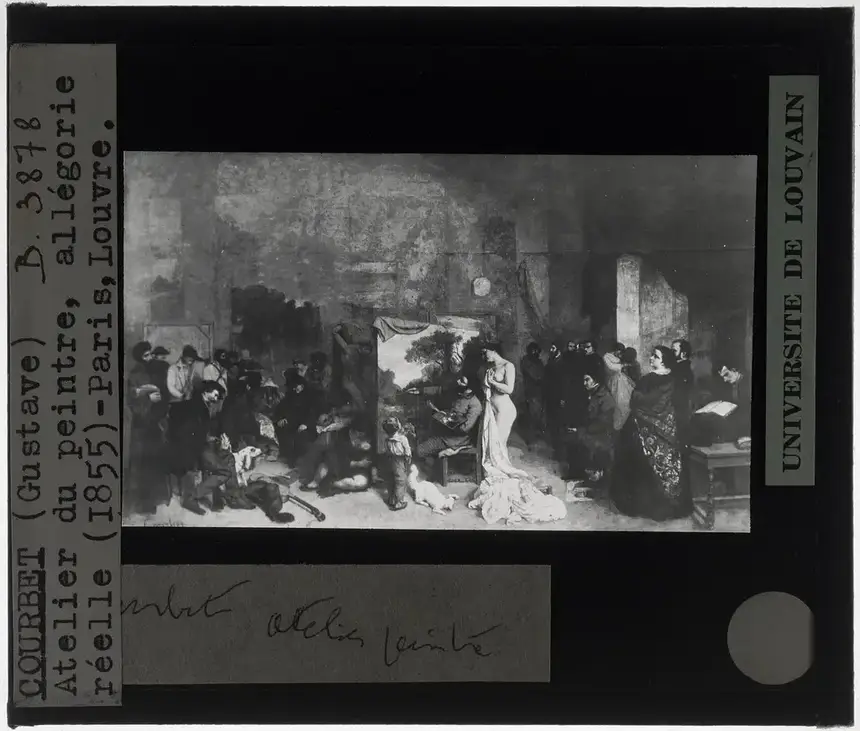
Rooms reward the close view. Het atelier van de schilder painted at 60 × 50 cm still holds together at arm's length.
Detail is suggested rather than counted, which is how interiors were painted and why they still work.
Our painter keeps the fall-off: bright near the opening, warm and thin further away.
The darks are mixed, not blackened — black straight from the tube would kill the passage.
Our painter loads the brush differently for the near and far passages, and you can read the difference.
This one repaints badly, so our painter gets the values right early and leaves them.
Given the subject, this sits naturally in a living room or a study rather than a hallway.
| Artist | Gustave Courbet |
|---|---|
| Title | Het atelier van de schilder |
| Medium | Oil on canvas, hand-painted to order |
| Reproduction | Hand-painted oil on canvas, made to order |
| Copyright | Public domain; the original is out of copyright |
What a print loses
Prints are good at information and bad at paint. This subject is mostly paint.
Our painter follows the same logic rather than copying a photograph of it: the far distances go down cool and weak, the near ground stays loaded, and nothing is blended flat.
| Aspect | Hand-painted oil | Printed canvas |
|---|---|---|
| Size | Any size, painted to your wall | Limited by the printer |
| Impasto | Real paint standing off the canvas | Flat ink, sometimes embossed to imitate |
| Handling of colour | Mixed on the palette and finished on the canvas | Fixed by the colour profile |
| Lifespan | Slow to change; varnish can be refreshed decades later | Fades and cracks sooner |
| Changing something | Tell us and the passage gets repainted | Usually means starting the file again |
The passage that will take longest is the one that looks simplest.
Every canvas is painted to order, so the quote follows your size, frame and destination rather than a fixed list. Tell us what you need on WhatsApp and we reply with an exact figure, usually within the hour. You deal directly with the studio that paints it — no reseller layer.
The sequence on our floor
No two canvases are painted the same way, but the sequence is always this:
- The canvas is stretched and primed — cotton or linen, sized and ready before any paint goes near it.
- A loose underdrawing — proportions checked by eye against the source image.
- Blocking the masses — thin paint, working the whole surface rather than one corner at a time.
- Getting the values right — the stage that decides whether the finished painting holds together.
- The colour passes — each area gets its own mixture rather than one colour used throughout.
- Finishing passes — the loaded highlights go on at the end and stay there.
- Left to dry before varnish — nothing is photographed or packed until the surface is ready.
The difficulty is restraint: leaving out most of what a photograph would show.
Framing
Framing is quoted separately, so you can decide after you have seen the finished canvas in photographs.
A frame is a separate line on the quote, not a bundle. You choose it once the painting exists.
What goes into it
Linen is worth the extra cost above about a metre across, because it holds tension better in humid rooms. The paint is built in layers, fat over lean, which is what stops it cracking later.
Oil paint dries by oxidation, not evaporation, which is why a finished canvas needs weeks before it travels. Stretcher bars are kiln-dried and wedged, so the canvas can be re-tensioned years later.
Looking after it
Do not wipe it with anything wet. Dust lightly, hang it somewhere stable, and forget about it.
Sizing it
Any size is possible. These are simply the ones that come up most often in quotes:
| Size (inches) | Size (cm) | Best for |
|---|---|---|
| 30 × 24 in | 76 × 61 cm | Dining room, bedroom feature wall |
| 24 × 20 in | 60 × 50 cm | Study, home office, above a desk |
| 20 × 16 in | 50 × 40 cm | Bedroom, hallway, above a console |
| 16 × 12 in | 40 × 30 cm | A shelf, a small wall, a gallery group |
| 64 × 48 in | 163 × 122 cm | Villa scale, lobby, hospitality wall |
| 48 × 36 in | 122 × 91 cm | Large living room, stairwell, loft |
If your wall is an odd shape, send the measurement and we will work to it. Proportions from the original are kept unless you ask us to change them. Our terms are DAP, meaning the freight is paid by us and any import charges are yours to settle. We will not estimate them, because the figure is your customs authority's to set.
It suits a room with warm, low light. Strong downlighting flattens the surface.
Send the wall, the size and whether you want a frame, and we will quote.
💬 Get a Quote for Het atelier van de schilderGetting it to you
Allow 9–15 days for the painting itself. Shipping is a separate line on your quote — you see it before payment, not after.
Transit is usually 7–10 business days, tracked all the way. Unframed canvases are rolled face-out on a tube; framed ones are corner-protected and crated.
Nothing ships before you have seen it. Photographs of the finished painting go to you first. Adjustments are part of the process. Say what you want different and it gets done.
We sell DAP: the price covers the painting and the freight, and any import duties or taxes are the buyer's to settle with customs. We do not collect them and we do not estimate them.
A deposit starts the canvas and books the painter's time; the balance is due before the crate leaves. Report any transit damage within 48 hours with photographs and we will deal with the carrier. We will not promise a payout, but we will not leave you to argue alone either.
The practical questions
When will it actually arrive?
Studio time is 9–15 days, then a few more days for the oil to set before we can photograph and pack it. We tell you where your canvas is at each stage.
Does it come with a certificate of authenticity?
No, and we would be wary of anyone who issues one for a public-domain reproduction. What you receive is a hand-painted canvas and photographs of it before it ships.
What happens after I message you?
You tell us the painting, size and whether you want a frame. We quote, a painter starts on your canvas, and you get photographs before it ships.
What is the canvas made of?
Cotton or linen, oil colour, and varnish. Stretcher bars are wedged so the canvas can be re-tensioned later.
How long does it take?
Painting takes 9–15 days. Air freight is usually 7–10 business days on top of that, tracked.
Is it really painted by hand?
Yes — oil on canvas, brush and knife. There is no printing, no giclée and no canvas transfer at any stage.
Who pays the import duty?
The buyer does. Terms are DAP: duties and taxes, where they apply, are paid on arrival. We never add a tax line of our own.
Will I see it before it ships?
Yes — photographs of the actual painting go to you first, and nothing is packed until you have seen them.
Can you paint it from a different photograph of the same work?
Send your own reference image and we will paint from that instead.
What does it cost?
Every canvas is quoted on size, frame and destination rather than a fixed list. Tell us what you need and we reply with an exact figure.
Can I change the size?
Any size you like. We paint to the number you give us rather than to a standard range.
Is owning a reproduction legal?
Yes. The painting is out of copyright because Gustave Courbet died more than 70 years ago. We paint copies honestly and never claim they are originals.