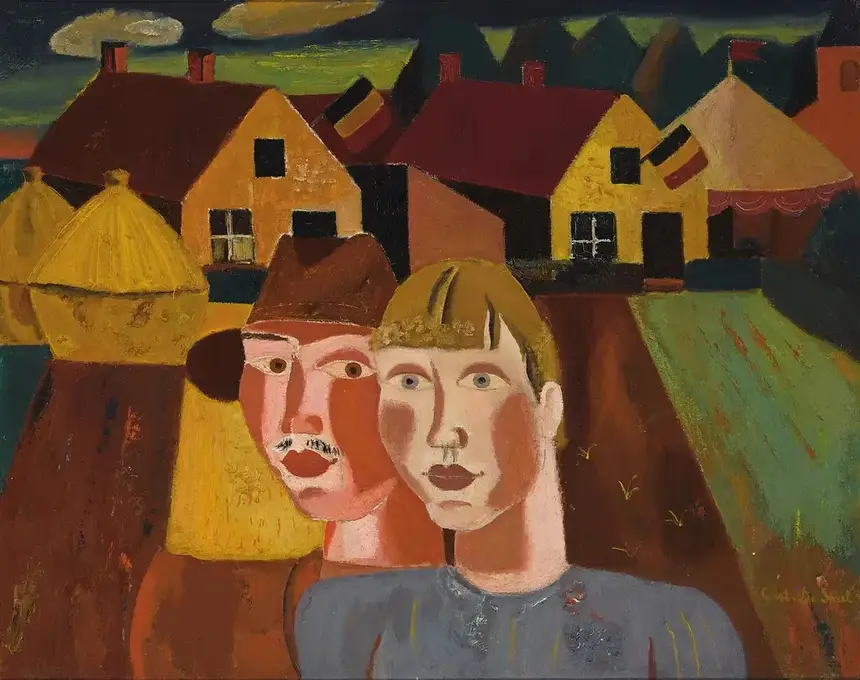
About The couple in the village
Gustave De Smet died in 1943, so the work has been in the public domain for decades. Reproducing it by hand is legal, and so is owning one.
We paint it in oil on canvas, one at a time, in Dafen Village. Nothing is printed, scanned or transferred.
It is an original composition painted before 1943, and our version is painted from the surviving image of it.
If you want something printed, we are the wrong workshop. We do not own a printer that touches canvas.
How to read it
The couple in the village rewards being close to. The further in you look, the more the brushwork turns into the subject.
Scale comes from the size of the marks, not from the size of the canvas — which is why enlarging it works.
Where the source relies on reflected light, we put it in. Removing it makes the form look like cardboard.
Saturated colour is kept for a small area; the rest is deliberately knocked back.
Our painter loads the brush differently for the near and far passages, and you can read the difference.
The risk with a city view is overworking, and the way to avoid it is knowing when to stop.
A plain wall is better than a busy one; the painting supplies the interest.
| Artist | Gustave De Smet |
|---|---|
| Title | The couple in the village |
| Created (original) | 1930 |
| Medium | Oil on canvas, hand-painted to order |
| How it is made | Painted by hand in oil on canvas, to your size |
| Copyright | Public domain; the original is out of copyright |
Hand-painted, not printed
What you lose in a print is the air. A press lays ink flat; a painter builds depth in layers, and the depth is what you actually see.
Where the original is loaded, ours is loaded. Where it is thin, ours is thin. Matching the weight of the paint matters more than matching the colour.
| Aspect | Hand-painted oil | Printed canvas |
|---|---|---|
| Edges | Chosen by the painter, passage by passage | Whatever the file happens to contain |
| What it takes | One painter, several days, start to finish | A machine, a few minutes |
| Later on | Can be restored, re-framed, handed on | Replaceable, and usually replaced |
| How it ages | Warms and settles; cleanable by a conservator | Fades, then cracks at the stretcher |
| The surface | Built up with brushes and knives | Printed flat in one pass |
Anyone can copy the shapes. The skill is in the transitions, and that is what takes the days.
Every canvas is painted to order, so the quote follows your size, frame and destination rather than a fixed list. Tell us what you need on WhatsApp and we reply with an exact figure, usually within the hour. There is no agency in between; the studio that paints your canvas is the one answering your messages.
The sequence on our floor
This is how the painting is built, in the order our painters build it:
- Stretching and priming the support — cotton duck or linen goes onto the bars and gets its ground.
- A loose underdrawing — proportions checked by eye against the source image.
- Blocking the masses — thin paint, working the whole surface rather than one corner at a time.
- The values are established — this is the stage that decides whether the painting works.
- Building the colour — a warm and a cool version of each passage, put down in order.
- Finishing passes — the loaded highlights go on at the end and stay there.
- Drying and varnishing — the final varnish goes on once the paint has set, before we photograph it.
Getting The couple in the village right means painting it in the right order, and the order is not obvious.
Keeping it
Dust it with a dry, soft brush. Keep it out of direct sun and away from radiators, and it will outlive you.
Frames
We can supply a simple floater frame, a traditional gilt, or nothing at all. It is your call.
If you are shipping, an unframed canvas rolled in a tube is considerably cheaper to move than a framed one.
What it is made of
We do not use a printer at any stage. There is no giclée, no canvas transfer, no digital underlayer. We use cotton duck for most sizes and linen where the canvas is large or the client asks for it.
The ground is a proper acrylic sizing, so the oil does not rot the fabric over time. Large canvases get a cross-brace; anything over about a metre and a half needs one.
Choosing a size
You are not choosing from a list; you are telling us a measurement. These are the common ones:
| Size (inches) | Size (cm) | Best for |
|---|---|---|
| 40 × 30 in | 102 × 76 cm | Living room focal wall, above a sofa |
| 32 × 24 in | 81 × 61 cm | Living room, above a sideboard |
| 30 × 24 in | 76 × 61 cm | Dining room, bedroom feature wall |
| 24 × 20 in | 60 × 50 cm | Study, home office, above a desk |
| 20 × 16 in | 50 × 40 cm | Bedroom, hallway, above a console |
| 16 × 12 in | 40 × 30 cm | A shelf, a small wall, a gallery group |
If your wall is an odd shape, send the measurement and we will work to it. Proportions from the original are kept unless you ask us to change them. Shipments go out DAP. If your customs office charges duty or tax on arrival, that is between you and them — we do not collect it and we do not put a number on it.
This reads well above a sofa or a sideboard, where it will be seen from two to three metres.
Tell us where it will hang and how big it needs to be — we will price it properly.
💬 Get a Quote for The couple in the villageTimeline and shipping
The painting takes 9–15 days, and delivery is priced separately on the quote so there is no surprise later.
Transit is usually 7–10 business days, tracked all the way. Rolled in a tube it travels cheaper and safer than framed; most overseas clients take it that way.
You see photographs of the finished painting before it ships, and you tell us what to adjust. If something is not right, tell us what to adjust and we adjust it.
Import charges, where they exist, are the buyer's responsibility (DAP). We never add them to the quote and never guess what they will be.
Work begins on a deposit and ships on the balance. Both figures are on the quote. Damage in transit should be reported to us within 48 hours, with photographs. We pursue it with the carrier rather than promising a refund.
What people ask us
Can I resell the reproduction?
Yes. Because the underlying work is in the public domain, the hand-painted canvas is yours to sell, gift or install commercially.
When will it actually arrive?
Studio time is 9–15 days, then a few more days for the oil to set before we can photograph and pack it. We tell you where your canvas is at each stage.
Will it look exactly like the image?
Not exactly, and that is the point — it is a painting, not a scan. Composition, colour and drawing follow the original closely; the surface is where a painter's own decisions show.
Do you ship to my country?
We ship to over 20 countries. Give us your city and the freight appears as its own line on the quote.
Is owning a reproduction legal?
Yes. The painting is out of copyright because Gustave De Smet died more than 70 years ago. We paint copies honestly and never claim they are originals.
How do I hang it?
Roughly 145 cm from floor to centre works for most rooms. Tell us your wall and we will give you the measurement.
What if it arrives damaged?
Report damage within 48 hours with photographs. We deal with the carrier rather than leaving you to argue alone.
Can you paint it from a different photograph of the same work?
Send your own reference image and we will paint from that instead.
Can you change the colours to suit my room?
Sometimes. We will adjust the palette if it can be done without ruining the picture, and say so if it cannot.
Do you take a deposit?
Work begins on a deposit and ships once the balance is paid. Nothing is charged that is not on the quote.
What does it cost?
There is no price list, because the number depends on your size and frame. Message us and we will quote exactly.
Can you paint a different work by Gustave De Smet?
Yes — send us the image, or look through the other Gustave De Smet works on the site.