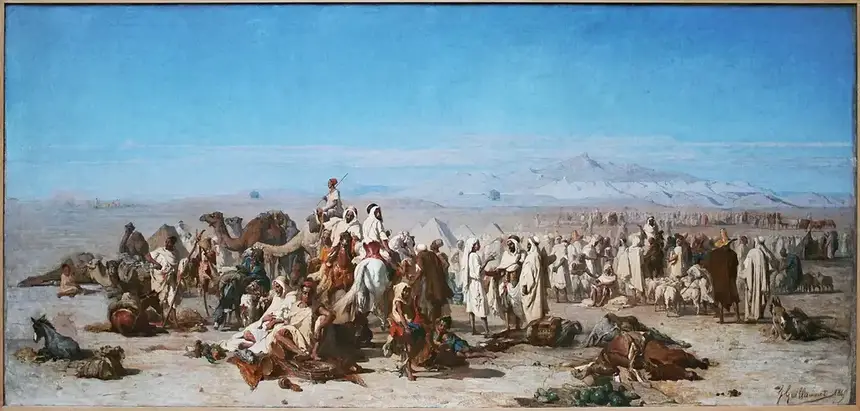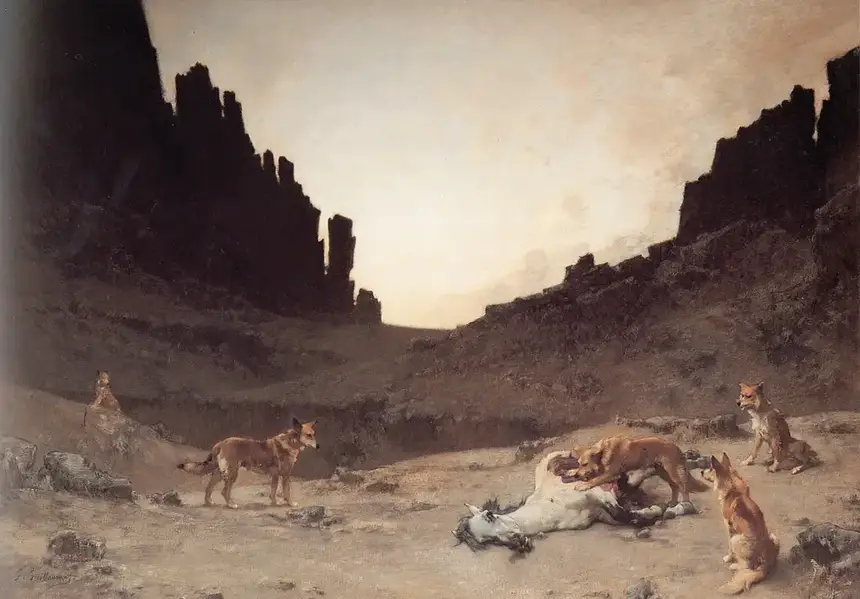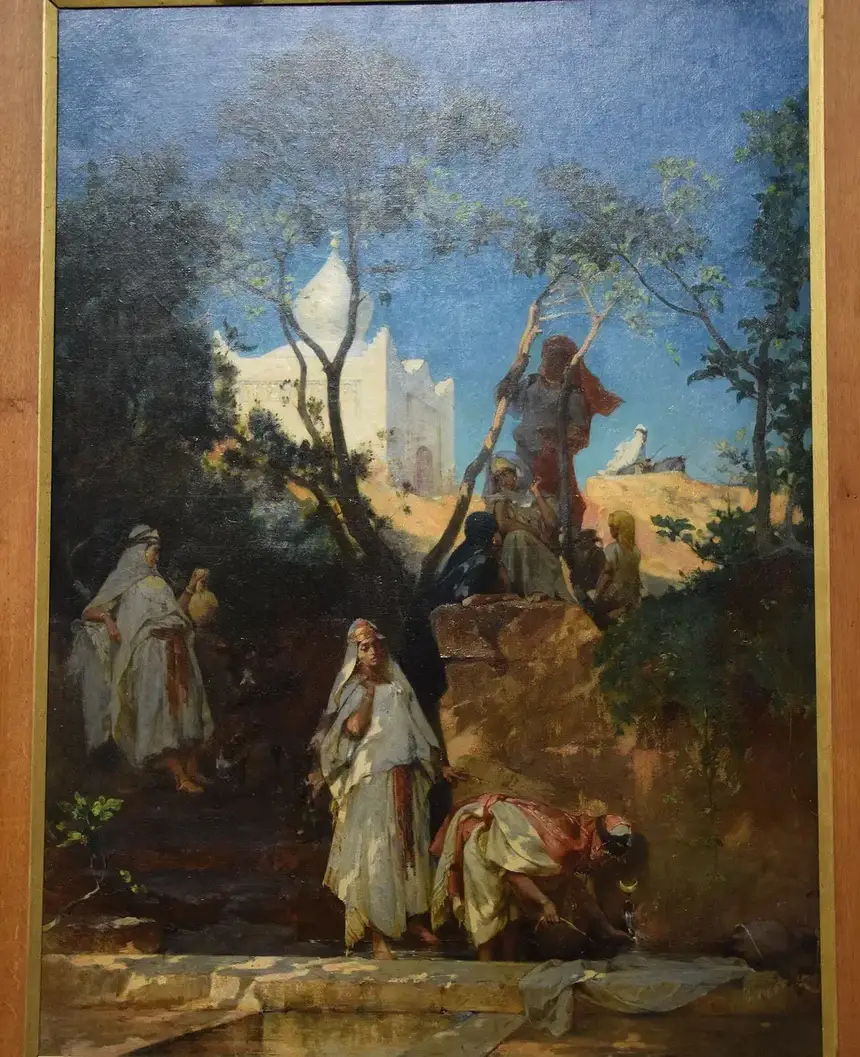
About the original
Because Gustave Guillaumet died in 1887, this work is in the public domain. We are painting a copy of a painting — we never pass it off as the original, and neither should anyone selling you one.
We paint it in oil on canvas, one at a time, in Dafen Village. Nothing is printed, scanned or transferred.
It is an original composition painted before 1887, and our version is painted from the surviving image of it.
If you want something printed, we are the wrong workshop. We do not own a printer that touches canvas.
How to read it
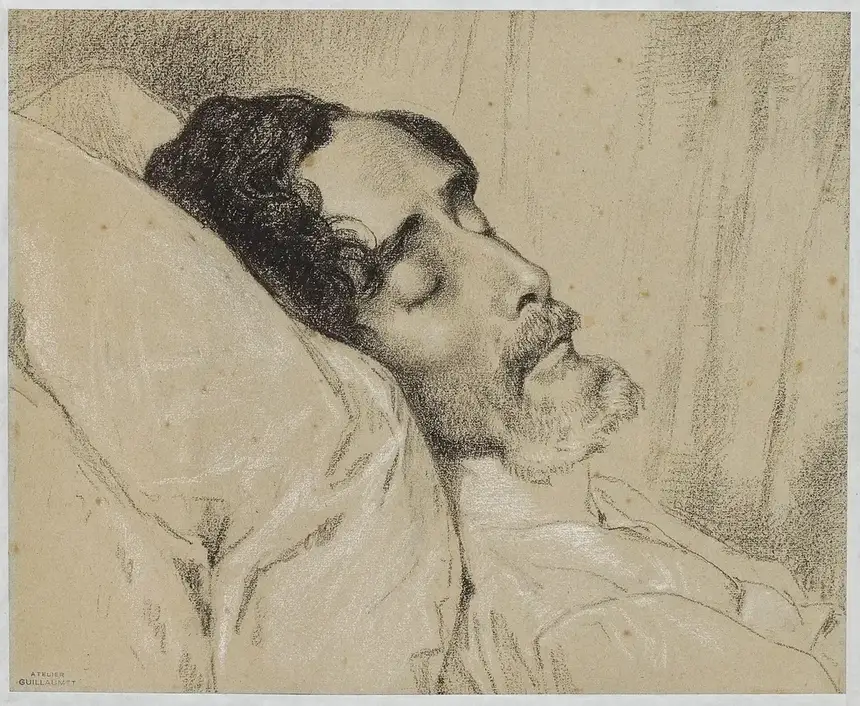
The difficulty in Portrait mortuaire d'Aimé is not the features. It is the transition between them, and that is brushwork.
We do not enlarge a photograph and trace it. The drawing is done by eye, which is why the features stay related.
Our painter keeps the halftone — the narrow band between light and shadow — which is where a face lives.
Our painter keeps the colour relationships rather than the exact hues, because relationships are what survive.
Where the source has a loaded passage, ours is loaded too — you will feel it from the side.
Matching the original's degree of finish is harder than matching its colours.
It works best on a wall you pass rather than one you sit and stare at — the paint rewards a moving eye.
| Artist | Gustave Guillaumet |
|---|---|
| Title | Portrait mortuaire d'Aimé |
| Medium | Oil on canvas, hand-painted to order |
| How it is made | Painted by hand in oil on canvas, to your size |
| Public domain | Yes — the artist died over 70 years ago |
The case for painting it by hand
What you lose in a print is the air. A press lays ink flat; a painter builds depth in layers, and the depth is what you actually see.
Where the original is loaded, ours is loaded. Where it is thin, ours is thin. Matching the weight of the paint matters more than matching the colour.
| Aspect | Hand-painted oil | Printed canvas |
|---|---|---|
| Later on | Can be restored, re-framed, handed on | Replaceable, and usually replaced |
| Lifespan | Slow to change; varnish can be refreshed decades later | Fades and cracks sooner |
| Changing something | Tell us and the passage gets repainted | Usually means starting the file again |
| Surface | Hand-painted oil on canvas | Ink on canvas, flat |
| Time to make | Days of one painter's working time | Minutes |
The passage that will take longest is the one that looks simplest.
We quote per commission rather than from a catalogue, because size, surface and framing move the number more than anything else. Message us on WhatsApp with your wall in mind and we will price it properly. You are buying from the workshop, not a catalogue.
How the canvas is built
Every canvas is painted to order, so nothing is pulled off a shelf. This is the sequence:
- Stretching and priming the support — cotton duck or linen goes onto the bars and gets its ground.
- The drawing goes down — charcoal or thin paint, done by eye rather than traced from a printout.
- The big shapes are blocked in — thin paint, one colour at a time, the whole canvas at once.
- Getting the values right — the stage that decides whether the finished painting holds together.
- The colour passes — each area gets its own mixture rather than one colour used throughout.
- Detail and highlights last — put on thickly and then not touched again.
- Left to dry before varnish — nothing is photographed or packed until the surface is ready.
The risk with a portrait is overworking, and the way to avoid it is knowing when to stop.
Care and cleaning
Once the varnish has cured the surface can be cleaned by a conservator, but in a normal house it will not need it for decades.
What it is made of
The paint is built in layers, fat over lean, which is what stops it cracking later. Each painter works on one canvas at a time — the painting you ordered is not shared with another order.
Stretcher bars are kiln-dried and wedged, so the canvas can be re-tensioned years later. Large canvases get a cross-brace; anything over about a metre and a half needs one.
Whether to frame it
A frame is a separate line on the quote, not a bundle. You choose it once the painting exists.
A frame is a separate line on the quote, not a bundle. You choose it once the painting exists.
Canvas sizes
You are not choosing from a list; you are telling us a measurement. These are the common ones:
| Size (inches) | Size (cm) | Best for |
|---|---|---|
| 40 × 30 in | 102 × 76 cm | Living room focal wall, above a sofa |
| 32 × 24 in | 81 × 61 cm | Living room, above a sideboard |
| 30 × 24 in | 76 × 61 cm | Dining room, bedroom feature wall |
| 24 × 20 in | 60 × 50 cm | Study, home office, above a desk |
| 20 × 16 in | 50 × 40 cm | Bedroom, hallway, above a console |
We will size the canvas to the room, not to a stock list. Send us the measurement. Terms are DAP. Import duties and taxes, where they apply, are paid by the buyer on arrival — we never collect them in advance and never guess at the amount.
Given the subject, this sits naturally in a living room or a study rather than a hallway.
Tell us the size and frame — exact quote back, usually within the hour.
💬 Get a Quote for Portrait mortuaire d'Aimé Guillaumet, DDUTGetting it to you
From order to finished canvas is 9–15 days. Freight appears as a separate line on the quote and is fixed before you pay.
Expect 7–10 business days in transit, with tracking from our door to yours. Unframed canvases are rolled face-out on a tube; framed ones are corner-protected and crated.
You approve the painting from photographs before it is packed — that is the checkpoint. If something is not right, tell us what to adjust and we adjust it.
Duties and import taxes are the buyer's account (DAP). Your customs authority sets them; we do not.
A deposit starts the canvas and books the painter's time; the balance is due before the crate leaves. Damage in transit should be reported to us within 48 hours, with photographs. We pursue it with the carrier rather than promising a refund.
Questions worth asking
Does changing the size change the composition?
No — we keep the original's proportions and scale from there, rather than cropping the image to fit a standard frame.
Can I resell the reproduction?
Yes. Because the underlying work is in the public domain, the hand-painted canvas is yours to sell, gift or install commercially.
Can I change something in the composition?
Often yes — background, cropping, or adapting the proportions to your wall. Tell us what you have in mind and we will say honestly whether it will work.
What is the canvas made of?
Cotton or linen, oil colour, and varnish. Stretcher bars are wedged so the canvas can be re-tensioned later.
How do I hang it?
Roughly 145 cm from floor to centre works for most rooms. Tell us your wall and we will give you the measurement.
Who pays the import duty?
You do. We sell DAP, so any duty or tax your customs authority charges is settled by you at import. We do not collect it and we do not estimate it.
Do you take a deposit?
A deposit starts the canvas and the balance falls due before it ships. Both figures appear on the quote.
Does it come framed?
Frames are priced on their own line. Most clients choose after seeing the photographs.
Can you paint it from a different photograph of the same work?
Yes. If you have a better reference, send it on WhatsApp and we will work from yours.
Will I see it before it ships?
Yes — photographs of the actual painting go to you first, and nothing is packed until you have seen them.
How long does it take?
From order to finished canvas is 9–15 days; delivery adds about 7–10 business days by air.
Do you ship to my country?
We export to more than 20 countries. Tell us where you are and we will quote the freight as a separate line.