About Moreaule dragon a plusieurs tetes
Because Gustave Moreau died in 1898, this work is in the public domain. We are painting a copy of a painting — we never pass it off as the original, and neither should anyone selling you one.
Ours is a painting made with brushes. There is no giclée, no canvas transfer and no digital underlayer anywhere in the process.
It is an original composition painted before 1898, and our version is painted from the surviving image of it.
What arrives is a canvas with paint on it, made by a person. That is the only thing we sell.
What the painting is doing
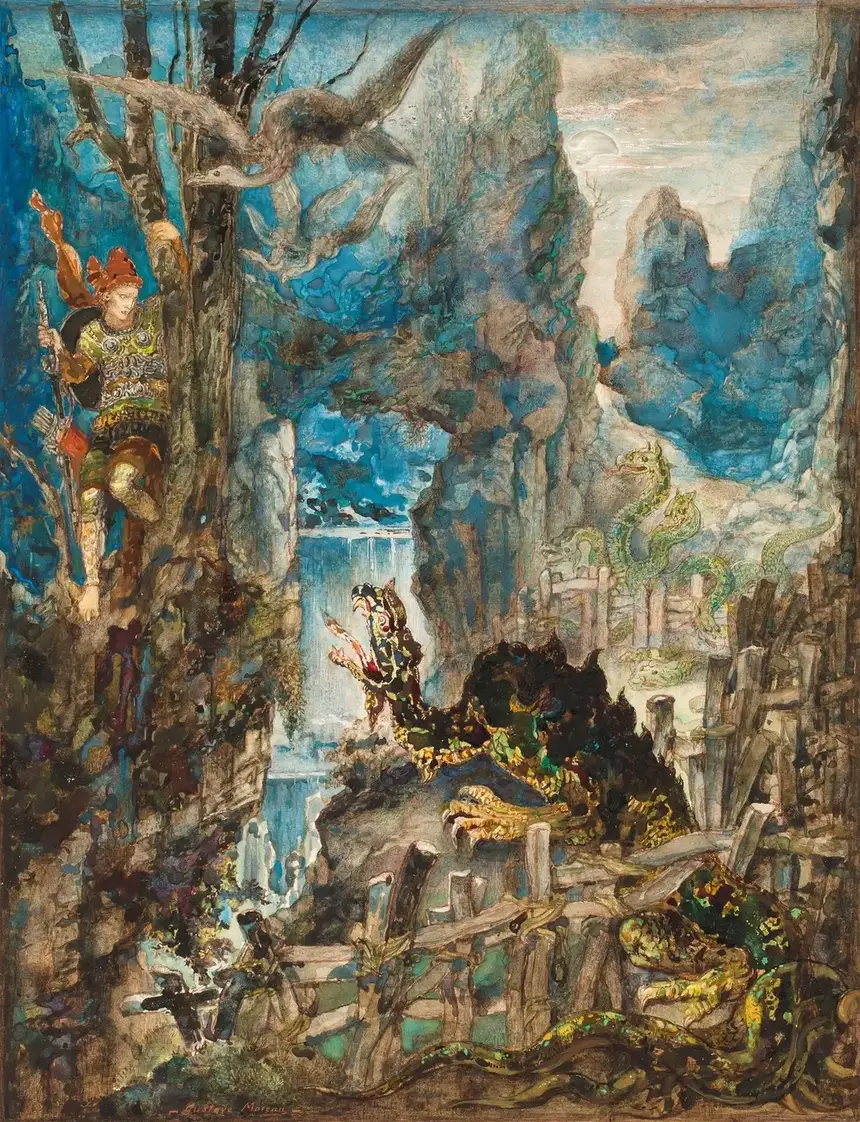
Moreaule dragon a plusieurs tetes rewards a second look because the light is doing something specific, and it only does it in oil.
Our painter blocks the big shapes first and lets the detail come last, so the composition holds at any size.
Light is handled as a value problem: how dark the darkest dark is determines the whole picture.
Colour here is mixed for the passage, not for the object, which is why nothing looks like it was filled in.
Nothing here is blended flat. Blending is what makes a painting look printed.
Matching the original's degree of finish is harder than matching its colours.
Hang it at eye level — roughly 145 cm from the floor to the centre — and it will hold the wall.
| Artist | Gustave Moreau |
|---|---|
| Title | Moreaule dragon a plusieurs tetes |
| Created (original) | 1880 |
| Medium | Oil on canvas, hand-painted to order |
| Our version | Oil on canvas, painted by hand to order |
| Copyright | Public domain; the original is out of copyright |
What a print loses
The difference is not subtle when the two hang side by side. Ink sits on the surface; oil stands off it.
Paint goes on in the original's order — thin first, thick last — so the surface behaves the way the painter intended.
| Aspect | Hand-painted oil | Printed canvas |
|---|---|---|
| Depth | Built in layers, catches light from the side | Flat; highlights are printed as pale ink |
| Time to make | Days of one painter's working time | Minutes |
| Lifespan | Slow to change; varnish can be refreshed decades later | Fades and cracks sooner |
| Later on | Can be restored, re-framed, handed on | Replaceable, and usually replaced |
| Changing something | Tell us and the passage gets repainted | Usually means starting the file again |
The difficulty is restraint: leaving out most of what a photograph would show.
Every canvas is painted to order, so the quote follows your size, frame and destination rather than a fixed list. Tell us what you need on WhatsApp and we reply with an exact figure, usually within the hour. You are buying from the workshop, not a catalogue.
How the canvas is built
No two canvases are painted the same way, but the sequence is always this:
- We start with the canvas itself — stretched, sized and left to settle before any colour is mixed.
- Laying in the drawing — done by eye from the reference, not traced or projected.
- The big shapes are blocked in — thin paint, one colour at a time, the whole canvas at once.
- Getting the values right — the stage that decides whether the finished painting holds together.
- The colour passes — each area gets its own mixture rather than one colour used throughout.
- Detail and highlights last — put on thickly and then not touched again.
- Drying and varnishing — the final varnish goes on once the paint has set, before we photograph it.
The risk with a landscape is overworking, and the way to avoid it is knowing when to stop.
Living with it
Once the varnish has cured the surface can be cleaned by a conservator, but in a normal house it will not need it for decades.
Frames
Frames are priced once you have chosen them, not estimated in advance.
A frame is a separate line on the quote, not a bundle. You choose it once the painting exists.
Materials
Varnish goes on only once the paint is properly dry, months after the last stroke, not before. We do not use a printer at any stage. There is no giclée, no canvas transfer, no digital underlayer.
We use a neutral-sized ground so the whites stay warm rather than going blue over time. Linen is worth the extra cost above about a metre across, because it holds tension better in humid rooms.
Canvas sizes
Any size is possible. These are simply the ones that come up most often in quotes:
| Size (inches) | Size (cm) | Best for |
|---|---|---|
| 16 × 12 in | 40 × 30 cm | A shelf, a small wall, a gallery group |
| 64 × 48 in | 163 × 122 cm | Villa scale, lobby, hospitality wall |
| 48 × 36 in | 122 × 91 cm | Large living room, stairwell, loft |
| 40 × 30 in | 102 × 76 cm | Living room focal wall, above a sofa |
| 32 × 24 in | 81 × 61 cm | Living room, above a sideboard |
| 30 × 24 in | 76 × 61 cm | Dining room, bedroom feature wall |
If your wall is an odd shape, send the measurement and we will work to it. Proportions from the original are kept unless you ask us to change them. Duties and import taxes are the buyer's account (DAP). Your customs authority sets them; we do not.
A plain wall is better than a busy one; the painting supplies the interest.
Tell us the size and frame — exact quote back, usually within the hour.
💬 Get a Quote for Moreaule dragon a plusieurs tetesTimeline and shipping
Painting takes 9–15 days. Freight is quoted as its own line on the quote, agreed before you pay anything, and never added afterwards.
Expect 7–10 business days in transit, with tracking from our door to yours. Unframed canvases are rolled face-out on a tube; framed ones are corner-protected and crated.
Nothing ships before you have seen it. Photographs of the finished painting go to you first. Adjustments are part of the process. Say what you want different and it gets done.
We quote DAP, so any duty or tax your country charges is settled by you at import. We do not add a tax line of our own.
A deposit starts the canvas and books the painter's time; the balance is due before the crate leaves. If a crate arrives damaged, send us photographs within 48 hours and contact us directly — we will sort it out with you.
What people ask us
How close will it be to the original?
The composition, colour and drawing follow the original closely; the brushwork carries the painter's own hand. The painter works freehand on a blank canvas, following the same logic as the original rather than copying a photograph.
When will it actually arrive?
Studio time is 9–15 days, then a few more days for the oil to set before we can photograph and pack it. We tell you where your canvas is at each stage.
What about duties and import taxes?
Those are the buyer's responsibility (DAP). The amounts are set by your customs authority, not by us.
Can you change the colours to suit my room?
We can shift the palette, but we will tell you honestly when a change would spoil the painting.
Does it come framed?
Framing is quoted separately, so you can decide once you have seen the finished painting in photographs.
Will I see it before it ships?
Yes — photographs of the actual painting go to you first, and nothing is packed until you have seen them.
Can I change the size?
Yes. The canvas is painted to your measurement, not taken from a stock list.
Who pays the import duty?
The buyer does. Terms are DAP: duties and taxes, where they apply, are paid on arrival. We never add a tax line of our own.
Is it really painted by hand?
Yes — oil on canvas, brush and knife. There is no printing, no giclée and no canvas transfer at any stage.
What does it cost?
Every canvas is quoted on size, frame and destination rather than a fixed list. Tell us what you need and we reply with an exact figure.
How do I hang it?
Centre it at about 145 cm from the floor, or two-thirds the width of the furniture below it. We will tell you the exact number for your wall.
Do you sell prints?
No prints at all — no giclée, no canvas transfer, nothing machine-made.